
Absolute value becomes much easier to use when you stop treating it like a symbol-manipulation trick and start seeing it as a way to measure distance. That shift makes inequalities, proofs, and comparison arguments feel far more intuitive.
I used to notice that many students could mechanically solve simple absolute value equations while still feeling completely lost once inequalities or proofs appeared. The strange part was that the actual definition of absolute value was usually not the problem.
The deeper issue was perspective.
Once absolute value becomes a distance concept instead of a sign-removal operation, many confusing inequalities suddenly start behaving in a much more predictable way.
Absolute Value Is Really Measuring Distance From Zero
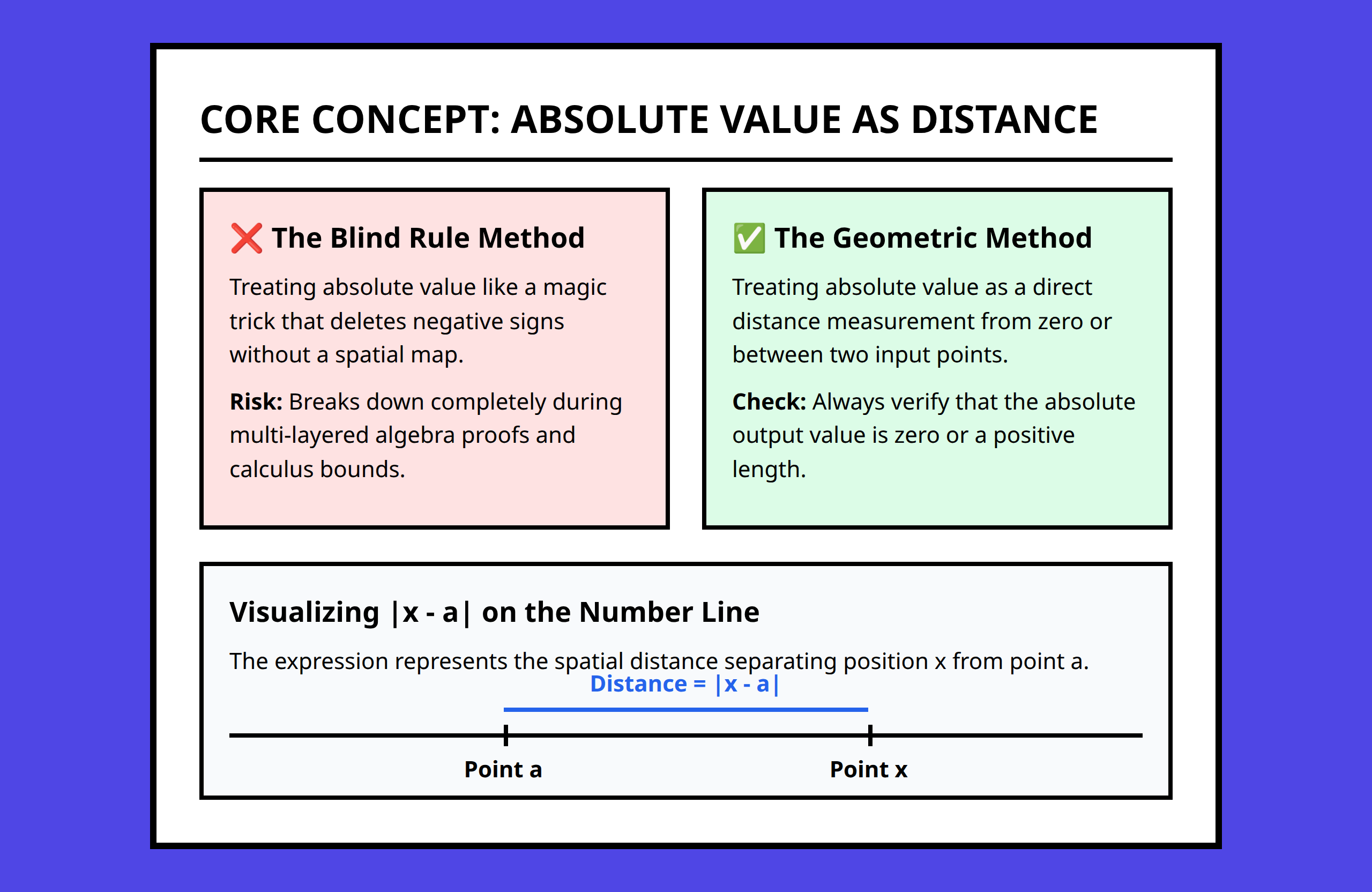
The geometric meaning of absolute value is surprisingly simple.
The quantity:
|x|
measures the distance between x and 0 on the real number line.
I think this idea matters because distance behaves differently from ordinary signed numbers. Distance is never negative. It only measures separation.
For example:
|3| = 3|-3| = 3
The numbers lie on opposite sides of zero, but their distances from zero are identical.
I would not rush past this interpretation because almost every important absolute value inequality grows naturally from it.
Once distance becomes the main idea, many formulas stop looking arbitrary.
Distance Logic Explains Why Absolute Value Equations Split Into Cases
Students often memorize procedures like:
|x| = a ⇒ x = a or x = -a
without understanding why two solutions appear.
The distance viewpoint makes the reason obvious.
If a point is exactly 5 units away from zero, it can sit either 5 units to the right or 5 units to the left.
That is not an algebra trick. It is geometry on the number line.
I think many proof difficulties disappear once students stop treating the notation mechanically and start asking:
“What distance relationship is this expression describing?”
That question creates much clearer intuition than memorizing isolated rules.
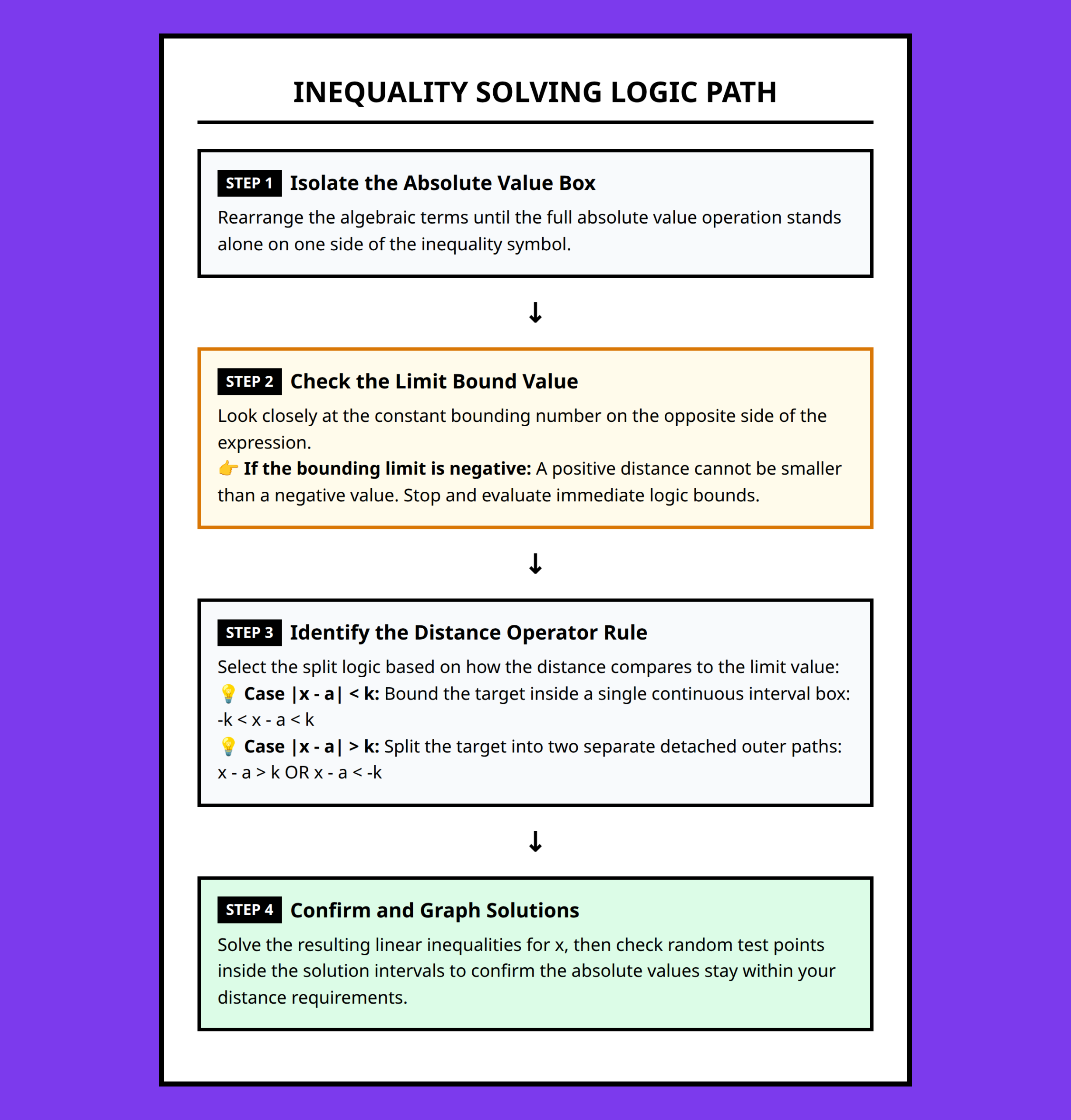
Absolute Value Inequalities Become Easier Once You Visualize Intervals
One of the biggest conceptual shifts happens with inequalities.
Consider:
|x| < 2
I would read this as:
“The distance from x to zero is less than 2.”
That immediately produces the interval:
-2 < x < 2
The number line interpretation becomes almost visual.
Now compare that with:
|x| > 2
The meaning changes completely.
The point must now stay more than 2 units away from zero, which creates two separate exterior regions:
x < -2x > 2
I think students often struggle because they try to memorize which inequalities produce “and” versus “or” conditions.
The distance interpretation removes most of that confusion naturally.
The Triangle Inequality Stops Feeling Random Once You Think Geometrically
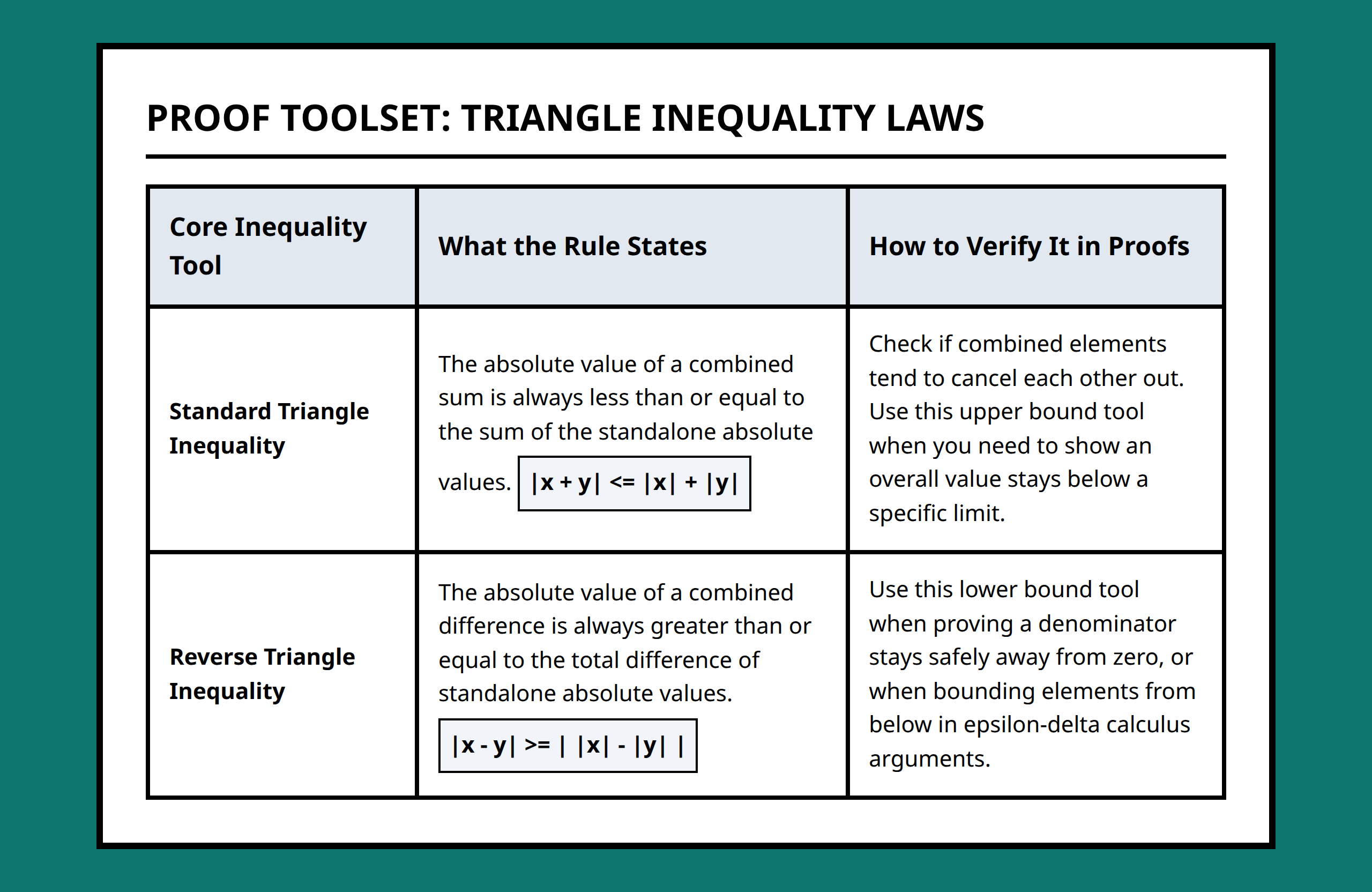
The triangle inequality looks intimidating when introduced symbolically:
|x + y| ≤ |x| + |y|
But the geometric meaning is actually very practical.
The direct distance between two points cannot exceed the distance traveled by taking a detour.
I would picture someone walking through a city.
Walking directly from one corner to another is never longer than taking an indirect route through extra streets first.
That is essentially the triangle inequality in distance form.
I think this is one of the most important moments in early analysis because it reveals that inequalities often describe structural constraints rather than computational tricks.
The inequality is expressing a limitation on how distances combine.
The Reverse Triangle Inequality Reveals Minimum Separation
The reverse triangle inequality often feels even stranger initially:
|x - y| ≥ ||x| - |y||
But the distance viewpoint helps again.
The distance between two points must at least account for the difference in their individual distances from zero.
I would think about two subway stations located on opposite sides of a city center. Even without knowing the exact route between them, the separation between their distances from downtown already guarantees some minimum distance between the stations themselves.
That is very close to the logic behind the reverse triangle inequality.
The inequality creates a lower bound on separation.
Many Proofs Quietly Depend on Distance Control
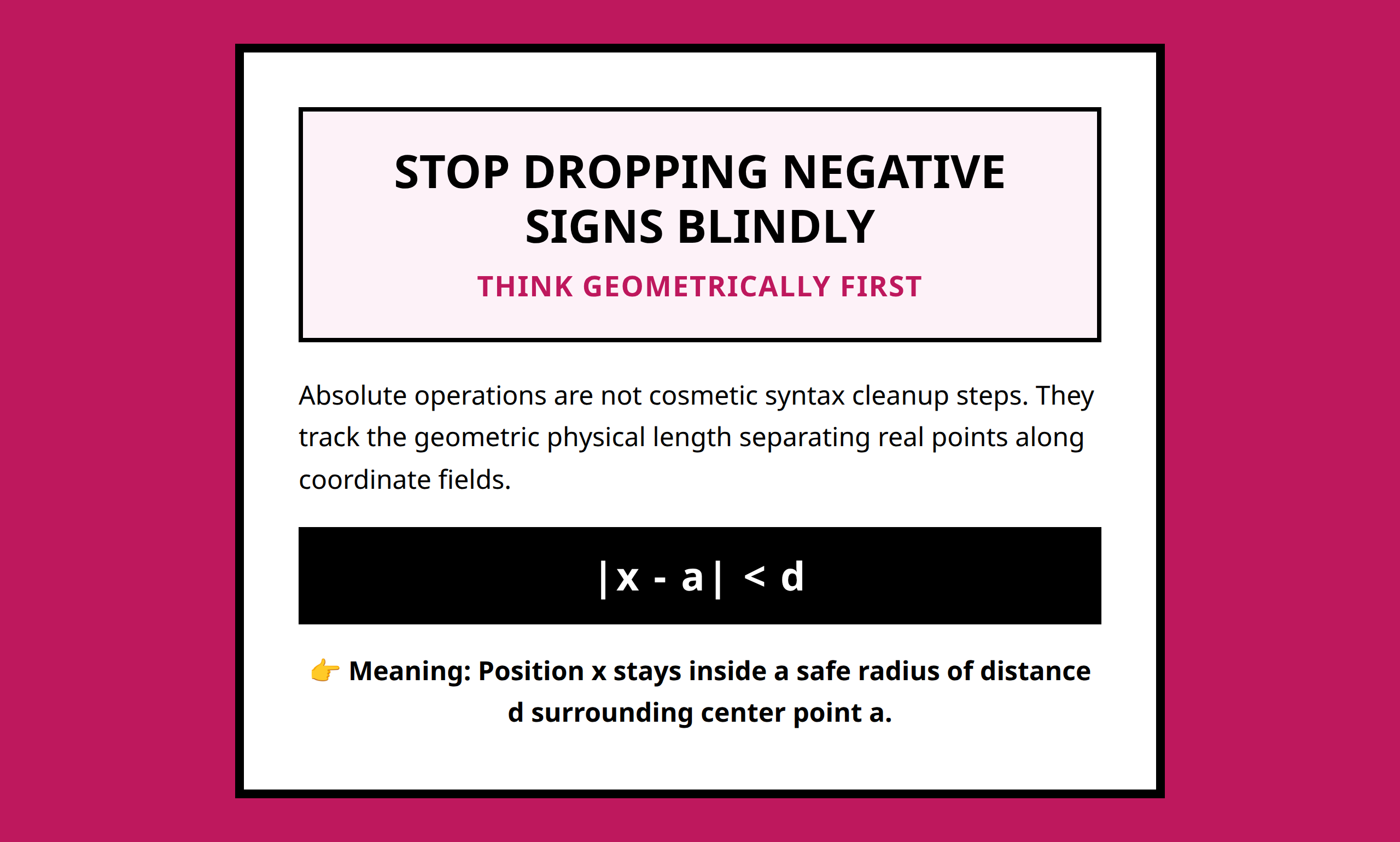
One thing I did not appreciate early enough is how often absolute value appears inside proofs.
It is not there for decoration.
Absolute value provides a clean way to control numerical differences.
For example, convergence arguments frequently depend on expressions like:
|x_n - L|
That quantity measures how far a sequence term sits from its limiting value.
I think this is why the distance interpretation becomes so important later in analysis. It creates a consistent language for discussing closeness, error, and approximation.
Without the geometric interpretation, many epsilon-style arguments feel abstract and mechanical.
With the interpretation, the logic becomes more operational:
How close are the quantities allowed to get?
Inequality Proofs Become Simpler When You Focus on Structure Instead of Symbols
Students often try to manipulate inequalities symbol by symbol without identifying the underlying structure first.
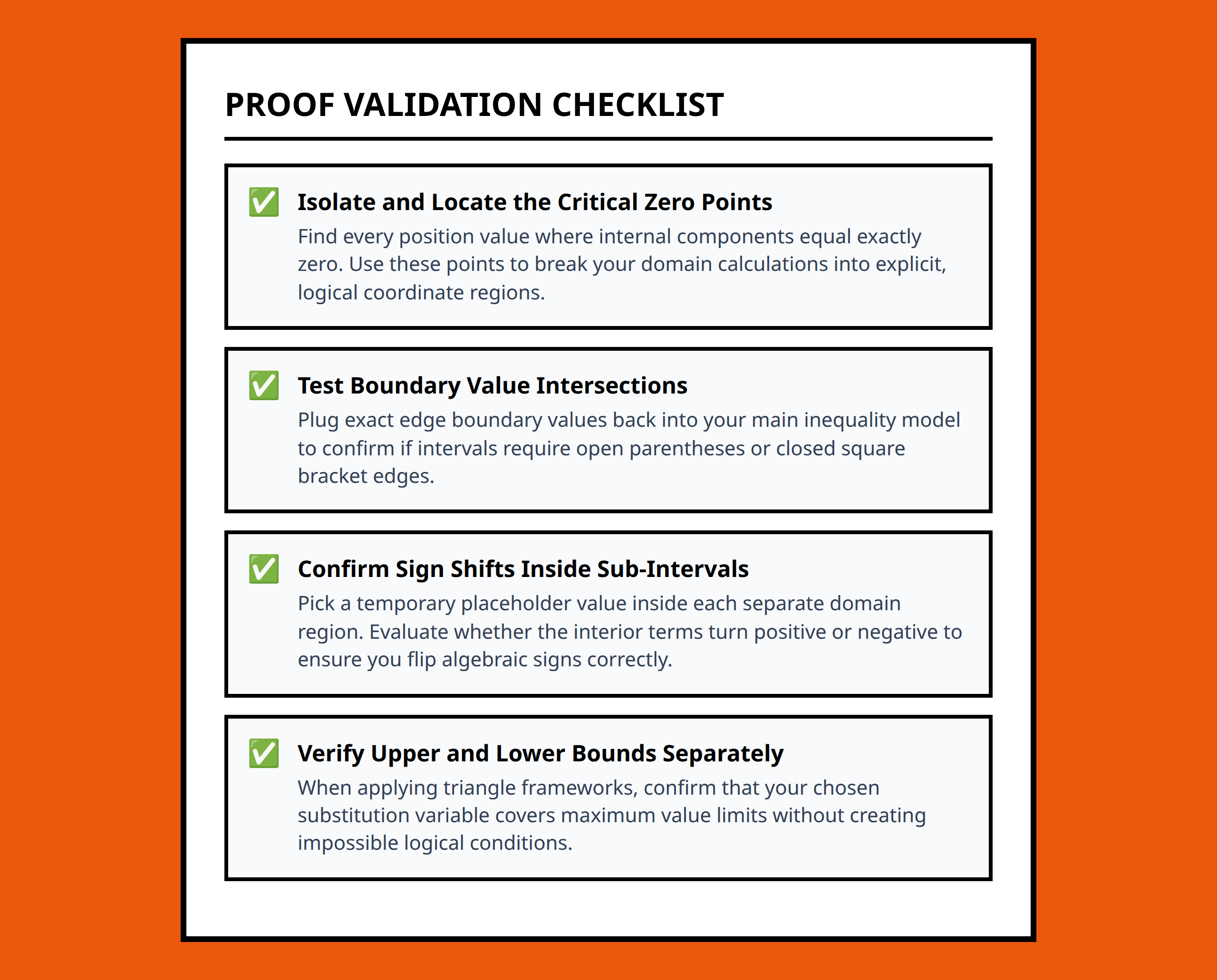
I would slow down and ask:
- What distance is being measured?
- What upper or lower bound is being imposed?
- What region of the number line satisfies the condition?
- Is the inequality describing closeness or separation?
Those questions usually reveal the logic much faster than algebraic trial and error.
A realistic example appears when someone studies late at night and keeps flipping inequality signs incorrectly while solving absolute value problems mechanically. The symbolic steps become fragile because there is no geometric picture underneath them.
Once the student starts sketching intervals visually, the mistakes often drop sharply because the reasoning becomes spatial rather than procedural.
Absolute Value Matters Because Analysis Depends on Measuring Closeness
I think the deepest reason absolute value becomes central in analysis is that mathematics constantly needs ways to measure closeness.
Limits, convergence, approximation, continuity, and inequalities all depend on controlling distance between quantities.
Absolute value provides the simplest and most flexible language for doing that on the real line.
Once I started viewing absolute value as a measurement tool instead of a notation rule, many inequality arguments became easier to organize mentally.
The important shift was not computational.
It was conceptual.
Instead of asking only:
“How do I remove the bars?”
the better question became:
“What distance relationship is this inequality trying to control?”
That question usually leads much closer to the real structure of the problem than memorizing isolated manipulation rules ever will.
References:
- https://www.youtube.com/watch?v=stjunpWrteI
- https://www.youtube.com/watch?v=6wFC38rVMbk
- https://www.youtube.com/watch?v=5BdHT60StHM
- https://www.youtube.com/watch?v=UlCqp3V8Ook
- https://math.libretexts.org/Bookshelves/Algebra/Advanced_Algebra/02:_Graphing_Functions_and_Inequalities/206:_Solving_Absolute_Value_Equations_and_Inequalities
- https://www.khanacademy.org/math/algebra-home/alg-absolute-value/alg-absolute-value-inequalities/v/absolute-value-inequalities
- https://www.stitz-zeager.com/AppendixA-7.pdf
- https://math.stackexchange.com/questions/193938/proving-absolute-value-inequalities
- https://math.stackexchange.com/a/193947
- https://math.stackexchange.com/questions/2338883/logic-behind-absolute-value-problem
- https://math.stackexchange.com/questions/389725/easy-inequality-problem
- https://www.mathwords.com/a/absolute_value_rules.htm
- https://www.reddit.com/r/learnmath/comments/g95kcg/absolute_value_and_inequalities_i_dont_understand/
- https://louis.pressbooks.pub/appliedalgebra/chapter/2-6-linear-inequalities-and-absolute-value-inequalities/
- https://www.youtube.com/watch?v=d6CuD2QrR3A
- https://www.vaia.com/en-us/textbooks/math/calculus-9-edition/chapter-0/problem-59-solve-the-inequalities-x-12x-3/
- https://flexbooks.ck12.org/cbook/ck-12-basic-algebra-concepts/section/6.10/primary/lesson/absolute-value-inequalities-bsc-alg/
- https://flexbooks.ck12.org/cbook/ck-12-college-precalculus/section/1.10/primary/lesson/absolute-value-c-precalc/
- https://www.studysmarter.co.uk/explanations/math/pure-maths/absolute-values/
- https://www.vaia.com/en-us/explanations/math/pure-maths/absolute-values/
- https://quizlet.com/531848143/algebra-2-lap-2-ch-4-absolute-value-and-piecewise-functions-flash-cards/