
Netmiko works because it does not force network engineers to abandon the way they already think. Instead of replacing the CLI, it automates the same SSH workflows engineers already use every day, which makes the jump into Python automation much less intimidating.
I’ve noticed that many network engineers do not struggle with automation because they dislike automation itself. The real friction usually comes from the feeling that automation demands an entirely different mindset overnight. APIs, data models, orchestration frameworks, JSON structures, and Python libraries can make the transition feel larger than it really is.
That is why Netmiko matters. It reduces the psychological distance between traditional CLI administration and automation. Instead of asking engineers to stop using familiar IOS commands, it allows them to automate those exact workflows through SSH using Python.
For someone already comfortable with Cisco IOS, that distinction changes everything.
The Real Problem Is Not SSH Commands — It’s Scale
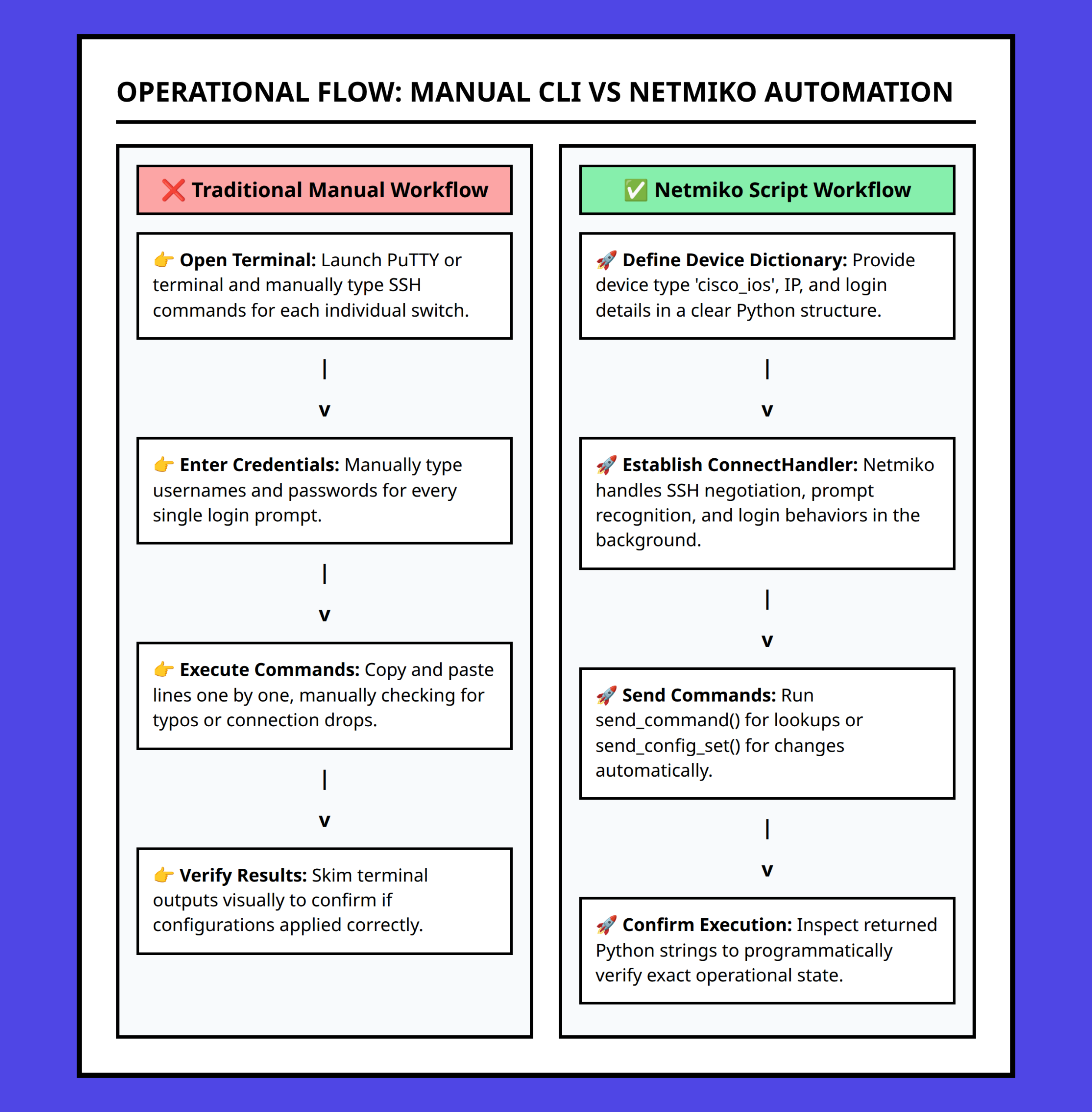
Most network engineers already know how to manage routers and switches through the CLI. The problem starts when the environment grows.
One switch is manageable. Five devices are still reasonable. But once someone is logging into dozens or hundreds of devices to repeat the same verification steps or configuration changes, the operational model starts breaking down.
I think this is where many automation conversations become confusing. People often talk about automation as if the goal is replacing engineers with code. In practice, the first real benefit is usually much simpler: reducing repetitive manual work.
A common situation looks something like this:
- A network administrator needs to check interface status across multiple branch routers.
- The commands are simple.
- The logic is simple.
- The real problem is repetition and time.
Manual CLI work scales poorly because the engineer becomes the automation layer. Every repeated login, every copied command, and every pasted configuration depends on human attention staying consistent for hours.
That is exhausting work, and it creates risk.
Netmiko Starts From Familiar IOS Workflows
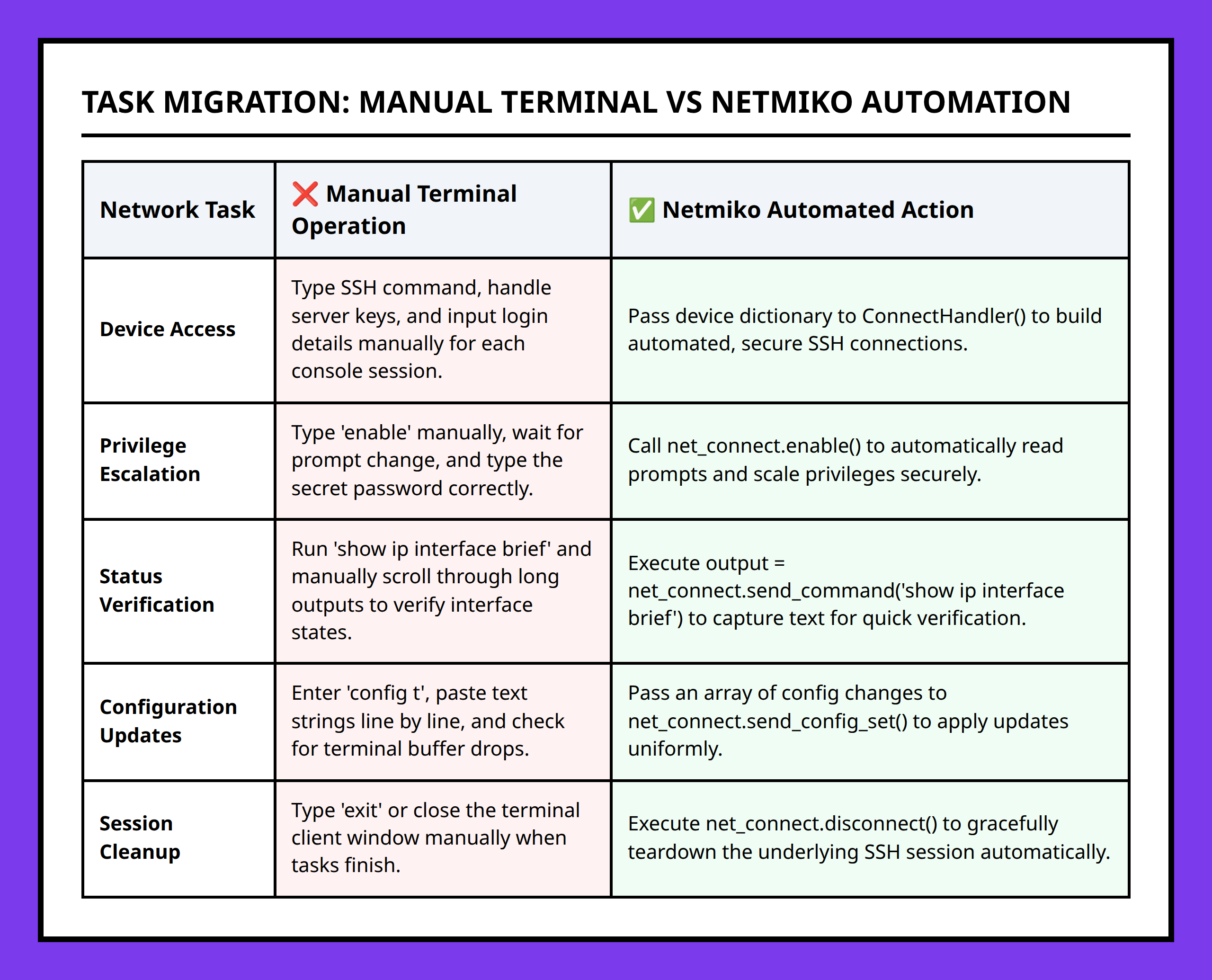
One reason Netmiko is approachable is that it does not force beginners into abstract automation concepts immediately.
Instead, the workflow stays recognizable:
- Open an SSH connection.
- Log into the device.
- Run a command.
- Read the output.
- Disconnect.
The difference is that Python handles those steps programmatically.
What I like about this approach is that the engineer’s existing IOS knowledge still matters. Someone who already understands commands like show ip interface brief or basic configuration mode does not need to relearn networking logic from scratch.
That continuity lowers resistance. The engineer is not learning networking again. They are learning how to automate networking tasks they already understand.
Even the structure of a simple Netmiko script reflects this familiarity:
import netmiko connection = netmiko.ConnectHandler( ip='192.168.1.1', device_type='cisco_ios', username='admin', password='cisco' ) print(connection.send_command('show ip interface brief')) connection.disconnect() The important thing here is not the Python syntax itself. The important thing is that the operational workflow still feels recognizable to a CLI-focused engineer.
Why Netmiko Is Easier Than Starting With APIs
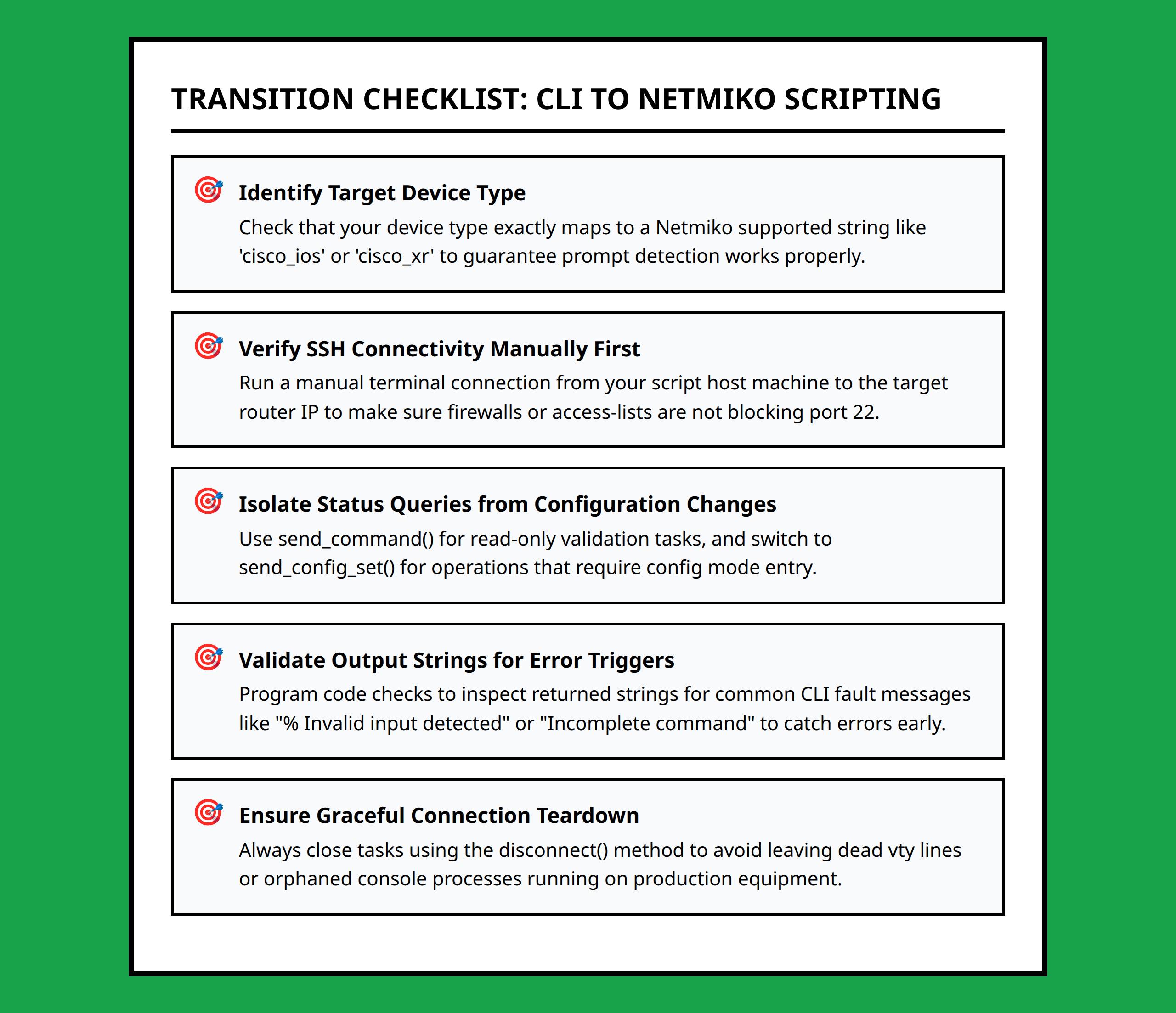
I would not tell a beginner to ignore APIs forever. Modern network automation eventually moves toward structured data, APIs, and orchestration.
But I also would not start there.
Many engineers become overwhelmed because they try to learn too many abstraction layers at once:
- Python syntax
- JSON
- REST APIs
- Authentication models
- YANG schemas
- HTTP methods
- Automation frameworks
That stack becomes mentally heavy very quickly.
Netmiko avoids much of that early complexity because it works through SSH and CLI interaction. The engineer already understands the commands, device behavior, and operational flow.
In other words, the networking side stays stable while the automation side gradually expands.
I think that progression matters more than people realize. Confidence compounds. Once someone successfully automates a simple verification task across multiple devices, automation stops feeling theoretical.
It starts feeling useful.
The Biggest Shift Is Realizing That Small Automation Still Counts
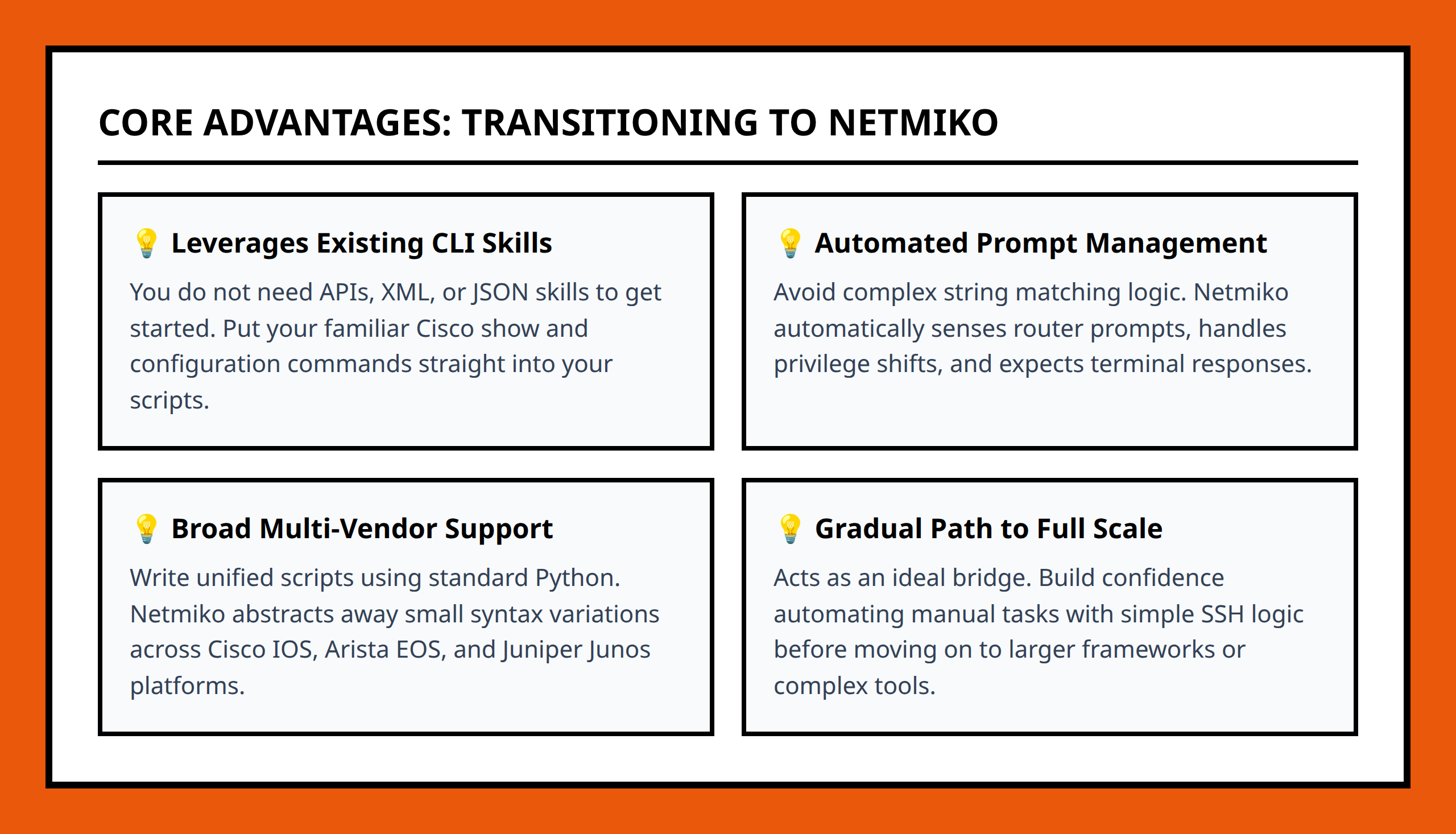
One thing I would emphasize to beginners is that automation does not need to start with large orchestration systems.
A small script that saves 20 minutes every day is already meaningful automation.
The source material repeatedly frames Netmiko as a practical entry point rather than an advanced infrastructure platform. I think that framing is important because many engineers underestimate the value of incremental improvements.
Imagine a junior administrator who normally logs into 15 switches every Monday morning to collect interface status information for a maintenance review.
The commands themselves are not difficult. The real cost is the repetition:
- logging into each device
- running the same commands
- copying output into notes
- checking for mistakes
Even a small Netmiko script can remove most of that manual friction.
The engineer still understands the network exactly the same way. The script simply removes repetitive operational labor.
That is a much healthier introduction to automation than trying to redesign the entire infrastructure on day one.
Netmiko Also Helps Engineers Learn Automation Thinking Gradually
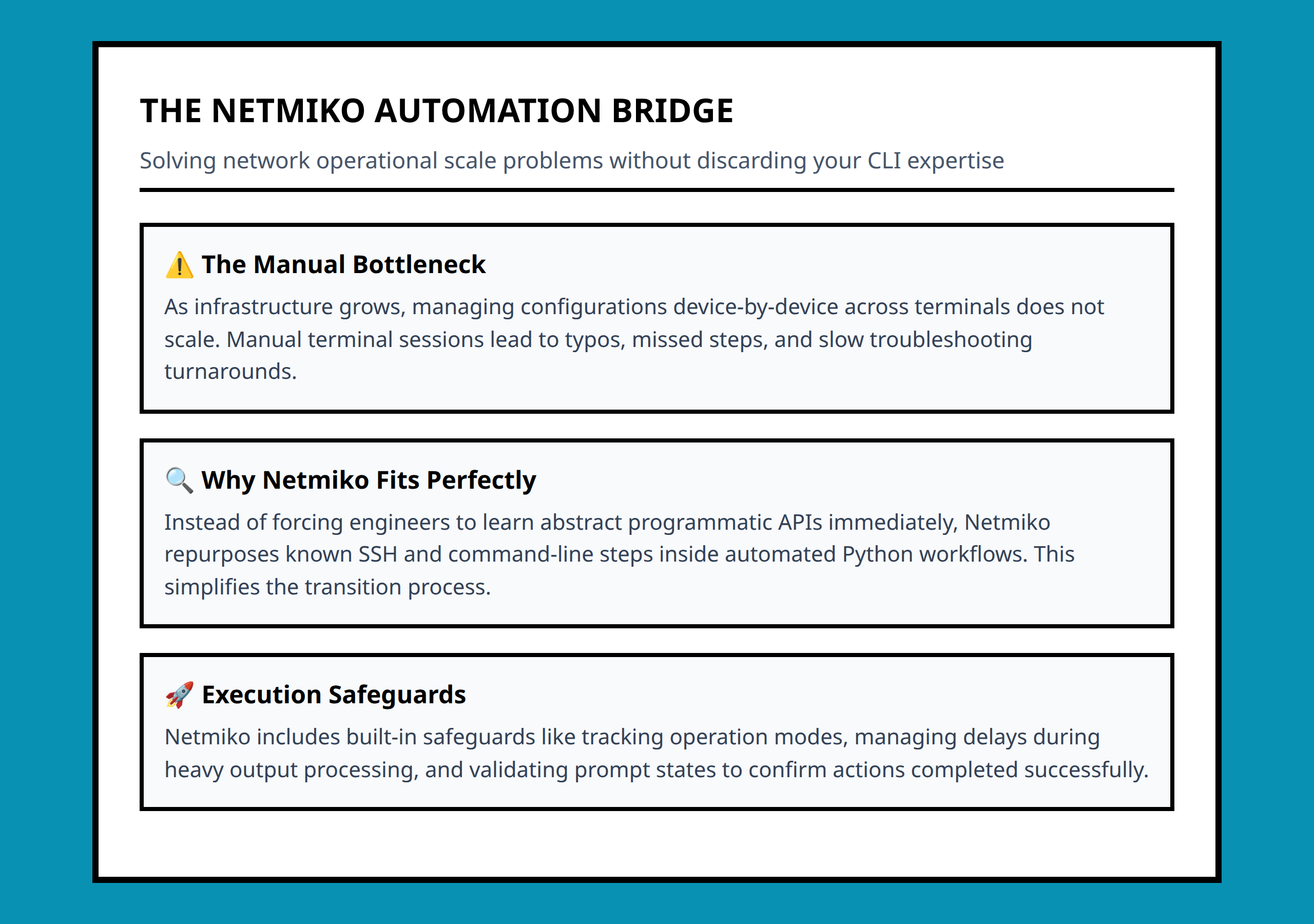
I do not think Netmiko is valuable only because of SSH automation. Its bigger value is that it teaches engineers how to think operationally in code.
Once someone starts automating CLI tasks, they naturally begin asking better questions:
- Why am I repeating this manually?
- Can this command run across multiple devices?
- Can I collect this output automatically?
- Can I standardize this process?
- Can I reduce human error here?
Those questions matter because they push engineers toward automation thinking without forcing them into advanced architecture discussions too early.
The progression described throughout the material reflects this idea clearly:
- Start with familiar CLI automation through Netmiko
- Move toward structured data with NAPALM
- Scale orchestration later with frameworks like Nornir
I think this sequence works because it respects how people actually learn operational systems. Most engineers do not jump comfortably from manual SSH sessions straight into enterprise orchestration frameworks.
They build confidence in layers.
Why SSH-Based Automation Still Matters
Sometimes people dismiss SSH automation because APIs and model-driven automation receive more attention now.
I think that misses an important operational reality.
Many real networks still depend heavily on CLI access. Older devices, mixed environments, temporary operational tasks, and transitional infrastructure often make SSH-based automation the most practical option available.
Netmiko works well in those environments because it does not require a complete modernization project before automation becomes possible.
That practicality matters.
A network engineer can begin automating useful work immediately as long as SSH access exists. There is no requirement to redesign the network architecture first.
That accessibility is one of the strongest reasons Netmiko remains such an effective transition tool.
The Most Important Thing Netmiko Changes
What stands out to me most is that Netmiko changes the emotional side of automation as much as the technical side.
For many engineers, automation initially feels like leaving behind years of operational experience. Netmiko softens that transition because the engineer’s CLI knowledge still stays central to the workflow.
The commands are familiar.
The troubleshooting mindset is familiar.
The device behavior is familiar.
Only the execution method changes.
That is why Netmiko works so well as a first step. It does not demand that engineers become software developers overnight. It simply gives them a practical way to automate work they already understand.
And honestly, that is usually the point where automation finally starts feeling realistic instead of intimidating.
References:
- https://www.youtube.com/watch?v=D-NPjb5P9Jw
- https://www.youtube.com/watch?v=85Bv4cmxQJE
- https://www.youtube.com/watch?v=W1Re2Il-2kk
- https://ivision.com/blog/understanding-network-automation-tools-scripting-iac/
- https://codilime.com/blog/python-paramiko-and-netmiko-for-automation/
- https://www.linkedin.com/pulse/from-cli-cognition-evolution-netmiko-network-kwame-asamoah-frimpong-2vlae
- https://kd9cpb.com/netmiko-auto
- https://medium.com/@aifakhri/network-automation-with-netmiko-in-a-virtual-data-center-network-9888dc270d8
- https://www.networkershome.com/fundamentals/python-networking/why-python-for-network-engineers/
- https://logcentral.io/blog/netmiko-python-network-automation-guide
- https://www.scribd.com/document/890652860/Network-Automation-With-Netmiko
- https://www.reddit.com/r/networking/comments/1rmvk1k/do_big_tech_network_engineers_use_libraries_like/
- https://www.reddit.com/r/networking/comments/1rmvk1k/do_big_tech_network_engineers_use_libraries_like/o92eb47/
- https://www.reddit.com/r/networking/comments/jsnwm8/what_do_you_use_automationpython_for_and_what_do/
- https://www.reddit.com/r/networkautomation/comments/12yyw2v/restconf_netconf_or_ssh_cli_netmiko_for_python/