
[MetaDescription]Moving Android into SELinux enforcing mode is a gradual debugging process built around audit logs, CTS testing, and repeated policy refinement across system services.
Getting Android into SELinux enforcing mode is rarely a one-step security upgrade. Most real deployments move through repeated cycles of auditing, denial analysis, policy fixes, and subsystem stabilization before enforcement becomes reliable enough for production.
One thing that becomes obvious quickly when working with Android SELinux is that permissive mode can create a false sense of stability. The device boots. Services appear to work. Apps launch. Then enforcing mode gets enabled and suddenly critical components start failing in places that looked completely healthy before.
I do not think this happens because SELinux is overly strict. Most of the time, it happens because permissive mode hides how many runtime assumptions the system has been making silently for a long time.
Takeaways
- SELinux enforcing mode exposes hidden policy problems that permissive mode only logs.
- Android hardening usually depends on repeated audit-and-fix cycles rather than one large policy rewrite.
- CTS testing helps expose real compatibility and policy enforcement gaps.
- System services often need subsystem-specific refinement before enforcement becomes stable.
- Blindly allowing every denial usually creates weak long-term policy quality.
Permissive mode can hide operational problems for a long time
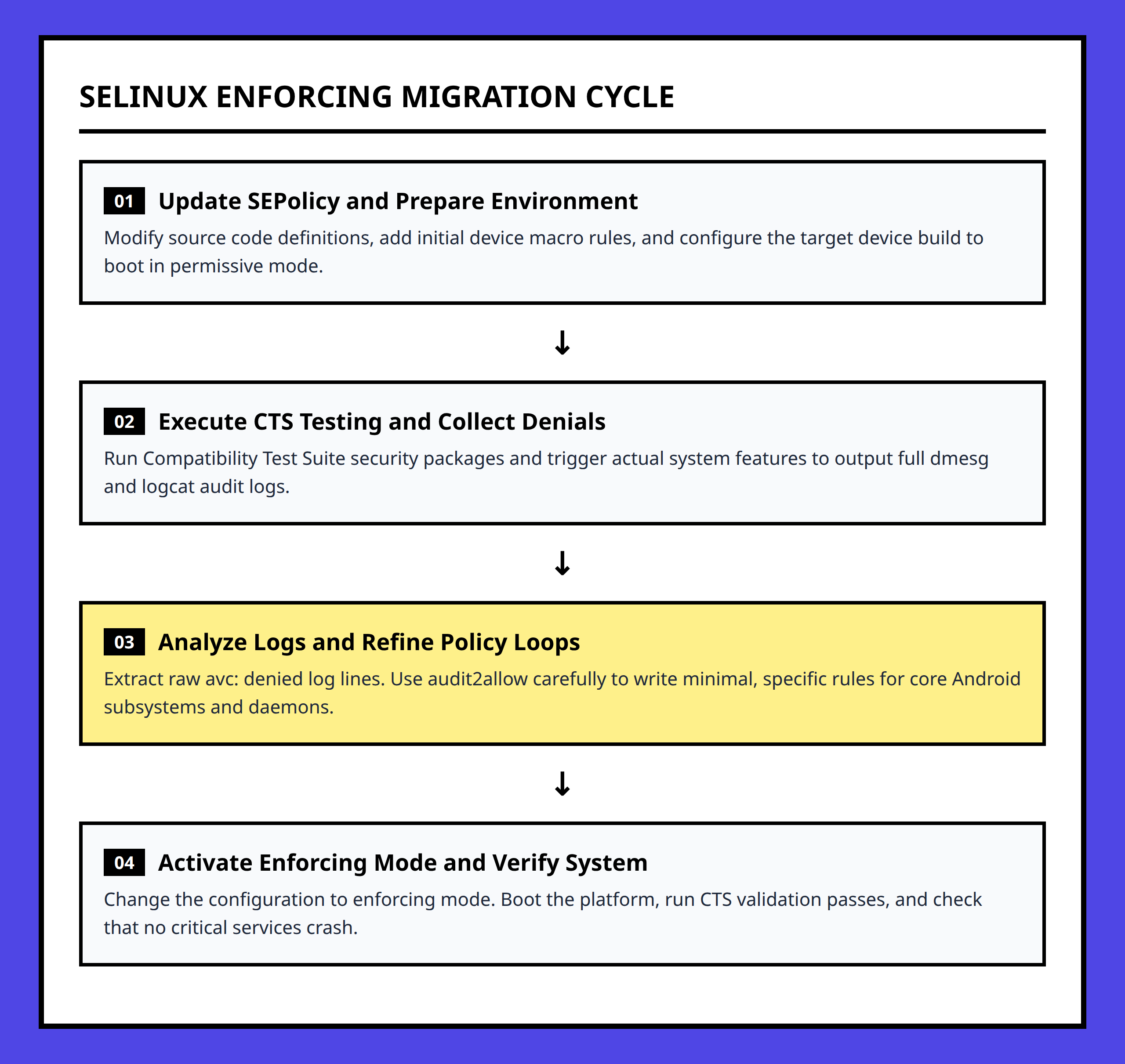
SELinux permissive mode is useful because it allows developers to observe denials without actively blocking operations.
That makes early bring-up work much easier.
A custom ROM builder, for example, may boot a partially completed Android image while still collecting audit logs in the background. Hardware services continue functioning because SELinux records violations instead of enforcing restrictions immediately.
The problem is that permissive mode can make systems appear healthier than they really are.
A media service may already be attempting forbidden filesystem access. A networking daemon may already depend on mislabeled resources. A vendor component may already violate expected policy boundaries repeatedly.
None of those problems necessarily break the system immediately while permissive mode remains active.
I would treat permissive mode mainly as a diagnostic phase, not as proof that the policy is ready.
Getting to enforcing mode starts with preparing the policy environment
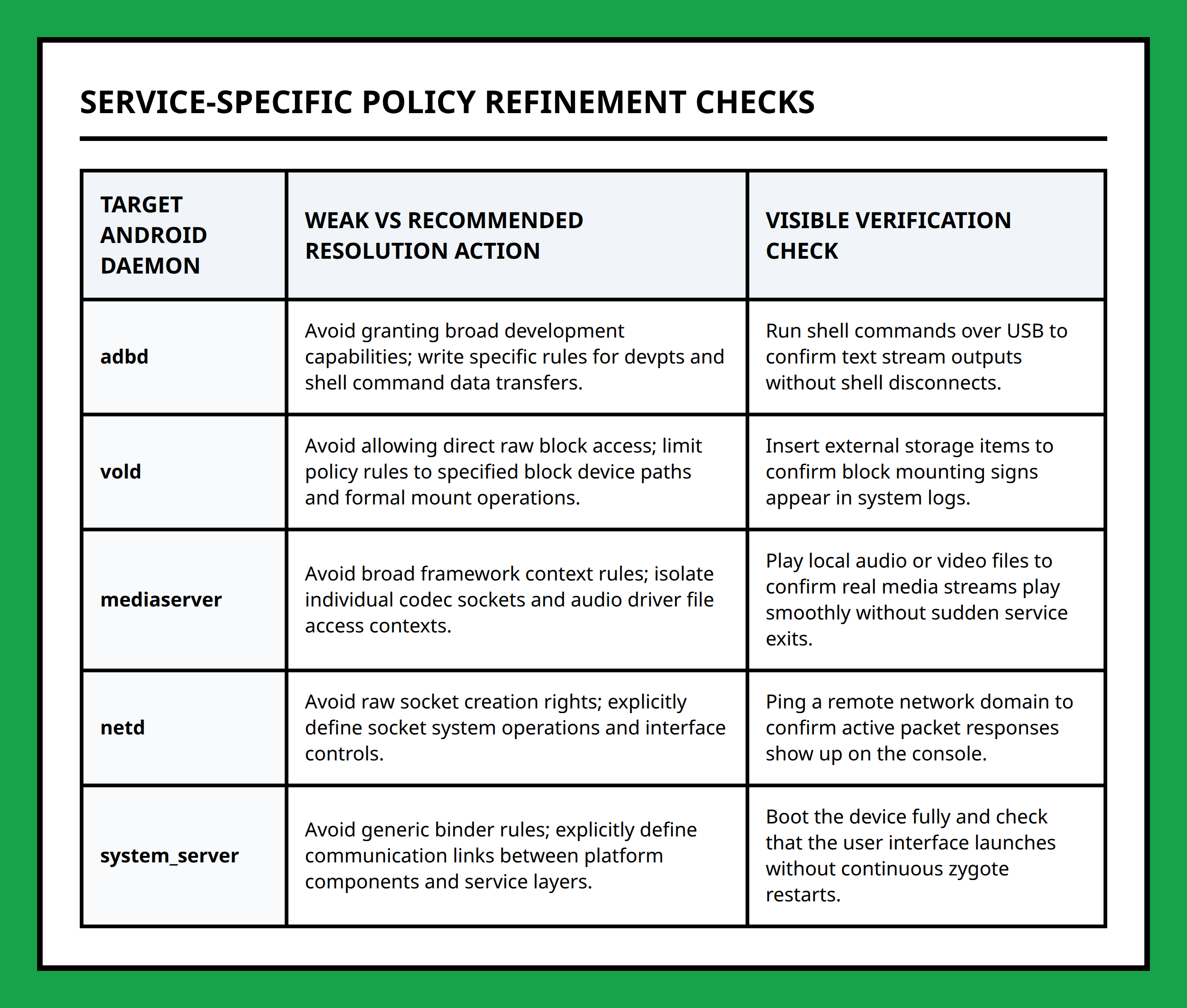
Before enabling enforcement, Android SELinux policy usually needs baseline cleanup and preparation.
This includes:
- Updating outdated policy rules
- Reviewing vendor-specific customizations
- Checking filesystem labeling consistency
- Removing obviously unsafe allow rules
- Verifying boot-critical services
I think one of the easiest mistakes during this phase is trying to “fix everything” immediately.
Large Android systems contain many interacting components:
- Core framework services
- Vendor daemons
- Hardware abstraction layers
- Debugging interfaces
- Media pipelines
- Networking subsystems
Trying to solve all policy issues simultaneously often creates confusion about which changes actually improved stability.
I would rather stabilize the system incrementally and keep the policy changes traceable.
CTS testing becomes part of the security workflow
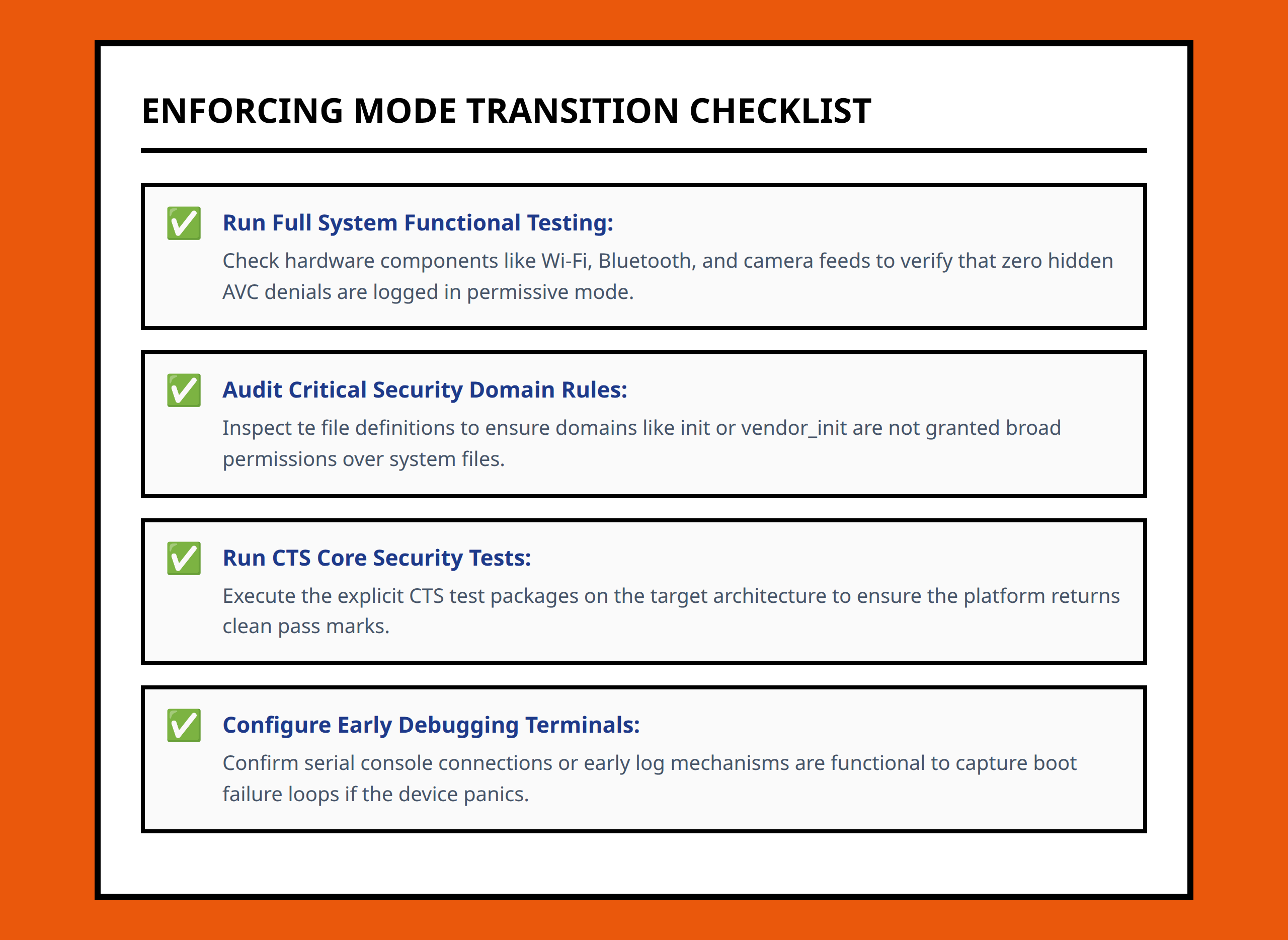
Once the environment becomes reasonably stable, Android teams often rely heavily on CTS, the Compatibility Test Suite.
CTS matters because SELinux policy problems do not always appear during casual device usage.
A phone may seem functional during normal testing while still failing important security expectations internally.
CTS helps expose:
- Unexpected permission failures
- Broken service communication
- Improper domain transitions
- Filesystem labeling inconsistencies
- Policy regressions across Android components
I think this is where enforcing-mode work starts feeling more like system engineering than ordinary debugging.
The goal is not only to stop visible crashes. The system also has to satisfy Android’s expected security behavior under structured testing conditions.
Audit logs become the real driver of policy refinement
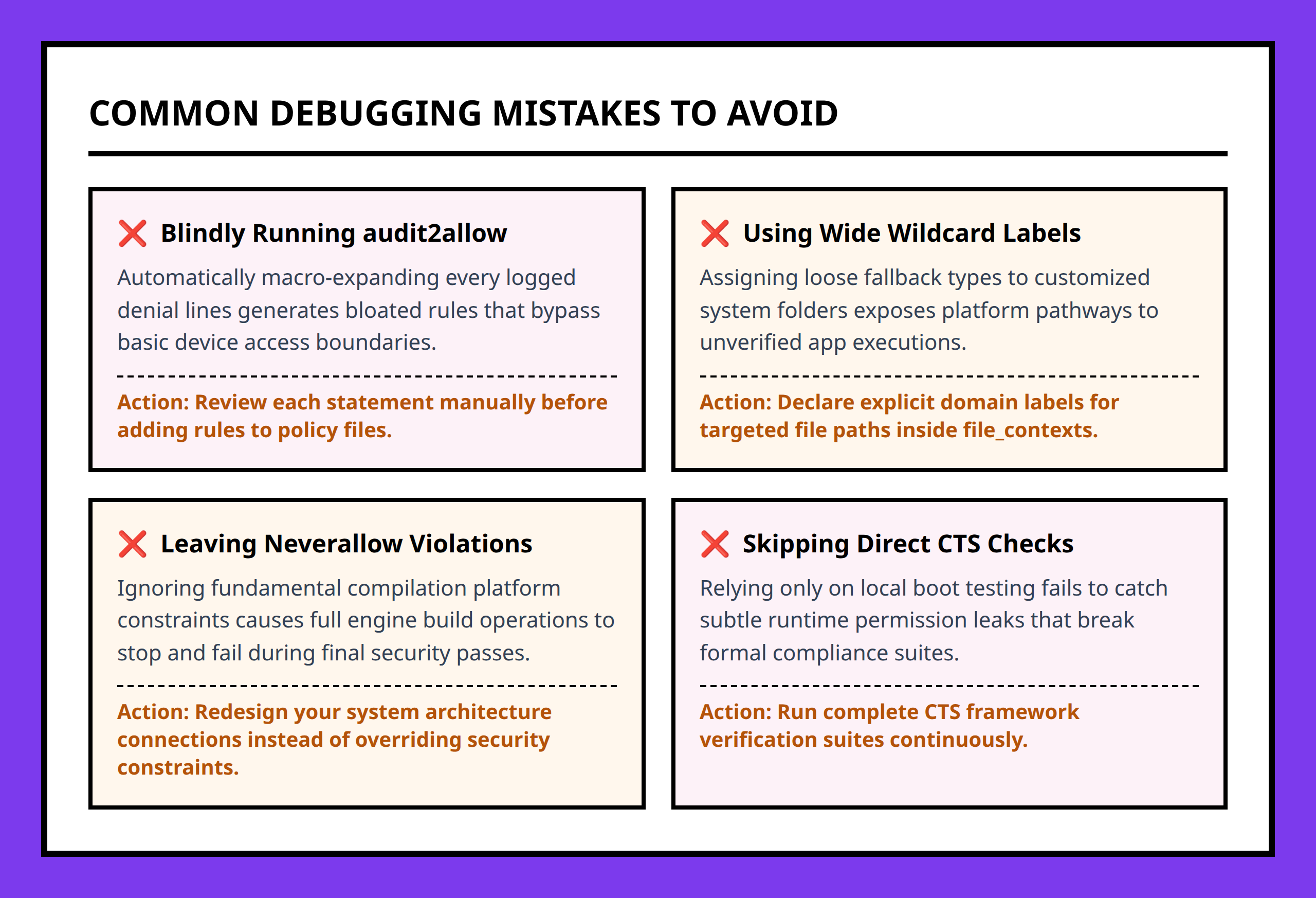
After CTS runs or enforcing-mode boot attempts, developers usually return to audit logs repeatedly.
This becomes the central refinement loop.
A typical cycle often looks something like this:
- Enable stricter enforcement.
- Collect SELinux denials.
- Identify which service failed.
- Determine whether the access should actually be allowed.
- Refine policy or labeling carefully.
- Retest the subsystem.
I think the word “carefully” matters more than many developers initially expect.
When a denial appears, the fastest solution is often adding a broad allow rule. But broad fixes can quietly weaken isolation across the entire system.
A denial involving a media service today may unintentionally open pathways affecting unrelated processes tomorrow.
That is why enforcing-mode stabilization tends to move slowly on serious Android deployments.
adbd often exposes debugging-related policy tension
The Android Debug Bridge daemon, adbd, commonly becomes one of the early policy refinement targets.
This happens because debugging services naturally operate near sensitive system boundaries.
Developers want flexibility during bring-up:
- Shell access
- File transfers
- Diagnostic visibility
- Process inspection
SELinux, meanwhile, tries to narrow unnecessary privilege exposure.
I think this creates a very real operational tension during enforcement work.
A permissive debugging environment makes development easier, but production policy cannot permanently trust debugging pathways too broadly.
That is why adbd policy tuning often becomes iterative rather than immediate.
vold and storage services reveal how messy real systems are
Storage management services such as vold frequently generate complicated SELinux denials during enforcement transitions.
Part of the difficulty comes from how many moving parts storage systems involve:
- Mount operations
- Removable media
- Filesystem transitions
- Metadata handling
- Encryption support
- Device node access
A small labeling inconsistency can ripple outward into multiple failures.
Imagine a custom Android build where external storage mounts successfully in permissive mode but breaks under enforcement. The visible symptom might look like a simple media issue, but the real cause could involve mislabeled mount points or blocked device access deep underneath.
I would usually investigate filesystem contexts and transition behavior before expanding permissions aggressively in cases like this.
Media and networking services often require repeated tuning passes
Services like mediaserver and netd often require several rounds of policy refinement.
These components process large amounts of external input and interact with many subsystems simultaneously.
That combination creates noisy audit behavior.
One denial fix may expose another hidden interaction immediately afterward.
I think this is one reason enforcing-mode transitions can feel frustrating initially. Solving one layer of denials often uncovers deeper assumptions underneath.
A media pipeline may appear stable until a camera service exercises a rarely used codec path. A networking service may work normally until VPN handling or DNS behavior triggers additional policy checks.
This is not necessarily bad news.
It usually means SELinux is finally forcing hidden runtime behavior into the open where it can be controlled intentionally.
system_server can become one of the hardest domains to stabilize
Among Android services, system_server often becomes especially sensitive during enforcing-mode work.
This service coordinates large portions of Android framework behavior and interacts with many system components simultaneously.
That broad responsibility creates policy complexity.
I think this is where careless allow rules become especially dangerous.
If developers grant overly broad permissions inside system_server, they risk weakening boundaries around one of Android’s most important runtime domains.
The pressure to “just make the system boot” can become very tempting here.
But enforcement-mode work tends to reward patience more than speed.
Carefully narrowing access over multiple refinement passes usually produces stronger long-term isolation than large emergency policy expansions.
Enforcing mode is really about stabilizing trust boundaries
What stands out to me most about Android SELinux migration work is that enforcing mode is not simply a switch.
It is a process of exposing assumptions the operating system has been making silently across services, filesystems, and runtime behavior.
Every denial tells developers something important:
- A service expected broader access
- A label did not match policy expectations
- A subsystem depended on implicit trust
- A runtime interaction crossed a security boundary unexpectedly
The operational challenge is deciding which behavior should remain allowed and which behavior should disappear permanently.
That is why stable enforcing-mode deployments usually come from repeated refinement cycles, not from one aggressive policy rewrite done under deadline pressure.
- SELinux enforcing mode: A SELinux operating mode where policy violations are actively blocked instead of only logged.
- Permissive mode: A SELinux mode where violations are recorded but allowed to continue for debugging purposes.
- CTS (Compatibility Test Suite): Android’s testing framework used to verify platform compatibility and expected system behavior.
- Audit log: A security log recording SELinux denials and policy-related system events.
adbd: The Android Debug Bridge daemon used for shell access, debugging, and device communication.vold: Android’s volume management daemon responsible for storage and mount handling.mediaserver: A system component involved in Android media processing and playback services.netd: Android’s network management daemon responsible for networking operations and configuration.system_server: A core Android runtime process that manages many framework-level services.- Policy refinement: The process of adjusting SELinux rules and labels based on observed runtime behavior and audit analysis.
- Domain: A SELinux security identity associated with a running process.
References:
- https://androidmobiles.org/from-permissive-to-enforcing-a-guide-to-hardening-android-with-selinux/
- https://source.android.com/docs/security/features/selinux/validate
- https://medium.com/@mayankzenmbm/the-complete-guide-to-selinux-in-android-from-core-concepts-to-deployment-59a3689c943c
- https://www.reddit.com/r/linuxquestions/comments/1q84b39/can_you_guys_explain_what_is_selinux_on_android/
- https://www.reddit.com/r/linuxquestions/comments/1q84b39/can_you_guys_explain_what_is_selinux_on_android/nyko8yn/
- https://www.reddit.com/r/LineageOS/comments/lg04qo/on_why_you_should_never_run_with_permissive/
- https://www.reddit.com/r/linuxadmin/comments/1e9doft/general_consensus_on_selinux/
- https://www.youtube.com/watch?v=EzgPVu0JoGg
- https://emteria.com/blog/selinux-android
- https://8ksec.io/android-selinux-internals-part-ii/
- https://source.android.com/docs/security/features/selinux/concepts
- https://www.quora.com/Why-does-Android-use-SELinux
- https://docs.redhat.com/en/documentation/red_hat_enterprise_linux/8/html/using_selinux/changing-selinux-states-and-modes_using-selinux
- https://docs.redhat.com/en/documentation/red_hat_enterprise_linux/6/html/security-enhanced_linux/sect-security-enhanced_linux-working_with_selinux-changing_selinux_modes
- https://www.tenable.com/audits/items/CIS_Red_Hat_EL7_STIG_v2.0.0_L2_Server.audit:ed6a1d970c1b2d9fdbd68035d89809d0
- https://www.ijcaonline.org/archives/volume165/number7/sambare-2017-ijca-913931.pdf