
[MetaDescription]Android applications receive SELinux domains through coordinated runtime labeling involving Zygote, seapp_contexts, and policy-driven domain transitions.
Android application isolation under SELinux depends on more than Linux user IDs. Runtime security comes from coordinated domain assignment involving Zygote, application metadata, policy mappings, and controlled process transitions that determine how every app behaves after launch.
One thing that confused me early on was how much Android app security depends on process creation itself. At first glance, it looks like Android simply assigns each app a UID and isolates it through Linux permissions. That is only part of the picture.
Once SELinux enters the system, Android starts treating application startup as a controlled security transition instead of a simple process launch. The operating system has to decide which domain the app belongs to, what context it should inherit, and how much trust the runtime should give it before the app even starts executing normally.
Takeaways
- Android app isolation depends on SELinux domain assignment during process startup.
- Zygote plays a central role because most Android applications inherit from it.
mac_permissions.xmlhelps map application identities to SELinux behavior.seapp_contextscontrols how applications receive runtime domains.- SELinux domain transitions reduce the amount of trust Android places in app processes.
Zygote became one of Android’s most sensitive security components
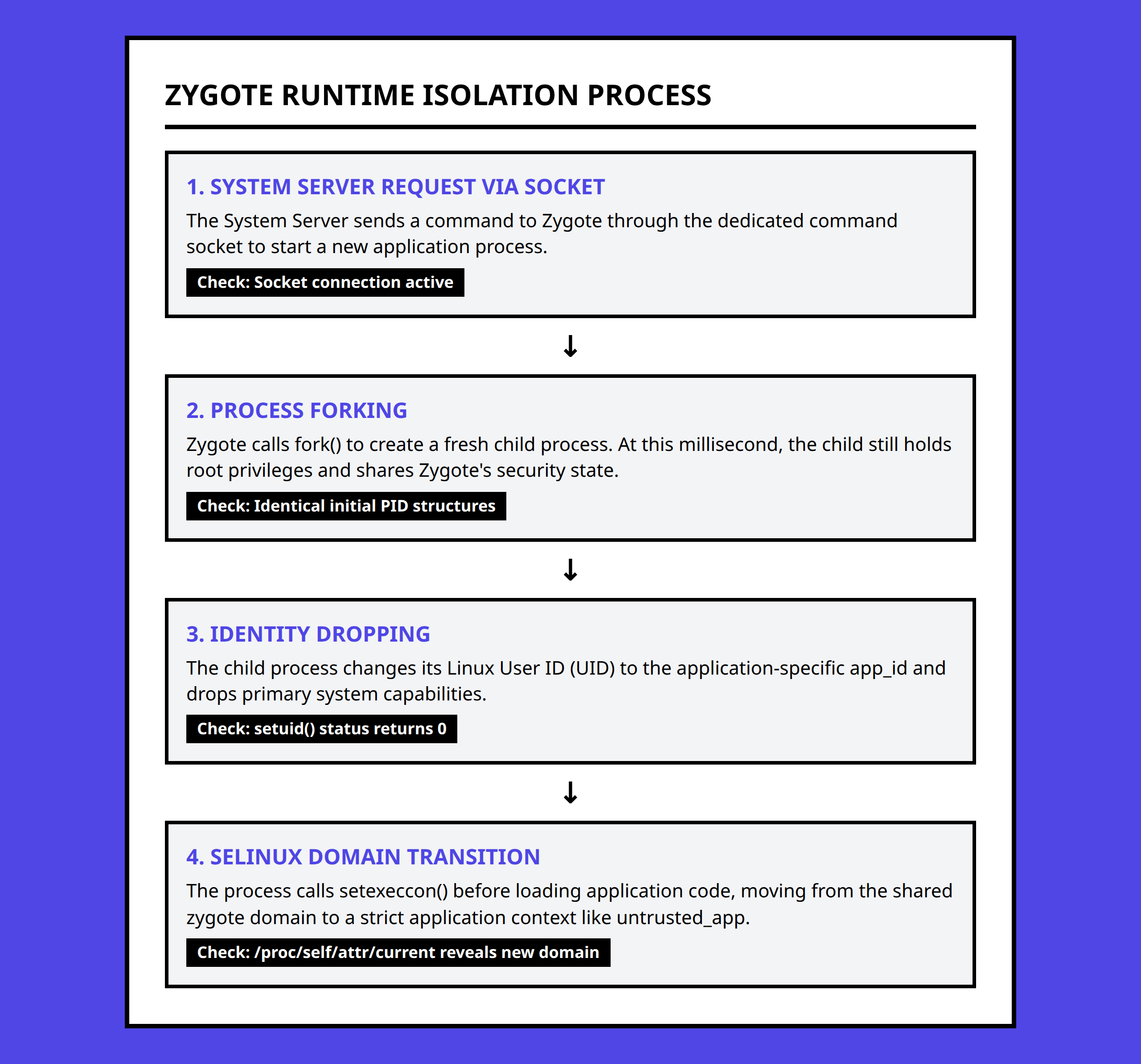
Most Android applications begin life through Zygote.
Zygote starts early during boot and preloads shared runtime resources that Android applications commonly need. When a user launches an app, Android usually forks a new process from Zygote instead of building the process completely from scratch.
This improves startup speed and memory efficiency.
But it also creates a security concern that I think many people underestimate initially.
If almost every application inherits from the same parent process, then Zygote becomes one of the most security-sensitive components in the operating system.
A weakness in how Zygote handles runtime transitions, sockets, or privilege separation could affect large portions of the Android application environment simultaneously.
That is why Android hardens Zygote carefully rather than treating it like an ordinary application launcher.
The Zygote socket creates an important trust boundary
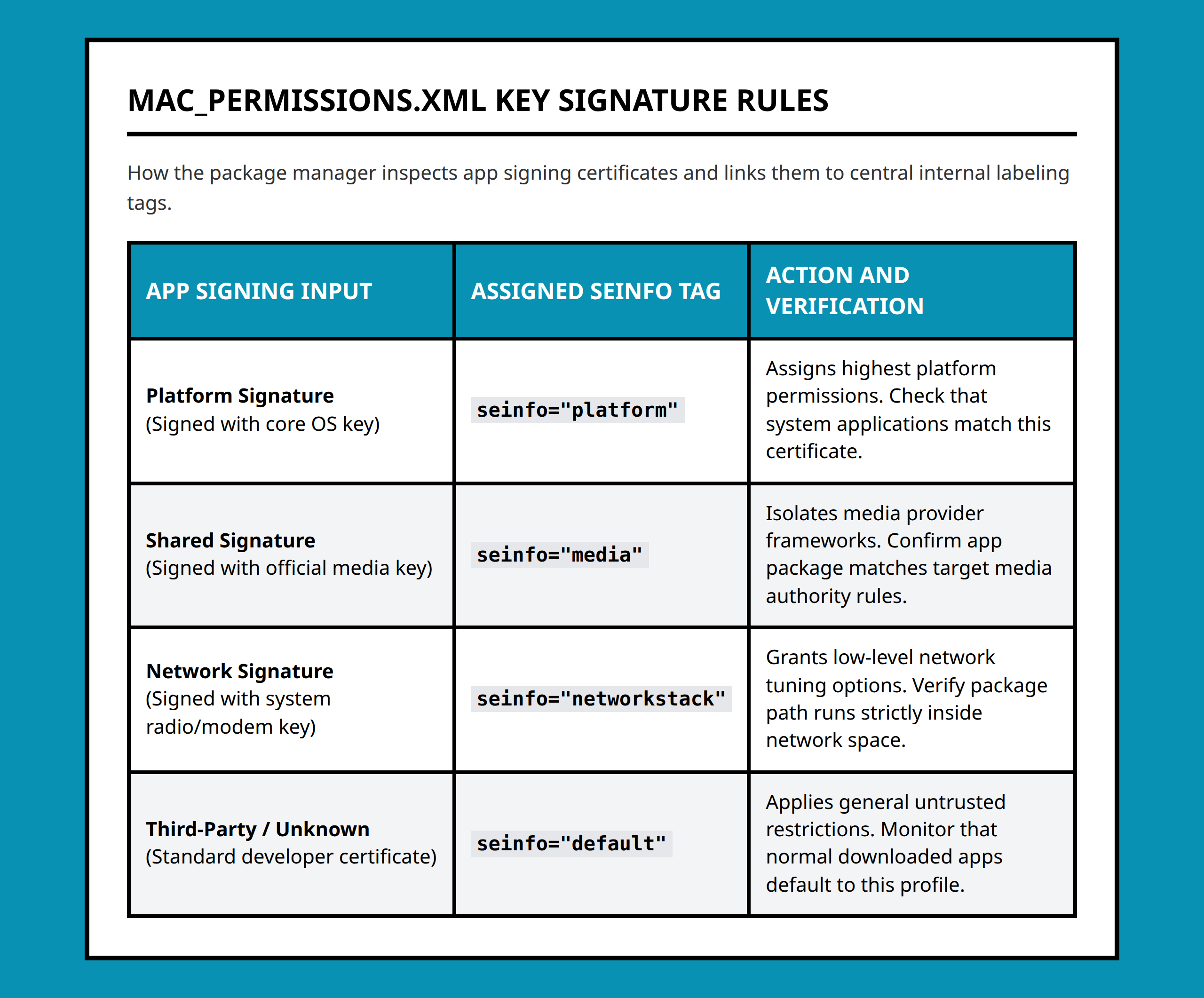
Android applications do not simply ask the kernel directly to create themselves.
Application startup requests typically move through a Zygote communication socket.
This socket becomes an important control point because it determines:
- Who can request new processes
- How runtime parameters are passed
- Which identities get assigned
- How privileges change during startup
I would pay close attention to this area when thinking about Android runtime security because process creation is not just a performance operation anymore. It is also a security decision.
Imagine a compromised service improperly interacting with the Zygote interface. If the process creation pipeline lacks proper controls, attackers may influence application startup behavior in unintended ways.
This is part of why Android places strong restrictions around who can communicate with Zygote and how those requests are validated.
SELinux isolation depends on more than Linux UIDs
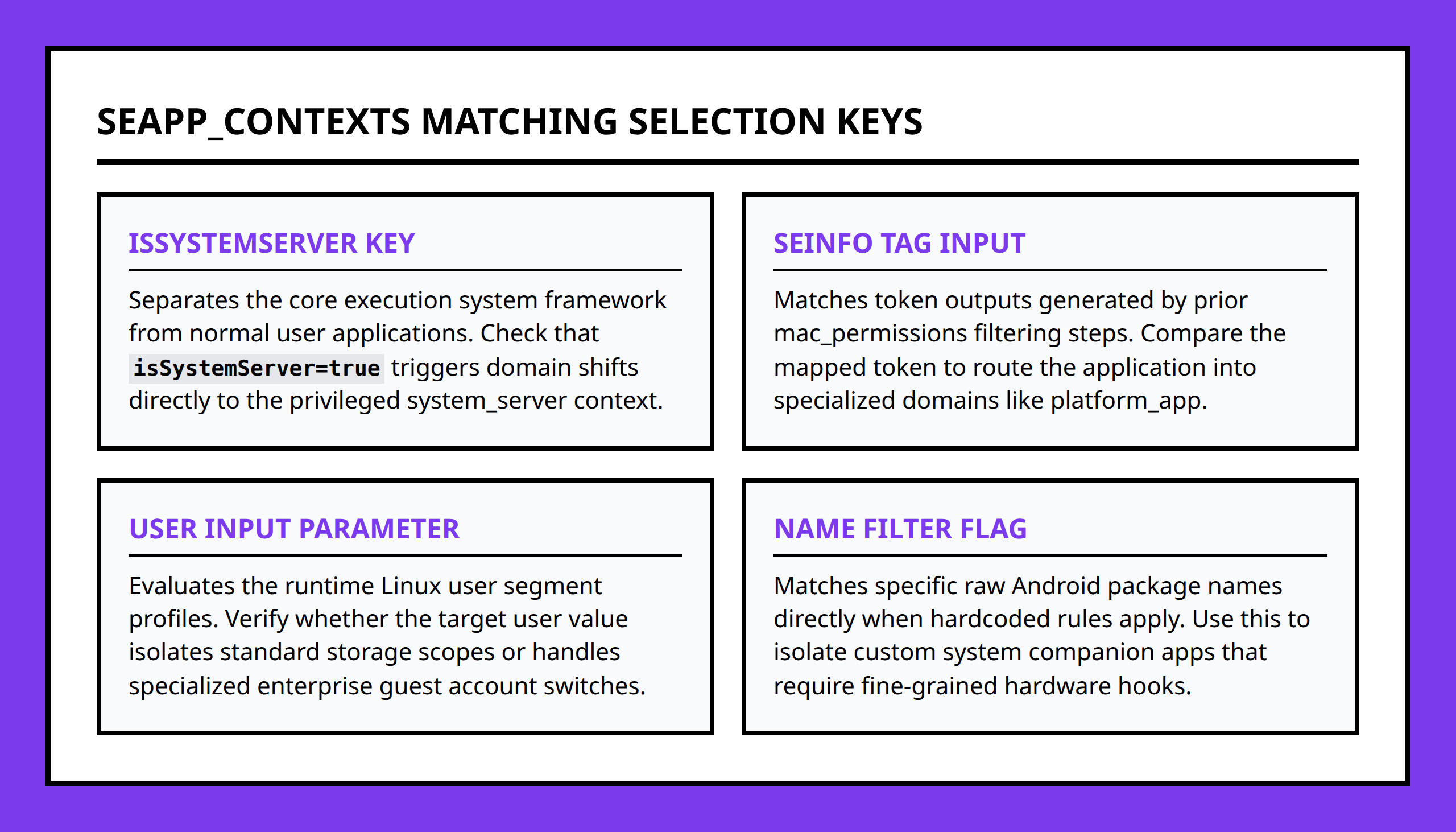
Android already isolates applications using separate Linux user IDs.
That still matters.
But SELinux adds another layer by assigning applications to security domains with more detailed behavioral restrictions.
This becomes important because two applications with separate UIDs may still interact with shared runtime services, IPC channels, or system resources.
UID isolation alone cannot fully describe what kinds of operations the app should perform.
I think this is where Android’s SELinux model becomes much more precise than ordinary Linux sandboxing.
The operating system is no longer asking only:
Which user owns this process?
It is also asking:
Which SELinux domain should this process belong to, and what behavior should that domain allow?
That extra classification layer helps Android narrow runtime trust much more aggressively.
mac_permissions.xml helps connect app identity to policy behavior
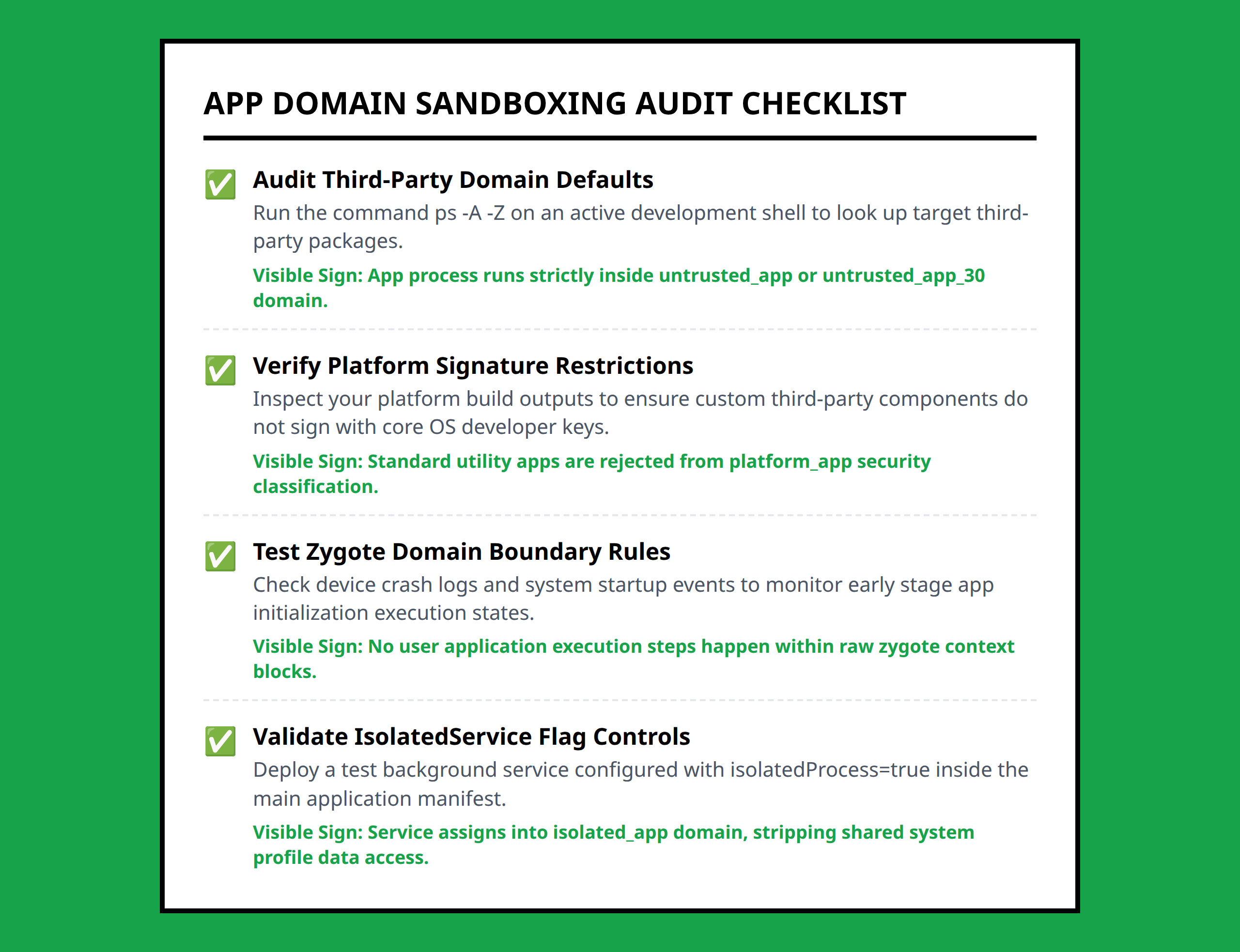
Android uses mac_permissions.xml to help associate applications with SELinux-related policy decisions.
This file can influence how applications receive security labeling based on properties such as:
- Application signatures
- Package characteristics
- Privilege level
- Assigned security categories
I think this mechanism becomes especially important once Android starts distinguishing between ordinary third-party apps and more trusted platform components.
Not every application should receive identical treatment.
A vendor system application handling sensitive device functionality may require different domain behavior than a downloaded consumer app installed from an app store.
The important point is that Android does not assign runtime identities randomly. SELinux domain placement becomes tied to structured application metadata and trust assumptions.
seapp_contexts is where runtime domain assignment becomes concrete
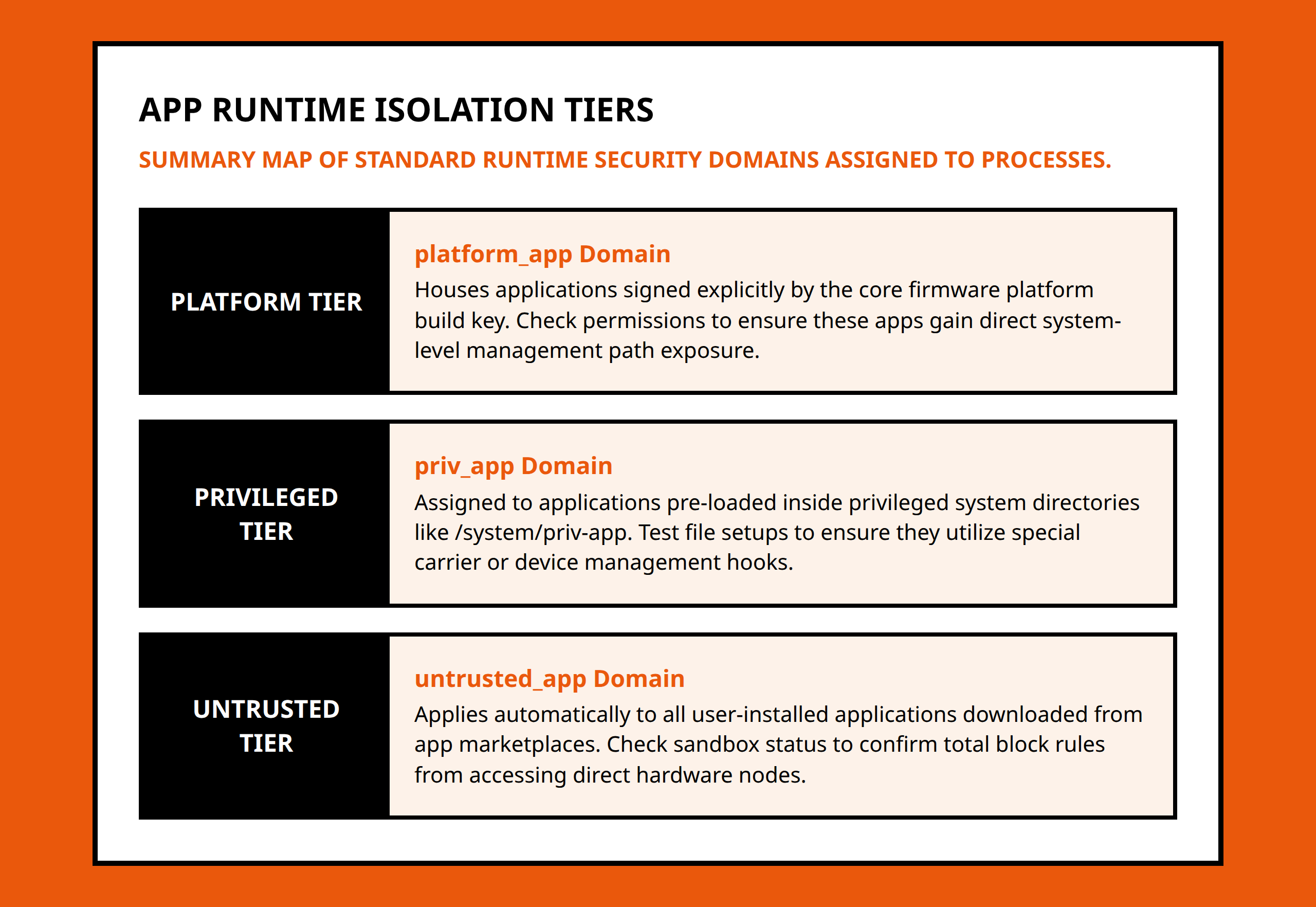
If mac_permissions.xml helps classify applications conceptually, seapp_contexts helps turn those classifications into actual runtime SELinux contexts.
This file contains rules describing how Android applications should receive:
- SELinux domains
- Process contexts
- Data directory labels
- Application isolation behavior
A simplified rule might conceptually describe:
- Which app type is being launched
- Which user category applies
- Which SELinux domain should result
I think this is one of the most operationally important parts of Android SELinux application security because it connects abstract policy design to actual running processes.
If the mappings become incorrect, applications may:
- Receive overly broad privileges
- Lose required access unexpectedly
- Break IPC interactions
- Cross isolation boundaries unintentionally
That is why runtime labeling logic tends to receive careful attention during Android platform work.
Domain transitions help Android reduce inherited trust
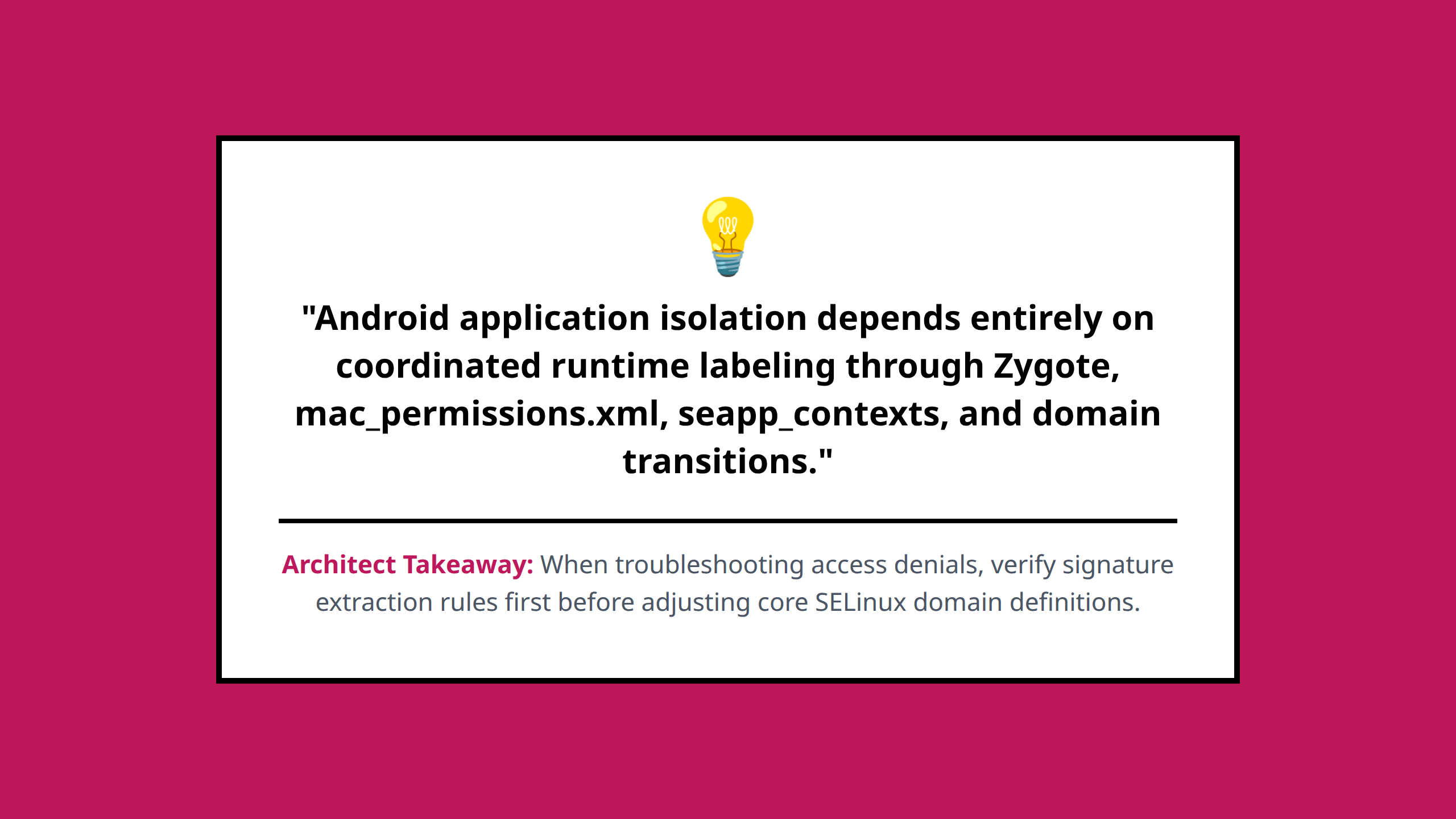
SELinux domain transitions are one of the most important containment mechanisms during application startup.
Without transitions, applications would inherit too much trust directly from the parent environment.
Android instead performs controlled transitions where the new application process moves into a more restricted SELinux domain appropriate for its role.
This matters because Zygote itself operates with capabilities and responsibilities ordinary applications should not retain.
I think this is one of the clearest examples of Android trying to narrow trust boundaries intentionally.
The system avoids letting applications remain too close to privileged runtime components after launch.
A practical way to picture this is imagining a newly installed app starting for the first time after boot. Even though the process originated from a trusted runtime parent, Android quickly confines it into a domain designed specifically for ordinary application behavior.
That separation reduces the damage a compromised application can cause later.
Application isolation is really coordinated runtime orchestration
What stands out to me most about Android SELinux app isolation is that no single mechanism handles the entire process alone.
The isolation model depends on several pieces working together:
- Zygote process control
- Secure startup communication
- Application metadata evaluation
- SELinux context mapping
- Domain transition enforcement
If one layer behaves incorrectly, the runtime trust model weakens quickly.
For example, a bad domain mapping inside seapp_contexts can undermine otherwise correct SELinux policy. Weak Zygote controls can expose process creation risks before the application domain even activates properly.
I would think about Android app isolation less like one sandbox wall and more like a coordinated startup pipeline where multiple security decisions happen in sequence.
That sequencing is exactly what allows Android to assign different trust levels to applications before they begin interacting with the rest of the operating system.
- Zygote: A core Android process that preloads shared runtime resources and forks new application processes.
- SELinux domain: A security category assigned to a running process that determines which operations the process may perform.
- Runtime isolation: The separation of applications and services while the operating system is actively running.
mac_permissions.xml: An Android configuration file used to associate application properties with SELinux-related security behavior.seapp_contexts: Android SELinux configuration rules that map applications to runtime process contexts and domains.- Domain transition: A SELinux mechanism that moves a process from one security domain into another during execution.
- UID: A Linux user identifier used by Android to isolate applications at the operating system level.
- IPC: Inter-process communication mechanisms that allow applications and services to exchange data and requests.
- Application sandbox: A security boundary limiting what an app can access or modify.
- Process context: The SELinux security identity attached to a running process.
References:
- https://source.android.com/docs/security/features/selinux
- https://ceur-ws.org/Vol-1326/103-Aron.pdf
- https://www.usenix.org/system/files/sec21fall-rossi.pdf
- https://8ksec.io/android-selinux-internals-part-ii/
- https://www.politesi.polimi.it/retrieve/a81cb05d-24e7-616b-e053-1605fe0a889a/2019_04_Rossi.pdf
- https://www.ezurio.com/documentation/android-security-part-3-security-enhanced-linux-in-android
- https://www.researchgate.net/publication/254007206_Practical_and_lightweight_domain_isolation_on_Android
- https://trust.cispa.saarland/publication/bugiel-11-spsm/bugiel-11-spsm.pdf
- https://www.hsc.com/resources/blog/seandroid-selinux-making-devices-more-secure-a-technology-primer/