
Supremum and infimum become essential in real analysis because many sets approach boundaries without ever reaching them. Understanding least upper bounds and greatest lower bounds helps explain how analysis handles incomplete-looking behavior in a precise way.
I remember feeling slightly frustrated the first time I encountered supremum and infimum. Maximum and minimum already seemed perfectly reasonable. If a set had a largest number, call it the maximum. If it had a smallest number, call it the minimum. The system looked complete enough.
Then analysis started asking harder questions.
What happens when a set clearly approaches a boundary but never actually reaches it? That is where the entire perspective shifts. Real analysis stops focusing only on what exists inside the set and starts caring about what constrains the set from outside.
Bounded Sets Introduce the Real Problem
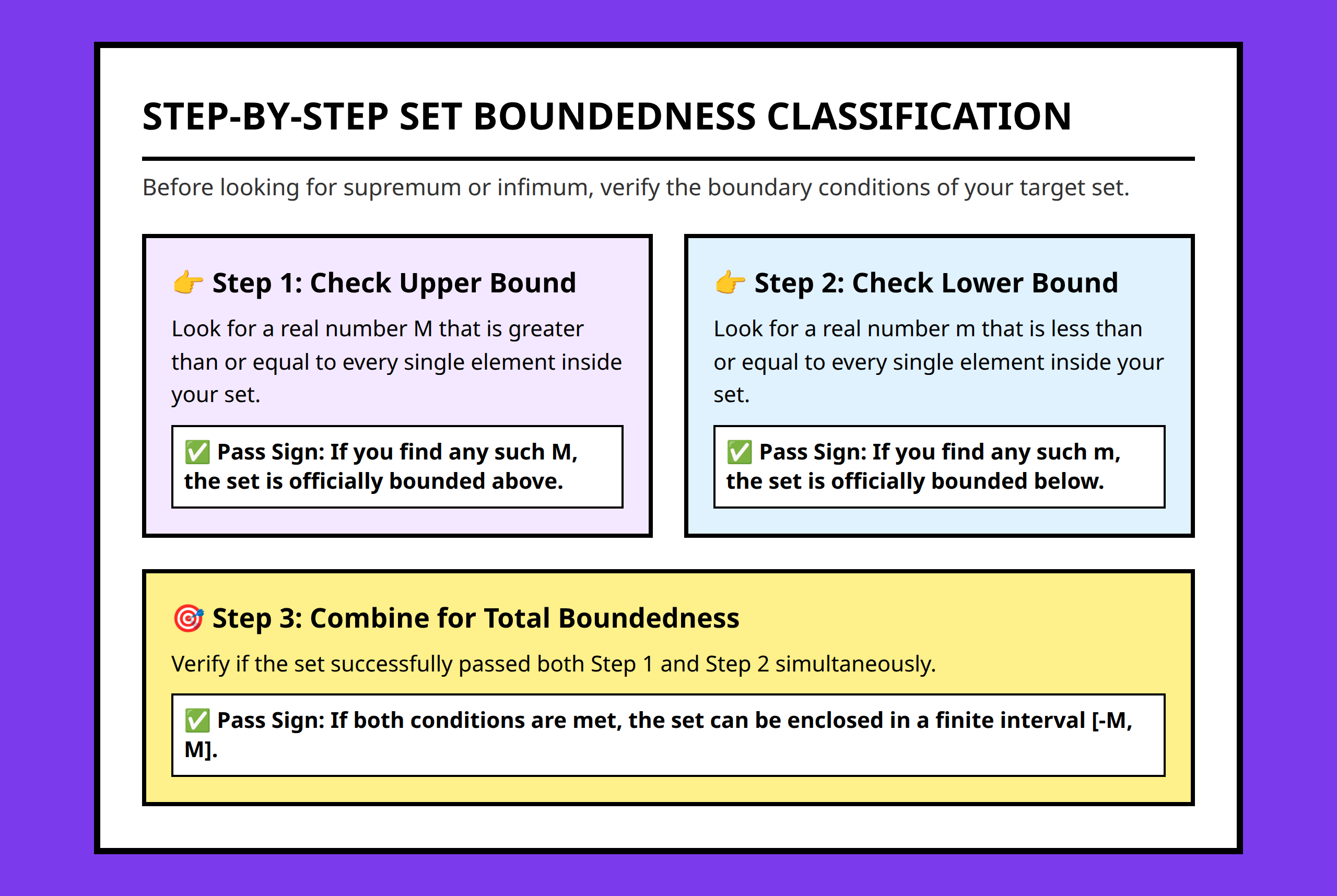
The idea of boundedness looks simple at first.
A set is bounded above if all its elements stay below some number. A set is bounded below if all its elements stay above some number.
But once boundedness enters the picture, I think the natural instinct is to ask:
Which bound matters most?
Suppose a student studies the interval:
(0,1)
The set clearly stays below 1 and above 0. So the set is bounded.
But something interesting happens immediately: the set has no maximum and no minimum.
That feels strange at first because the boundaries look obvious visually.
The problem is that neither endpoint belongs to the set itself.
This is exactly the kind of situation where supremum and infimum become necessary.
Maximum and Minimum Depend on Membership
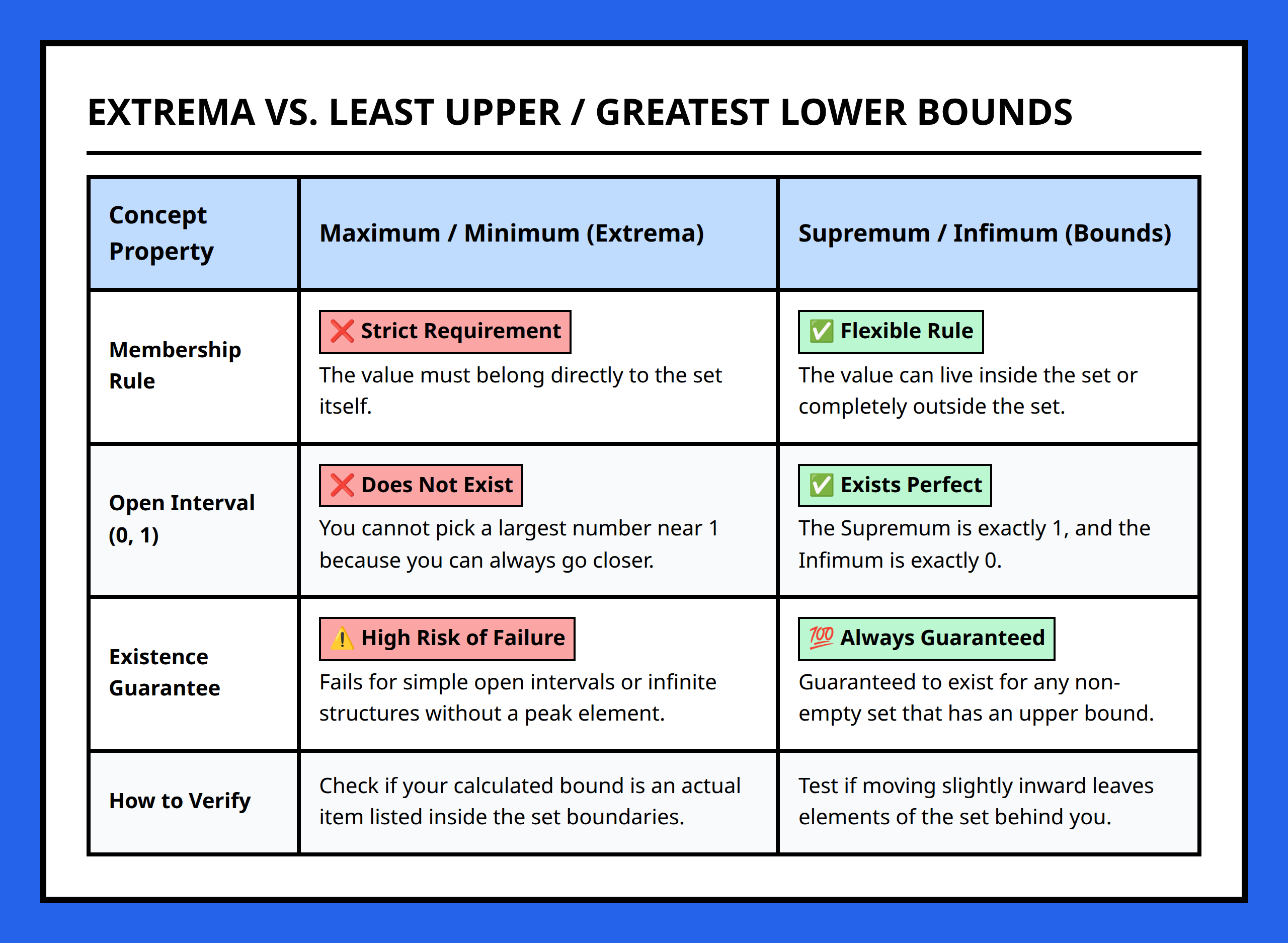
A maximum must actually belong to the set.
That detail matters much more than students initially expect.
For the interval:
(0,1)
the number 1 acts like an upper edge, but it is excluded from the set. No element inside the interval becomes the true largest value.
I think this is one of the first moments where real analysis forces you to separate intuition from formal structure.
The boundary may feel visually present, but analysis asks a stricter question:
Does the value actually belong to the set?
If not, it cannot be the maximum.
The same logic applies to minimum values and lower boundaries.
This distinction looks technical at first, but it becomes foundational later in convergence and limit arguments.
Supremum Captures the Boundary Even When the Maximum Fails
The supremum solves the problem differently.
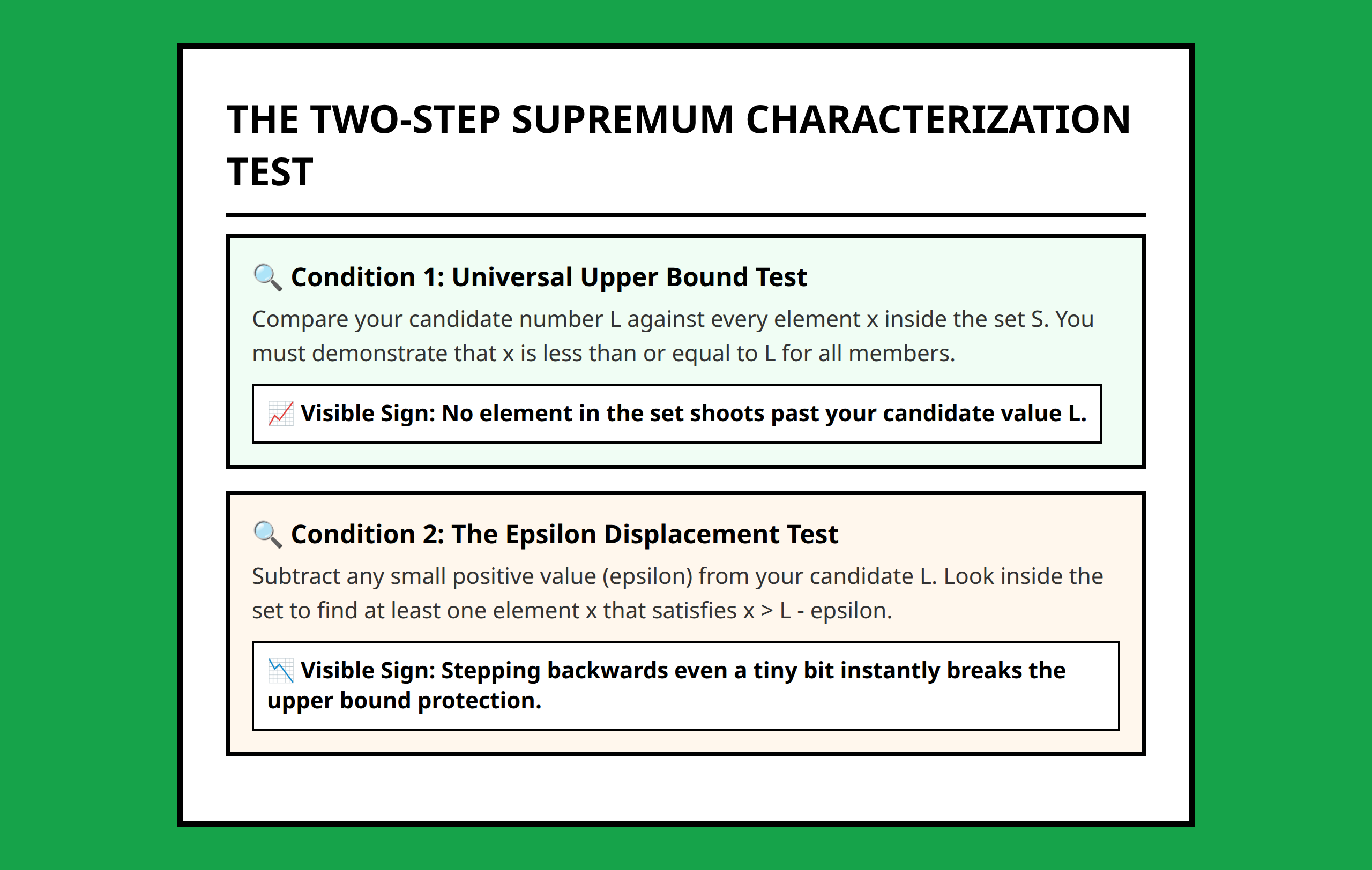
Instead of asking for the largest element inside the set, the supremum asks for the least upper bound.
That wording is extremely important.
An upper bound is any number larger than or equal to every element of the set. But many upper bounds may exist. The supremum is the smallest one that still works.
For:
(0,1)
the supremum is 1 even though 1 does not belong to the interval.
I think this is where the conceptual shift finally becomes visible. Analysis is not only describing what a set contains. It is describing the sharpest possible boundary that controls the set.
The supremum behaves like a limiting wall.
Elements can approach it arbitrarily closely without necessarily reaching it.
Infimum Plays the Same Role From Below
The infimum works symmetrically.
It is the greatest lower bound rather than the smallest element.
For the interval:
(0,1)
the infimum is 0 even though 0 itself is excluded.
I used to see supremum and infimum as separate vocabulary terms to memorize. Later I realized they express the same structural idea from opposite directions:
- supremum controls behavior from above
- infimum controls behavior from below
That symmetry becomes extremely useful once sequences and convergence enter the picture.
Least Upper Bounds Explain Why Completeness Matters
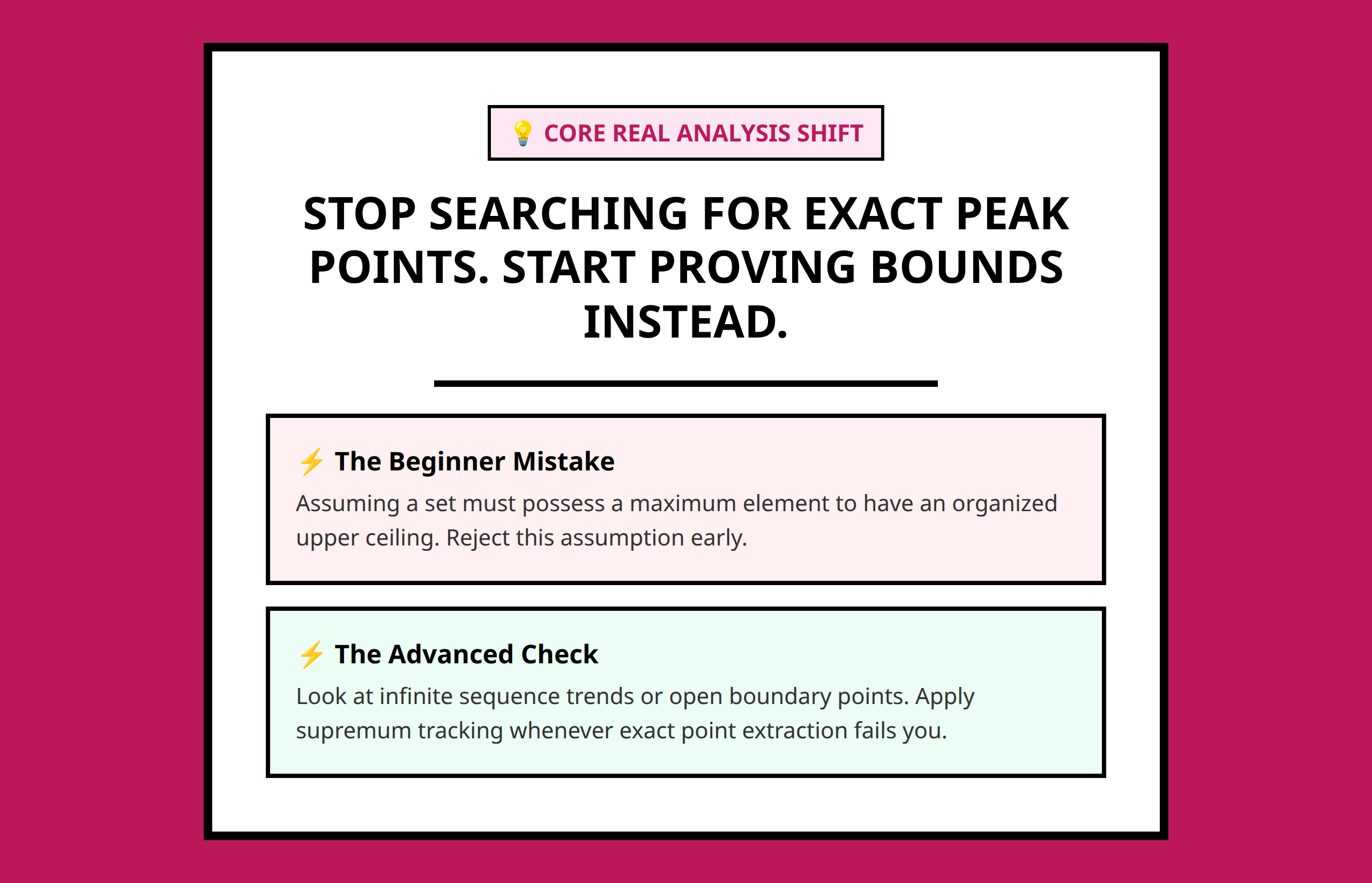
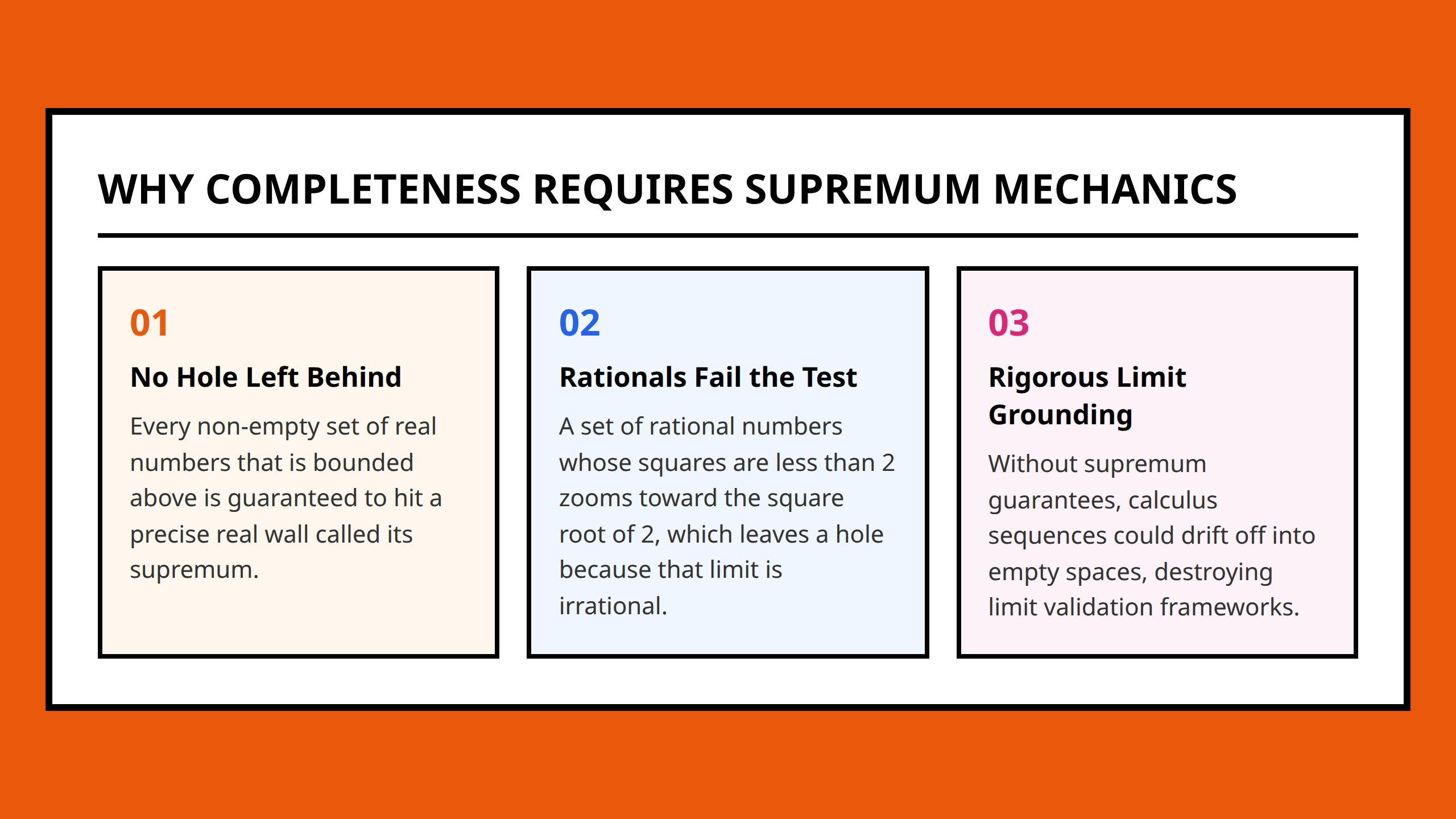
One reason supremum becomes so central in analysis is that the real numbers guarantee least upper bounds for bounded sets.
I think this property quietly supports a huge amount of convergence theory.
Suppose you have an increasing sequence trapped above by some upper bound. The sequence keeps climbing but cannot escape indefinitely.
What value does it approach?
The supremum provides the natural candidate.
This is why monotone bounded sequences converge so naturally in real analysis.
The least upper bound acts like the destination created by the structure of the real number system itself.
A practical analogy helps here. Imagine a parking garage with a height barrier. A delivery truck can keep moving upward level by level, but eventually the structure imposes a final accessible ceiling. Even if the truck never physically touches the ceiling, the upper restriction still controls the movement.
That is very close to how supremum functions mathematically.
Supremum and Infimum Make Open-Ended Behavior Precise
I think many students initially expect mathematics to focus only on exact values that exist directly.
Real analysis behaves differently.
It often studies limiting behavior, approximation, and arbitrarily close access to boundaries.
Supremum and infimum allow analysis to describe those situations rigorously.
Without them, many important sets would feel incomplete or awkward to analyze.
For example, sequences approaching irrational numbers, intervals missing endpoints, or sets defined through inequalities all depend heavily on least upper bound reasoning.
The framework remains stable because supremum and infimum describe boundaries even when direct extrema fail.
The Important Shift Is Conceptual, Not Computational
I think this topic becomes difficult because students search for a calculation trick when the real change is philosophical.
Maximum and minimum focus on possession.
Supremum and infimum focus on control.
That difference changes how you think about sets, limits, and convergence.
Instead of asking only:
“What values are inside the set?”
analysis begins asking:
- What constrains the set?
- What boundary can elements approach indefinitely?
- How sharp can the upper or lower control become?
Once those questions become natural, supremum and infimum stop looking like abstract terminology from early analysis chapters.
They start looking like the language needed to describe mathematical behavior that remains structured even when exact extrema disappear.
References:
- https://www.youtube.com/watch?v=QRGIhqz9vh4
- https://www.youtube.com/watch?v=o0TksrG5OsY
- https://www.youtube.com/watch?v=jObrBquKI5U
- https://www.youtube.com/watch?v=iVzvT4g5wOg
- https://math.stackexchange.com/questions/1827939/supremum-infimum-max-and-min-assistance-understanding-the-difference
- https://math.stackexchange.com/a/1827988
- https://math.stackexchange.com/questions/1719659/what-is-the-difference-between-a-supremum-and-maximum-and-also-between-the-infi
- https://math.stackexchange.com/questions/18605/max-and-min-versus-sup-and-inf
- https://en.wikipedia.org/wiki/Infimum_and_supremum
- https://www.math.ucdavis.edu/~hunter/m125b/ch2.pdf
- https://www.reddit.com/r/learnmath/comments/7v8mz2/university_maths_what_is_the_difference_between_a/
- https://www.reddit.com/r/askmath/comments/1f1m79q/hi_can_someone_comprehensively_explain_to_me_the/
- https://www.reddit.com/r/maths/comments/cklon5/i_dont_understand_infimum_and_supremum/
- https://www.math.purdue.edu/academic/files/courses/2007fall/MA301/MA301Ch6.pdf
- https://www.scribd.com/document/975656047/ROB-501-2018-02-Induction
- https://www.quora.com/Real-Analysis-What-is-the-difference-between-minimum-and-infimum
- https://www.expii.com/t/extension-infimum-and-supremum-446