
Android inherited Linux’s traditional permission system, but mobile devices exposed weaknesses that were easier to ignore on desktop systems. Once attackers started targeting Android at scale, problems around root access, weak isolation, and permission misuse became impossible to treat as edge cases.
I think many developers first encounter Android security through permissions, app sandboxes, or SELinux logs. What often gets skipped is the uncomfortable middle step: understanding why the original Linux permission model stopped being enough once smartphones became permanent, connected personal devices.
That gap matters because Android did not abandon Linux permissions by accident. The older model still worked for many basic tasks. The real problem was that mobile systems created new kinds of risk where a single mistake, privilege escalation, or badly isolated process could compromise the entire device.
Takeaways
- Linux DAC permissions rely heavily on object ownership and trusted root behavior.
- Android originally used Linux UID isolation to sandbox apps, but that model had important limits.
- Privilege escalation attacks repeatedly showed how one compromised process could bypass the entire sandbox.
- Linux capabilities reduced some root risks but still lacked fine-grained isolation.
- SELinux became necessary because Android needed policy-based restrictions that DAC could not provide.
Linux permissions were designed around ownership and trust
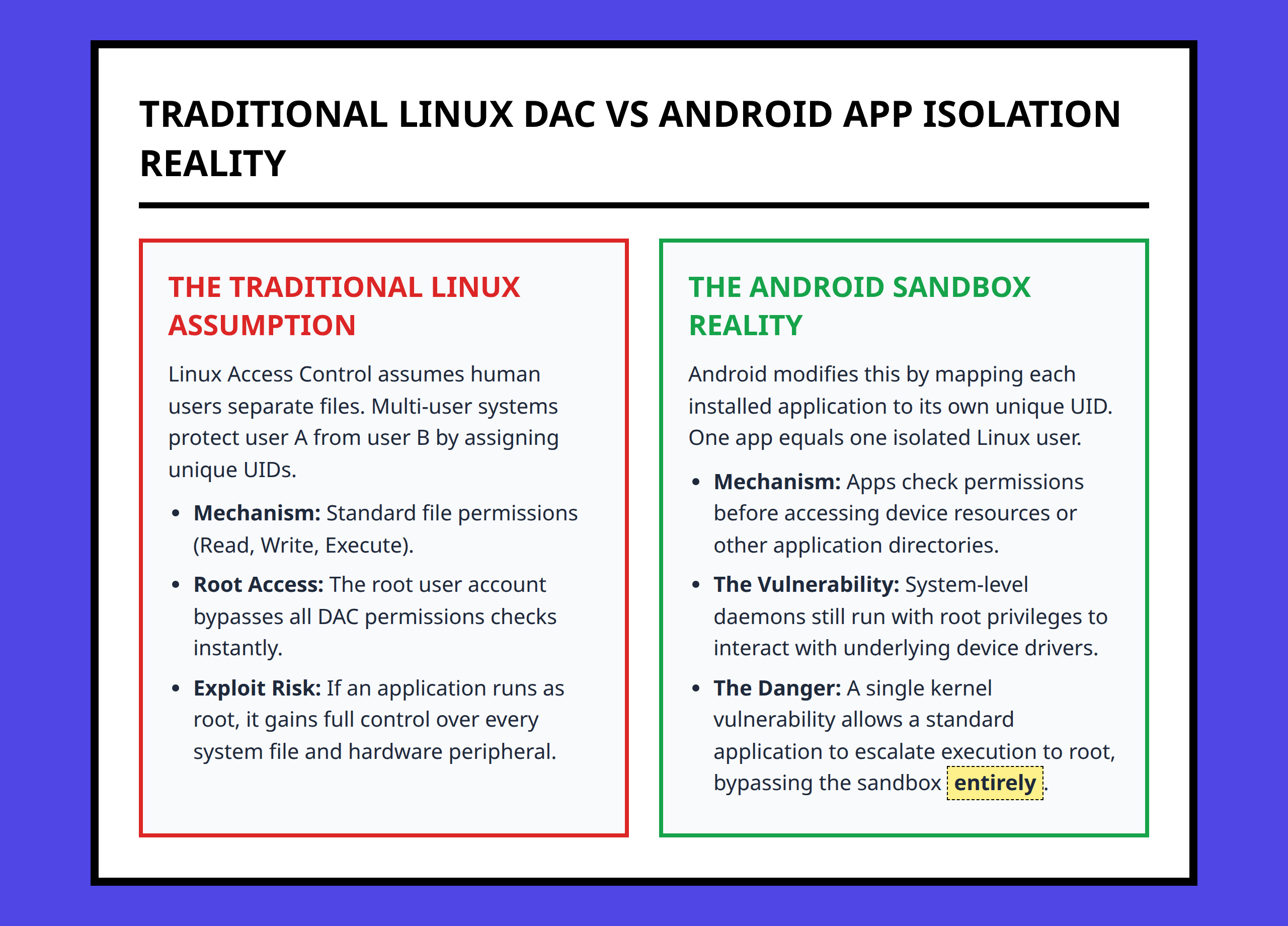
Android inherited Linux’s traditional Discretionary Access Control (DAC) system. DAC sounds technical, but the basic idea is simple: the owner of a file or object decides who can access it.
That system depends on three core pieces:
- User ownership
- Group ownership
- Permission bits like read, write, and execute
A file with permissions like rw-r--r-- allows the owner to read and write while everyone else can only read. Linux enforces those rules every time a process requests access through system calls such as open() or execve().
At first glance, this feels reasonable. A user owns their files, applications run under user accounts, and the operating system checks permissions before granting access.
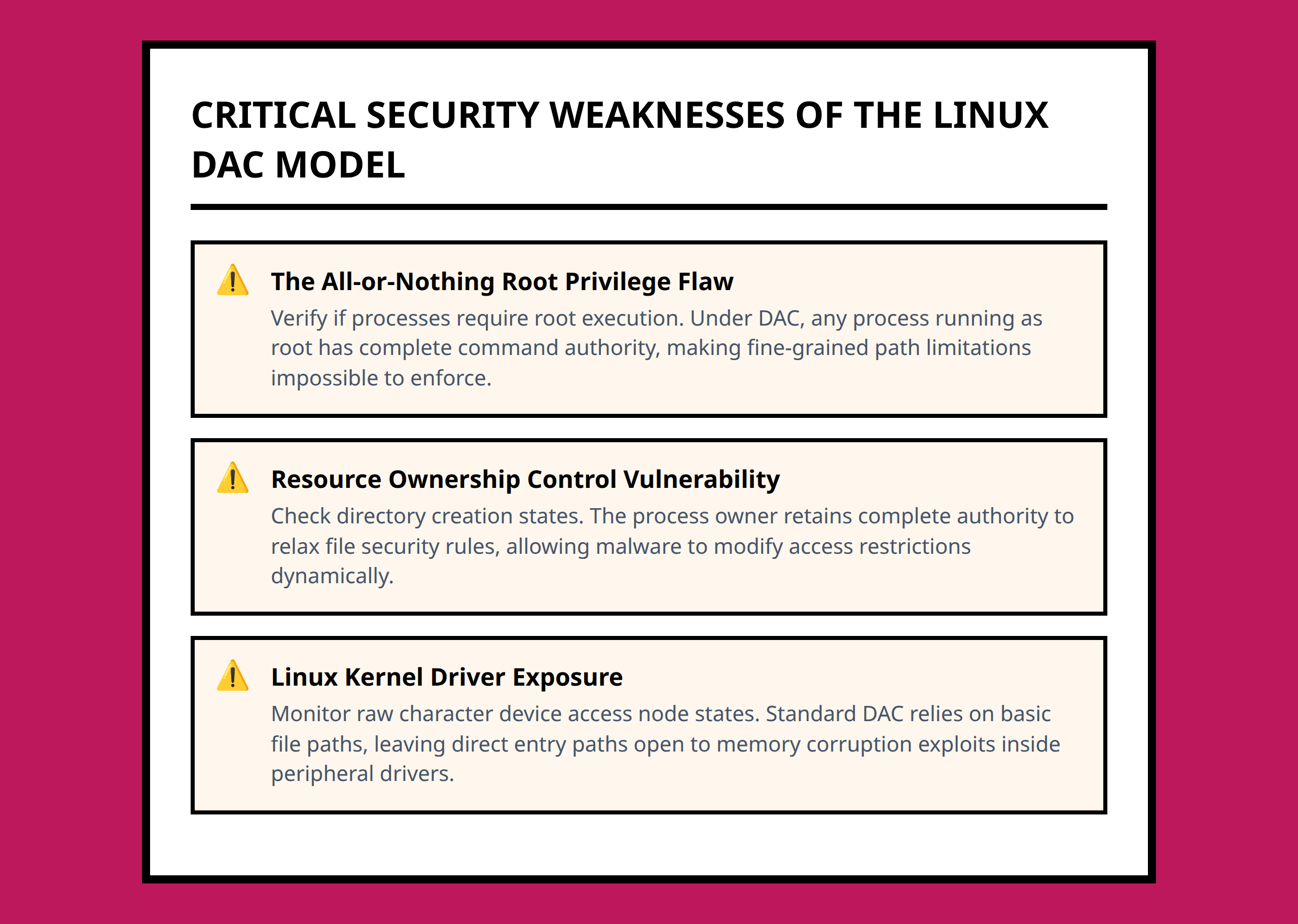
The problem is that DAC assumes the owner can be trusted to manage permissions safely.
That assumption becomes fragile on smartphones because applications constantly process outside input: messages, media files, network traffic, browser content, and downloaded apps. A small mistake in one process can quickly become a system-wide problem.
Android’s sandbox looked strong until attackers reached root
Android tried to strengthen isolation by giving each application its own UID. In practice, this meant apps could not directly access each other’s private files.
On paper, this was a smart use of Linux permissions.
If App A stored its data under its own UID, App B should not be able to read those files unless permissions were loosened intentionally.
I still think this was an elegant starting point for mobile isolation because it reused proven Linux behavior instead of inventing a completely new security model.
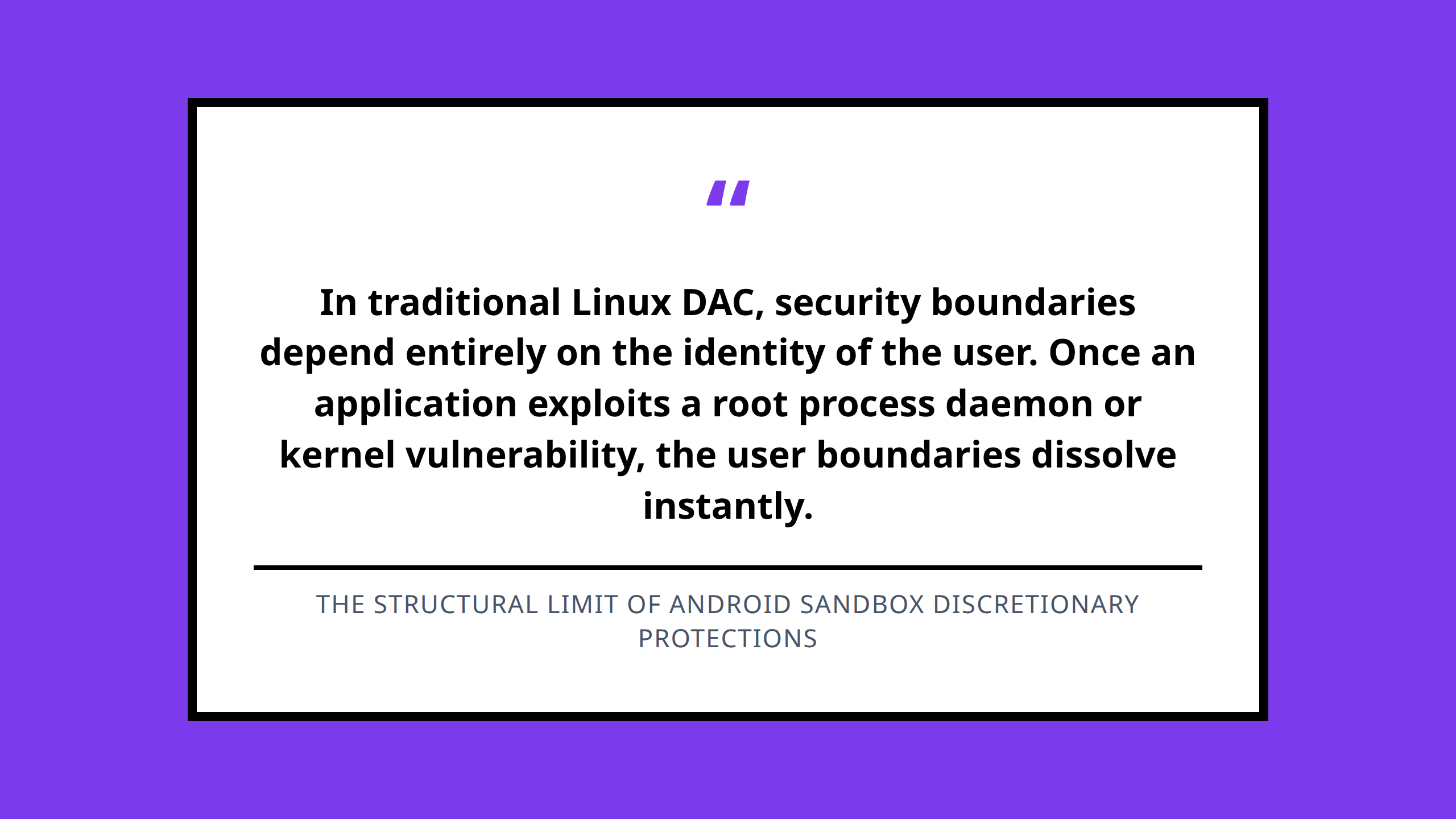
But the sandbox had a dangerous dependency: the entire system still trusted privileged processes.
Once an attacker gained root access, the sandbox effectively disappeared.
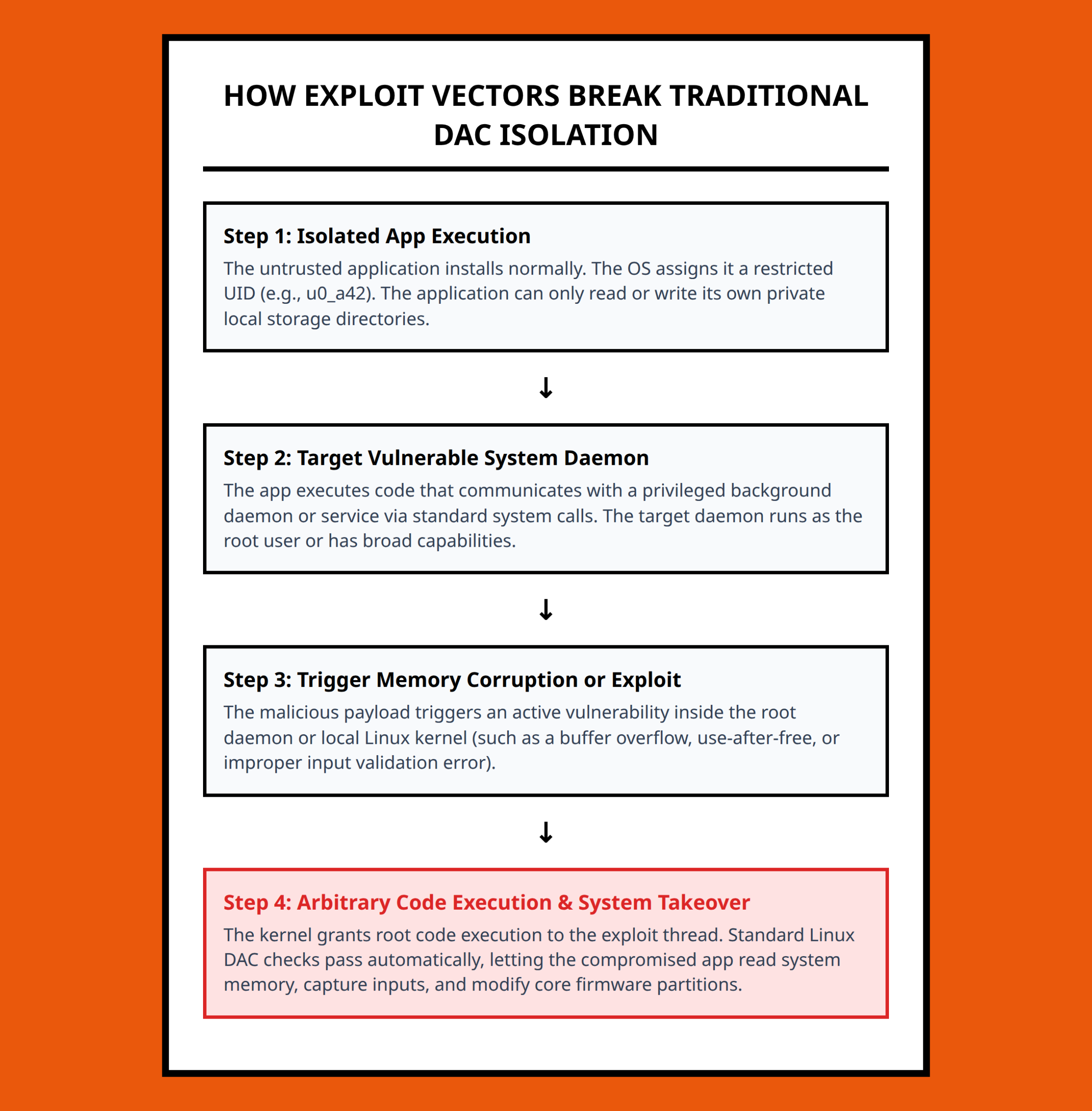
That mattered because Android devices included many privileged services running with elevated permissions. A vulnerability inside one of those services could become a shortcut around the entire application isolation model.
Imagine a modern phone where a vulnerable system daemon processes malformed input from an app. If the daemon runs as root and gets compromised, the attacker no longer needs to break individual app sandboxes. The attacker can simply bypass them.
That is the core weakness DAC struggled to solve.
The root user was too powerful for a mobile operating system
Traditional Linux systems rely heavily on the root user.
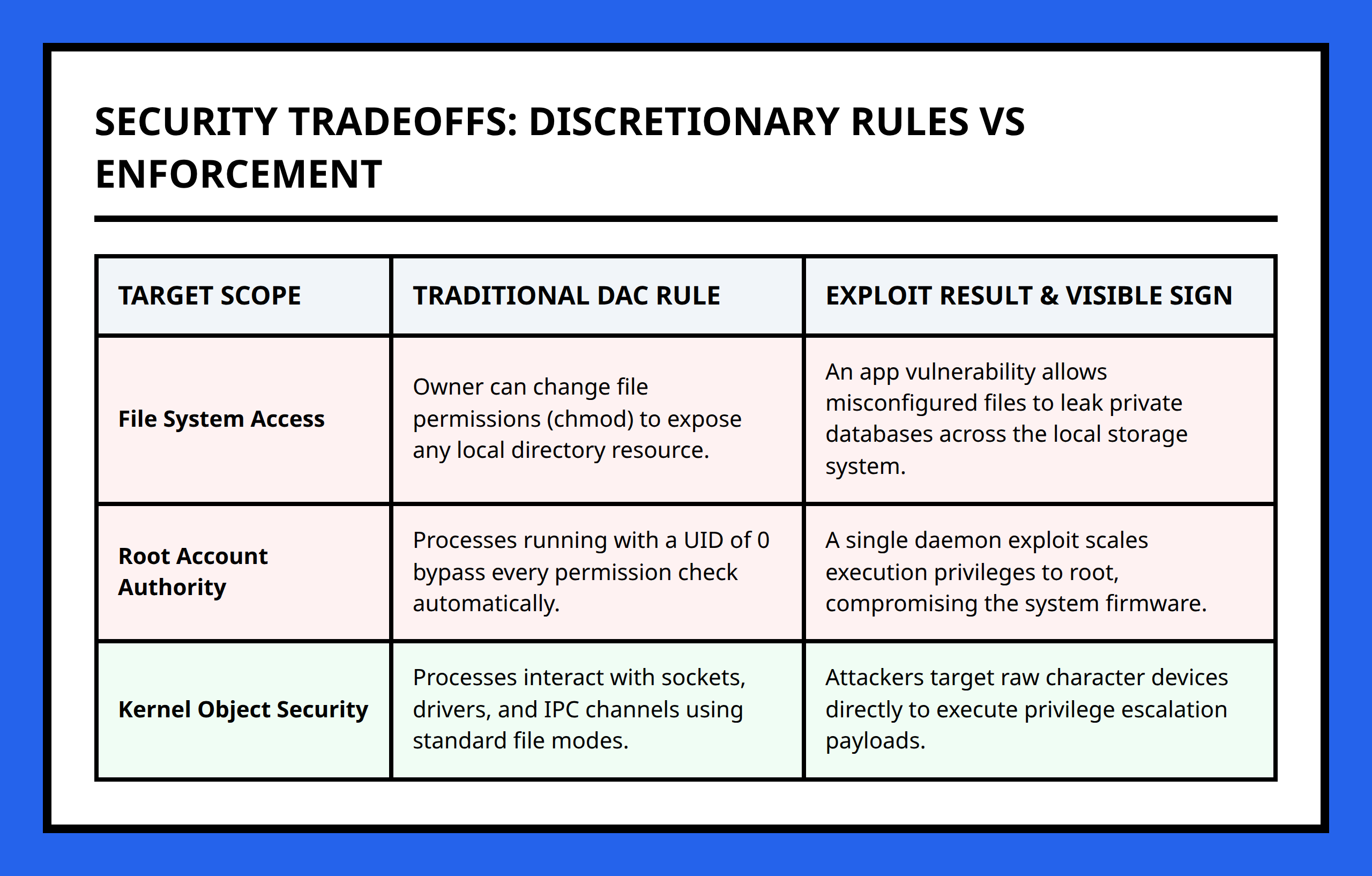
Root can change ownership, bypass permissions, access protected files, and control system behavior almost without restriction.
That level of authority was manageable on older systems where administrators actively controlled software installation and system usage. Smartphones changed the threat model completely.
Phones continuously run third-party applications, maintain permanent internet connectivity, and store personal communication, financial data, authentication tokens, and location history.
In that environment, a compromised root process becomes catastrophic.
The operating system tried to reduce this risk through the Linux capabilities model. Instead of giving a process unlimited root power, Linux could assign smaller subsets of privilege.
For example:
CAP_SYS_BOOTallows reboot-related operations.CAP_DAC_READ_SEARCHallows bypassing normal file permission checks.
The idea was to follow the principle of least privilege. A process should receive only the permissions required for its job.
That was a meaningful improvement, but the model still had a granularity problem.
A process with the wrong capability could still become dangerous if compromised. A daemon that only needed limited filesystem access could still expose sensitive information if attackers hijacked it.
I think this is where Android security hit an important wall. DAC and capabilities helped reduce accidental exposure, but they still trusted processes too broadly once privileges were granted.
Real Android exploits exposed the limits of DAC
Theoretical weaknesses become much harder to dismiss once attackers repeatedly exploit them in practice.
Several Android vulnerabilities demonstrated how fragile the original model could become.
The Skype vulnerability showed how dangerous bad permissions could be
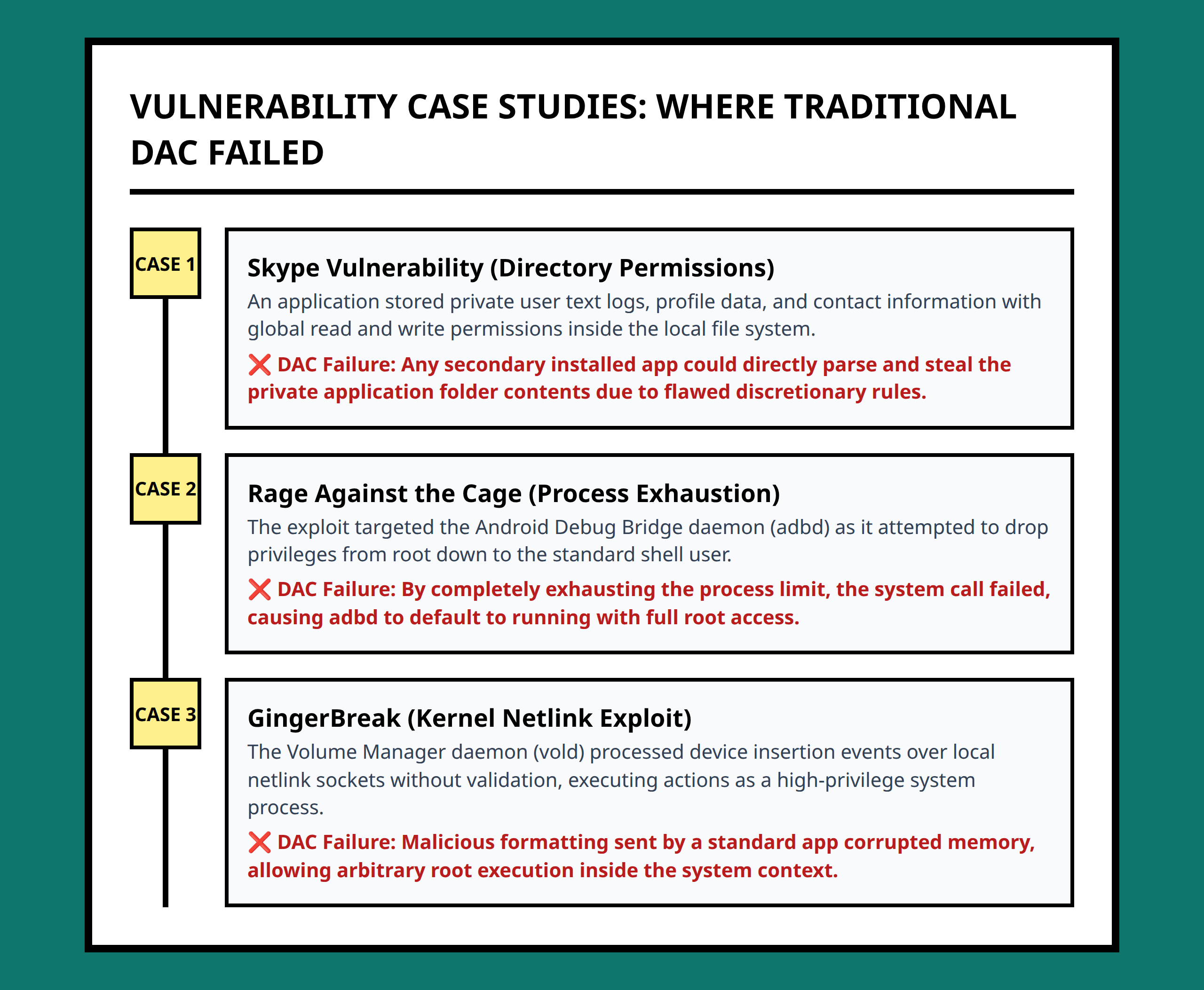
One Android Skype vulnerability exposed private data because a SQLite database became world-readable.
That database reportedly contained usernames, chat logs, and personal information.
The problem was not sophisticated kernel exploitation. The issue was simply that permissions became too open.
This is an important distinction.
DAC assumes object owners will configure permissions correctly. If an application accidentally exposes sensitive files through weak permissions, the operating system generally accepts that decision.
On a smartphone carrying years of personal communication, that assumption becomes risky very quickly.
GingerBreak showed how one daemon could collapse the sandbox
The GingerBreak exploit targeted Android’s vold daemon, which handled external storage management.
The daemon listened for messages through a NETLINK socket but reportedly failed to properly validate message sources.
Attackers could craft malicious input that triggered memory corruption and eventually arbitrary code execution.
The critical detail was not only the bug itself. The real issue was the privilege level involved.
Once the daemon was compromised, attackers gained root privileges. At that point, Android’s application isolation no longer mattered.
This is exactly the kind of failure DAC struggled to contain.
Rage Against the Cage exploited process limits and privilege transitions
Another exploit, Rage Against the Cage, targeted the Android Debug Bridge daemon.
The attack abused process limits and timing behavior during privilege transitions. The daemon attempted to drop privileges from root to a lower-privileged shell user, but the transition could fail under certain conditions.
If attackers controlled the timing correctly, the daemon could remain running as root.
What stands out to me here is how small the underlying mistake was.
The exploit did not require bypassing every security layer individually. It only needed one weak privilege transition inside a trusted process.
That is a recurring pattern in DAC-heavy systems: once a trusted process fails, the blast radius becomes very large.
MotoChopper revealed another uncomfortable truth
The MotoChopper exploit targeted a Qualcomm video driver vulnerability related to memory mapping.
In this case, attackers reportedly gained access to kernel address space and modified credential structures directly.
This exploit highlighted something important: not every problem was caused by DAC itself.
Some vulnerabilities existed lower in the stack, inside drivers or kernel components.
But DAC still had a containment problem.
Once attackers reached kernel-level control, the traditional permission model offered almost no meaningful resistance.
Android needed security policies that applications could not override
By the time these kinds of exploits became common, Android needed something stronger than owner-controlled permissions.
The operating system needed security rules that remained enforced even when processes behaved incorrectly, permissions were misconfigured, or applications became compromised.
That requirement pushed Android toward Mandatory Access Control (MAC) systems like SELinux.
The key shift was philosophical as much as technical.
DAC asks:
Does the owner allow this access?
MAC asks:
Should this access ever be allowed according to system policy?
I think that distinction explains why Android security evolved the way it did.
Modern smartphones cannot rely only on trusting applications, users, or privileged daemons to behave correctly forever. The system itself has to enforce boundaries even after something goes wrong.
That is the real breaking point where Android’s original Linux permission model stopped scaling against mobile threats.
- DAC (Discretionary Access Control): A permission system where object owners control who can access files or resources.
- UID: A User Identifier in Linux and Android. Android assigns separate UIDs to applications to isolate them.
- Root: The highest-privileged user account in Linux systems with near-unrestricted access.
- SELinux: A Linux security system that enforces policy-based access control rules beyond normal file permissions.
- MAC (Mandatory Access Control): A security model where centralized policies determine allowed access, even if object owners want different behavior.
- Capability: A smaller subset of root privileges assigned to processes in Linux.
- Daemon: A background system service that performs ongoing operating system tasks.
- System call: A request made by a program to the operating system kernel for services like file access or process execution.
- NETLINK socket: A Linux communication mechanism used between the kernel and user-space processes.
- Kernel: The core part of an operating system responsible for hardware access, memory management, and security enforcement.
References:
- https://arxiv.org/html/2601.00252v1
- https://www.linkedin.com/pulse/inside-android-fortress-disarming-runtime-permissions-santilli-ae8xf
- https://dl.acm.org/doi/fullHtml/10.1145/3448609
- https://www.researchgate.net/publication/260805408_Permission_Based_Android_Security_Issues_and_Countermeasures
- https://medium.com/@security.tecno/comprehensive-research-of-android-permission-mechanisms-09f89e6d75d8
- https://css.csail.mit.edu/6.5660/2024/readings/android-platform.pdf
- https://www.sidi.org.br/en/blog/android-security-models
- https://www.vogella.com/tutorials/AndroidPermissions/article.html
- https://www.linkedin.com/posts/laurie-kirk_how-android-security-works-in-a-nutshell-activity-7191904205572313088-HGwt
- https://www.kaspersky.com/resource-center/threats/android-mobile-threats
- https://www.researchgate.net/publication/378132995_Leaking_the_Privacy_of_Groups_and_More_Understanding_Privacy_Risks_of_Cross-App_Content_Sharing_in_Mobile_Ecosystem
- https://www.computer.org/csdl/magazine/sp/2024/06/10747397/21HRvaS8nqU
- https://www.cybersecurity-insiders.com/top-5-android-cyber-threats-of-2025-what-you-need-to-know/