
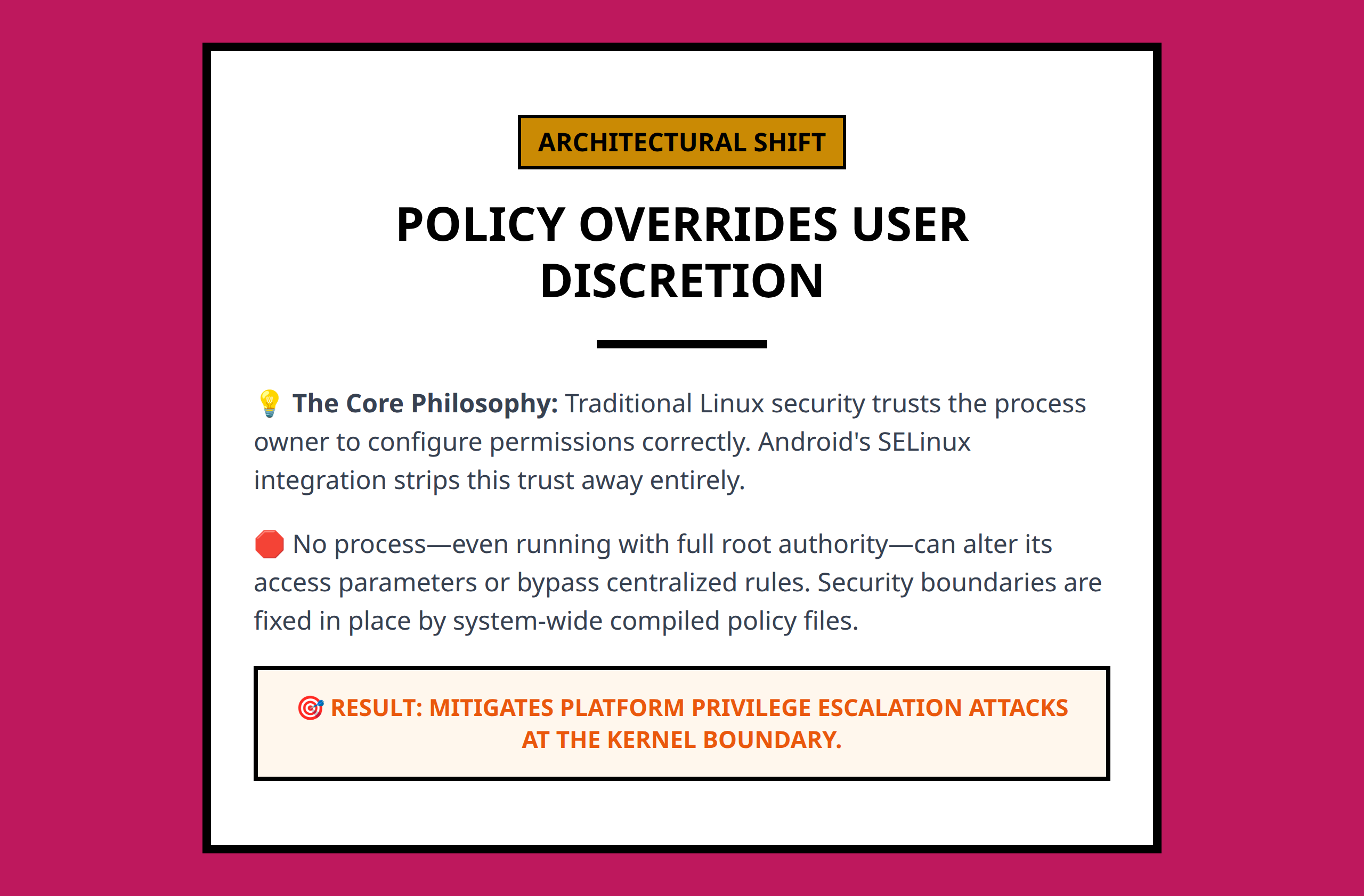
SELinux changed Android security by moving critical access decisions away from file owners and privileged processes and into a centralized policy system. That shift reduced the amount of trust the operating system placed in root access, application behavior, and human permission management.
When I first looked closely at SELinux, the most important realization was not about policies, labels, or kernel hooks. It was about trust. Traditional Linux permissions assume trusted behavior in many places. SELinux starts from a more suspicious assumption: even trusted processes can fail, become compromised, or behave incorrectly.
That change sounds subtle until you follow the consequences. Once Android devices became permanent internet-connected personal systems, relying mostly on owner-controlled permissions stopped being enough.
Takeaways
- Traditional Linux DAC permissions depend heavily on trusted ownership and root behavior.
- SELinux introduces Mandatory Access Control (MAC), where centralized policy determines allowed behavior.
- Android security moved toward SELinux because DAC alone could not reliably contain compromised privileged processes.
- SELinux works through policy enforcement, labels, and kernel-level security checks.
- The system can deny actions even when a process technically owns the target resource.
Traditional Linux permissions depend on trust in the owner
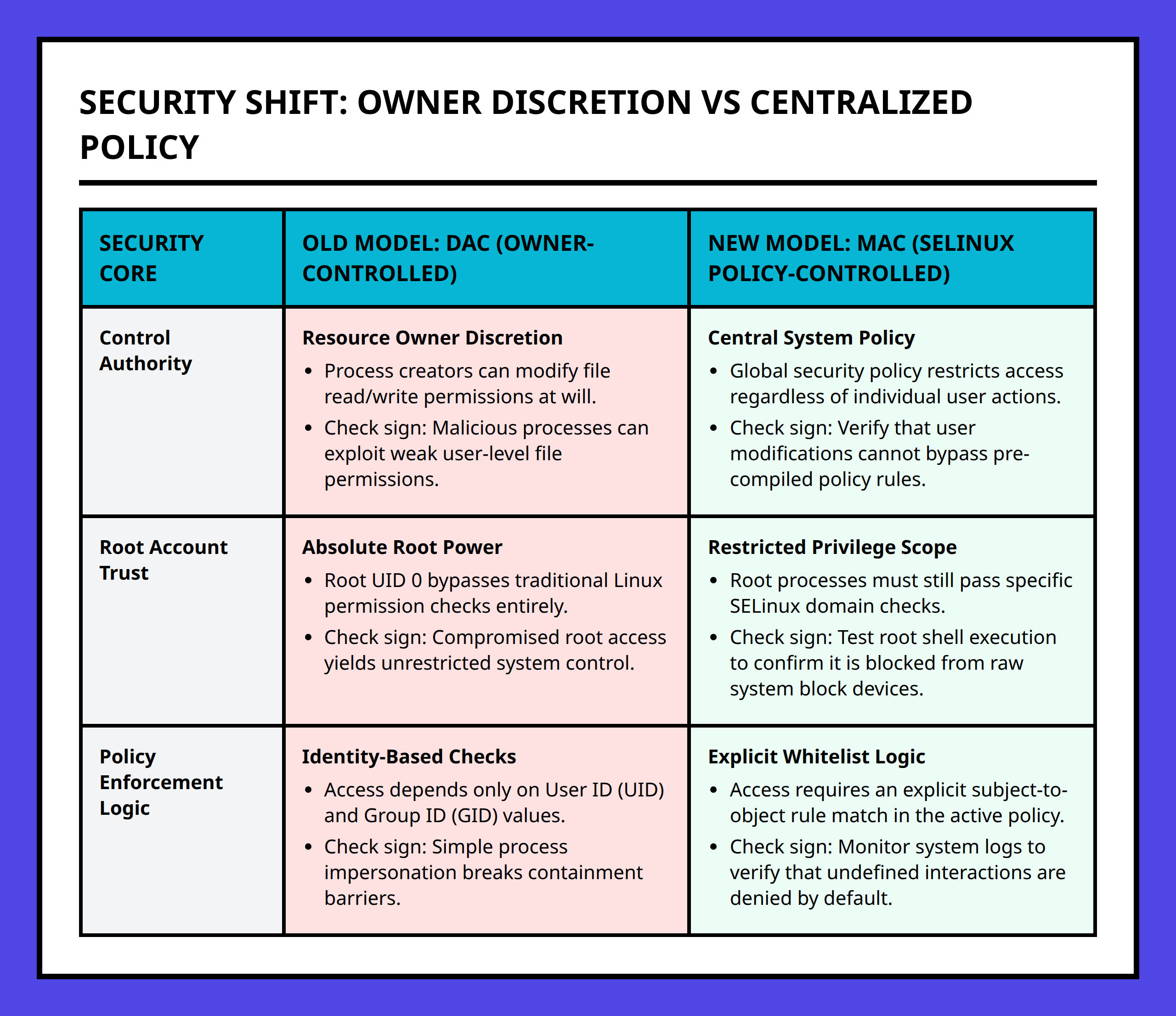
Linux originally relied on Discretionary Access Control (DAC). Under DAC, the owner of a file or object decides who gets access.
If a process owns a file, it can usually change permissions, grant access, or modify ownership depending on its privilege level. The system checks users, groups, and permission bits before granting access to resources.
That model works reasonably well for many traditional computing environments. A user creates files, controls access to those files, and trusted administrators manage the rest.
But Android introduced a very different environment.
Phones constantly run third-party applications, receive untrusted input from networks, process downloaded media, and maintain persistent connectivity. A compromised application or daemon is no longer a rare event that administrators can manually investigate later.
I think this is the point where DAC started showing structural weaknesses rather than occasional weaknesses.
The problem was not simply that applications could make mistakes. The larger issue was that the operating system still assumed owners and privileged processes would behave correctly most of the time.
SELinux changes the question the operating system asks
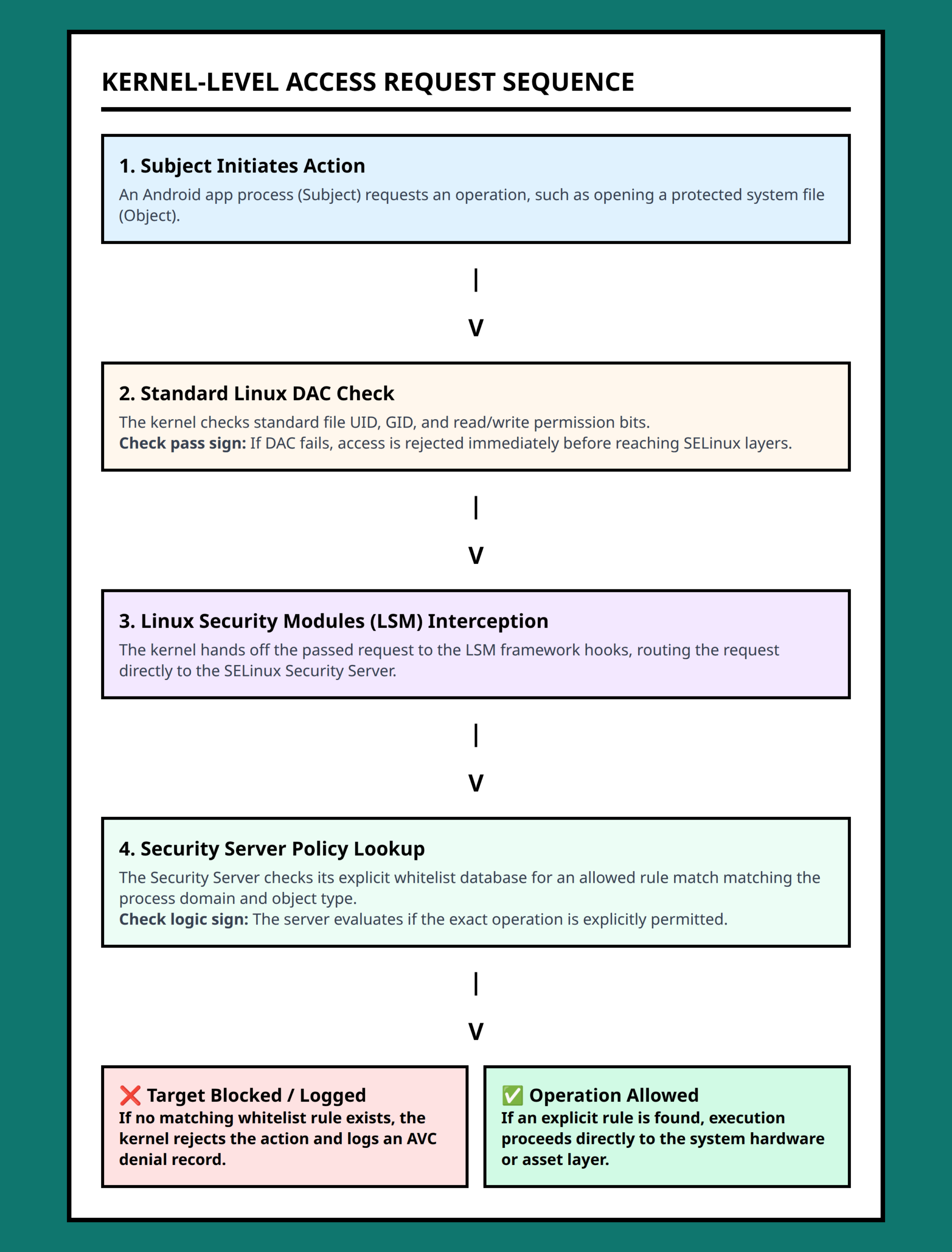
DAC systems usually ask something like this:
Does the owner allow this access?
SELinux changes the question completely:
Does system policy allow this access?
That difference matters because policy enforcement no longer depends mainly on ownership.
A process may technically own a file and still get blocked by SELinux policy. Even a privileged process may fail an access check if the centralized security rules forbid the operation.
This is the foundation of Mandatory Access Control (MAC).
In a MAC system, the operating system enforces security decisions independently from the preferences of individual users or processes.
I would describe this as Android moving from a “trust the process” model toward a “verify against policy” model.
That shift reduced the damage one compromised process could cause.
SELinux works beside DAC instead of replacing it
One detail that often confuses beginners is that SELinux does not completely remove Linux permissions.
DAC checks still happen.
SELinux operates alongside them.
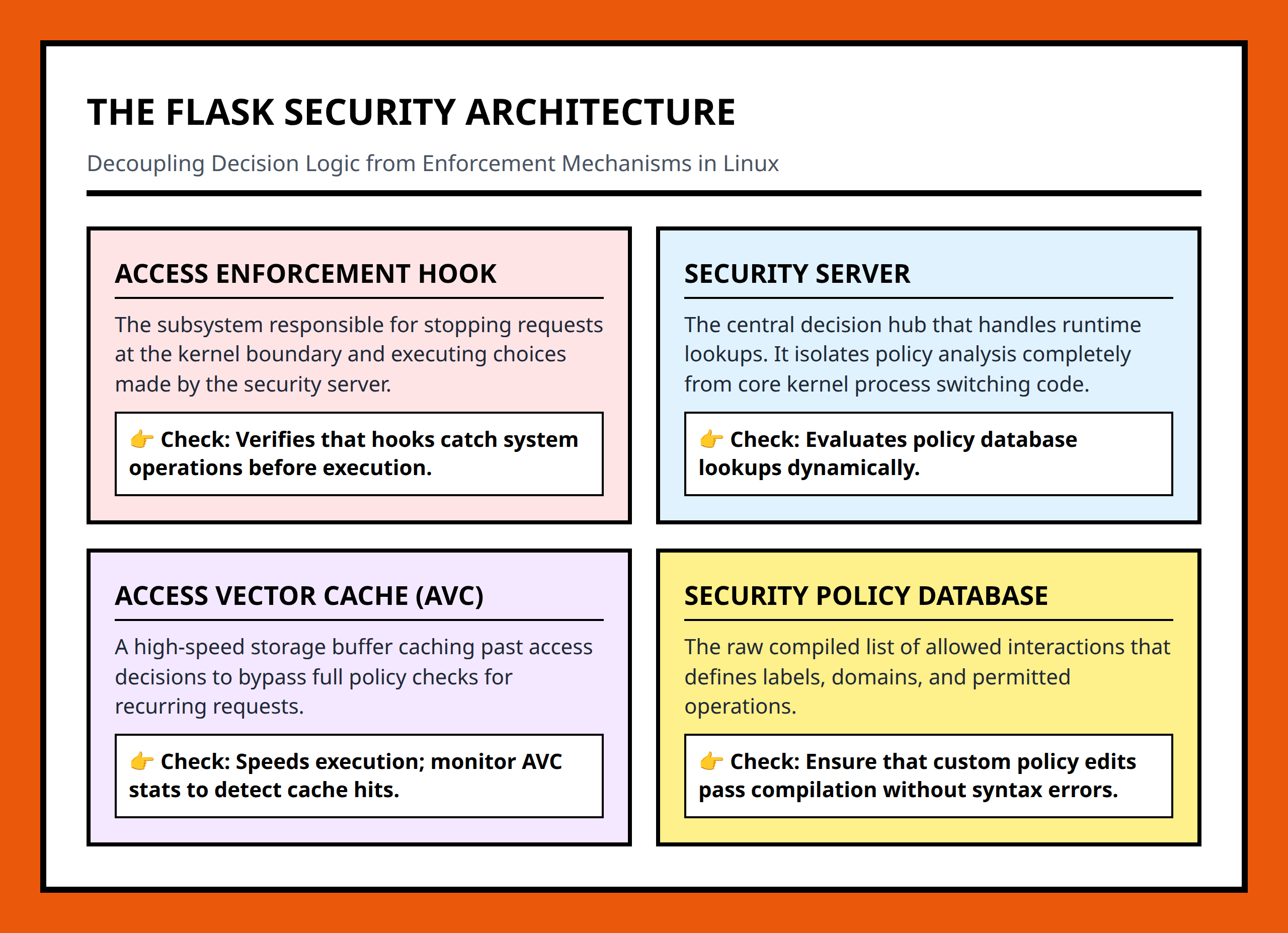
The Linux kernel first checks traditional DAC permissions. If DAC already denies the request, the process stops there. SELinux policy is not even consulted.
If DAC allows the operation, SELinux performs an additional policy validation step.
That sequencing is important because SELinux acts like a second security gate.
A file permission might technically allow access, but SELinux can still deny it based on policy rules.
I find this layered model more practical than many people initially expect. Android did not throw away decades of Linux permission behavior. Instead, it added another enforcement layer designed for modern threat models.
The Linux Security Module framework made SELinux possible
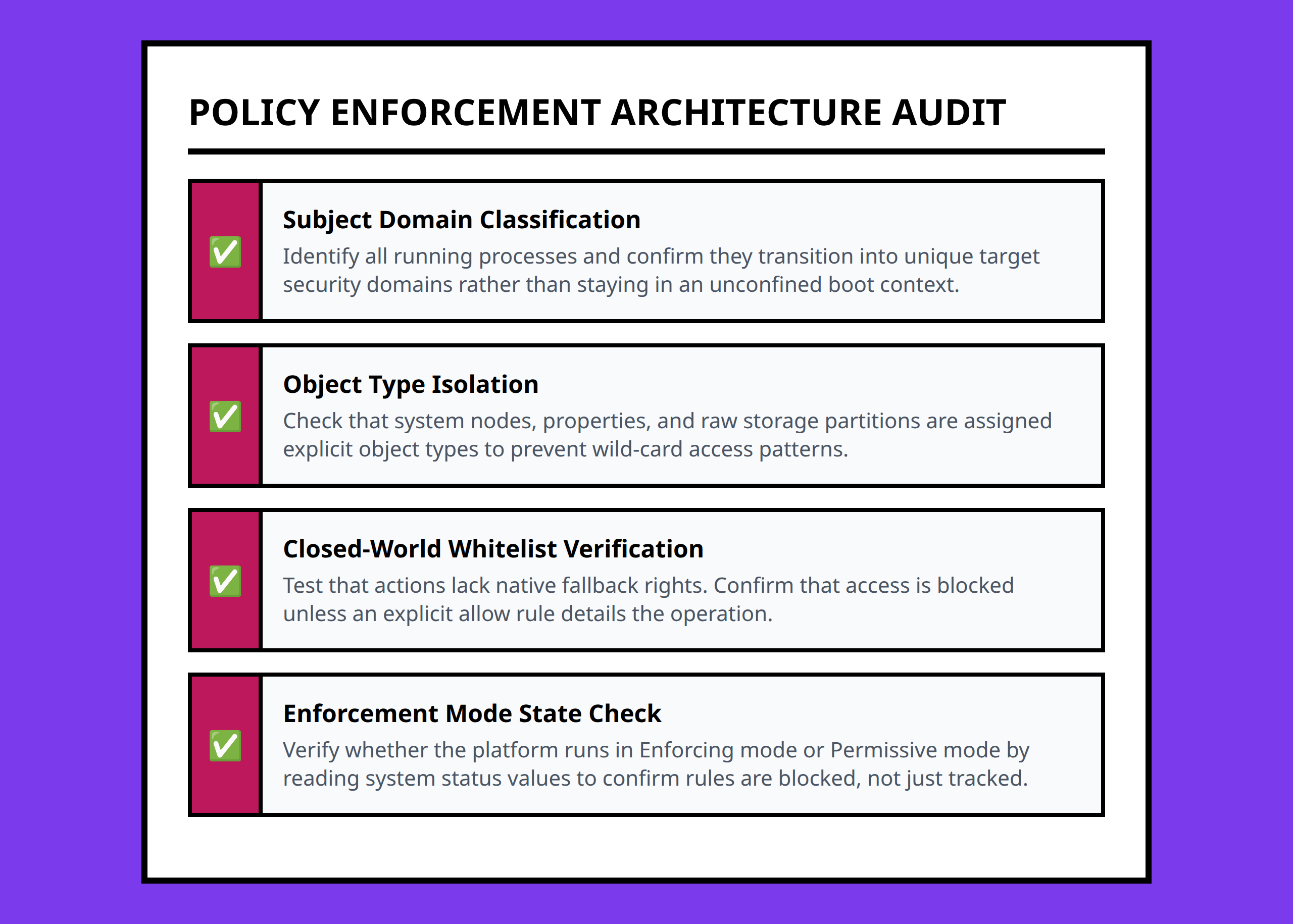
SELinux depends heavily on the Linux Security Module (LSM) framework.
LSM introduced security hooks inside the Linux kernel so additional security systems could participate in access decisions.
Without those hooks, SELinux would have required deeply rewriting large parts of the kernel.
Instead, the kernel exposes checkpoints where security providers can evaluate operations such as:
- Opening files
- Executing processes
- Accessing sockets
- Interacting with kernel resources
When SELinux is enabled, those hooks connect the kernel to SELinux policy enforcement logic.
I think this architecture is one reason SELinux became practical for large systems. The Linux kernel did not need to hardcode one security philosophy forever. The LSM framework allowed policy-driven enforcement to integrate into existing behavior.
That flexibility mattered for Android because Google needed stronger containment without abandoning the Linux foundation underneath the operating system.
SELinux treats processes as security subjects
One of the more important conceptual changes in SELinux is how it treats running processes.
Traditional discussions about permissions often focus heavily on users. SELinux shifts more attention toward the process itself.
A running process becomes a subject that attempts to interact with system objects.
Objects can include:
- Files
- Sockets
- Directories
- Devices
- Kernel resources
This matters because compromised processes become the real operational threat.
Imagine a media service processing malformed video input from a downloaded file. Even if the original user never intended malicious behavior, the compromised process may now attempt actions outside its normal role.
SELinux evaluates whether policy allows that process to interact with the target object in the requested way.
That is a much narrower trust model than simply asking whether the user technically owns the resource.
SELinux uses whitelist-style policy enforcement
SELinux follows a largely whitelist-oriented policy model.
In practical terms, this means access is not assumed automatically.
Policies explicitly define what kinds of interactions are allowed between subjects and objects.
This approach feels stricter because it is stricter.
A process does not simply inherit broad trust because it runs with elevated privileges.
That creates operational friction, especially for developers used to more permissive systems. But it also creates clearer containment boundaries.
I think this is where SELinux becomes easier to appreciate from a security perspective.
Many serious security incidents do not happen because systems lack permissions entirely. They happen because trusted components receive too much permission by default.
SELinux narrows those assumptions aggressively.
Root access stopped being enough
One of the most important implications of SELinux is psychological as much as technical.
On older Linux systems, root often represented near-unlimited authority.
SELinux weakens that assumption.
A privileged process can still face policy restrictions. Root access alone does not automatically bypass every security boundary anymore.
That is a major shift in operating system philosophy.
I think Android needed exactly this kind of change because smartphones created unusually high-value attack surfaces. Devices now store authentication tokens, payment data, personal conversations, work credentials, and location history all at once.
Under those conditions, assuming privileged processes will always behave correctly becomes too dangerous.
SELinux effectively acknowledges that reality by enforcing policy even after privilege escalation occurs.
The important point is not that SELinux makes Android invulnerable. The real value is that the operating system no longer places unlimited trust in ownership and privilege alone.
- DAC (Discretionary Access Control): A permission system where owners decide who can access files and resources.
- MAC (Mandatory Access Control): A security model where centralized policies control access decisions independently of resource owners.
- SELinux: A Linux security system that adds policy-based access controls on top of traditional permissions.
- LSM (Linux Security Module): A Linux kernel framework that allows security systems like SELinux to participate in access control decisions.
- Subject: In SELinux, a running process that requests access to a resource.
- Object: A protected resource such as a file, socket, or device that a subject attempts to access.
- Whitelist policy: A security model where actions must be explicitly allowed instead of automatically permitted.
- Kernel: The core part of an operating system responsible for hardware access, process management, and security enforcement.
- Privilege escalation: A situation where an attacker gains higher system permissions than originally intended.
References:
- https://www.scribd.com/presentation/660524889/3-MODULE-2-PART-1-19-05-2023
- https://www.redbooks.ibm.com/redbooks/pdfs/sg248568.pdf
- https://samirpaulb.github.io/posts/operating-system/
- https://www.studocu.com/in/document/anna-university/computer-science-and-engineering/cp25c03-aos-advanced-process-thread-management-in-operating-systems/145374784
- https://core.trac.wordpress.org/report/60
- https://www.scribd.com/document/1031041250/Cybersecurity-Topper-Notes
- https://es.scribd.com/document/701895595/spclNotess
- https://www.suse.com/c/what-is-selinux/
- https://pathlock.com/blog/role-based-access-control-rbac/
- https://www.microsoft.com/en-in/security/business/security-101/what-is-access-control