
Many students treat convergence like a collection of formulas to memorize. The real structure is much more practical: bounds, inequalities, monotonic behavior, and Cauchy logic work together like a diagnostic system for understanding whether a sequence settles down or falls apart.
I used to notice that students could often compute limits correctly while still having no clear idea why a sequence converged. They would recognize patterns, apply a rule mechanically, and move on. Then a slightly unfamiliar problem appeared, and the whole process broke down.
What changed my perspective was realizing that convergence in real analysis is not built from tricks. It is built from structure. A sequence is examined from several angles at once: whether it stays bounded, whether it moves consistently in one direction, whether its terms become close to each other, and whether subsequences reveal hidden instability.
Once I started looking at convergence this way, many disconnected-looking rules began to fit together naturally.
Convergence Starts With Behavior, Not Formulas
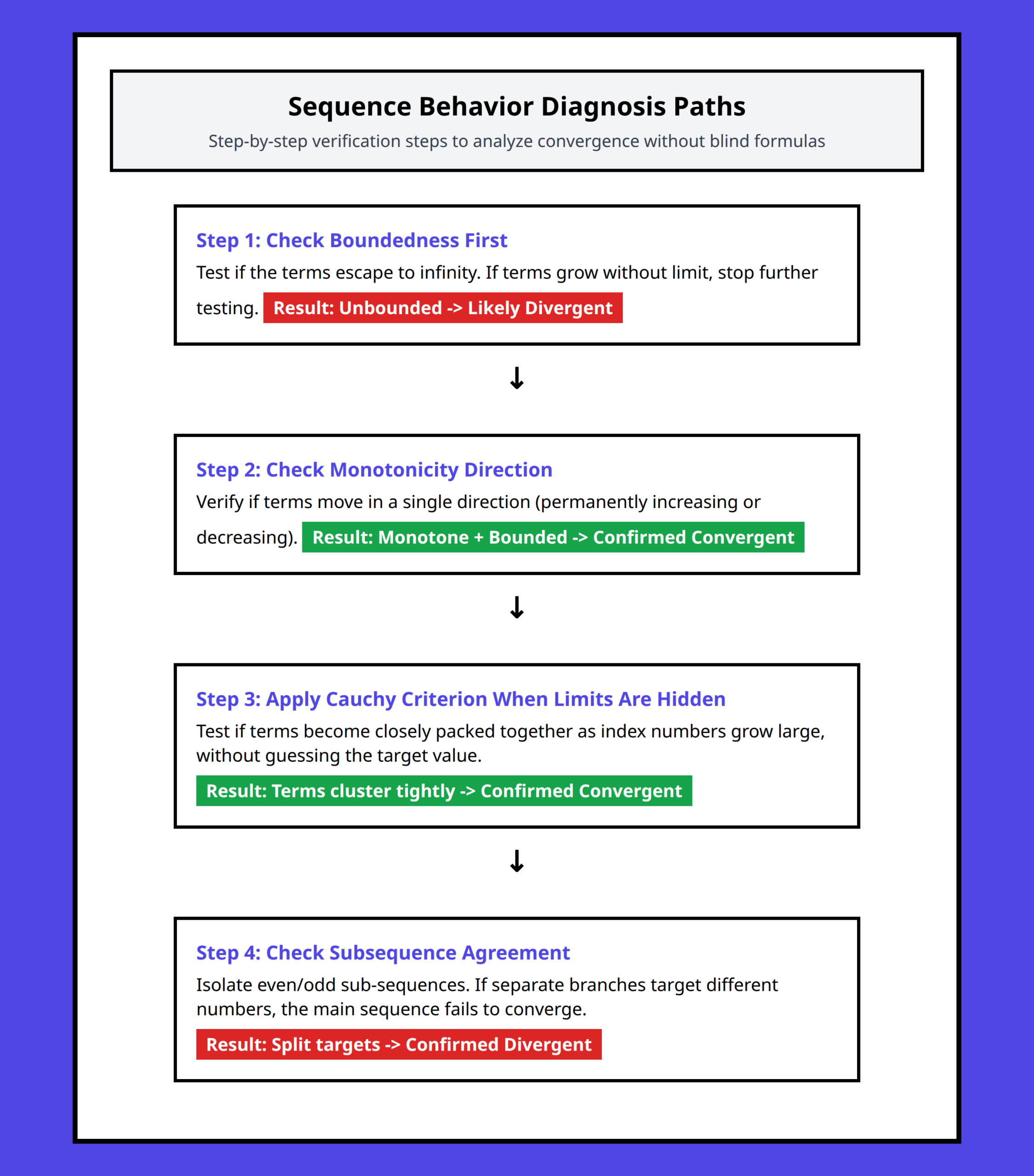
A sequence is simply an ordered list of numbers indexed by natural numbers. That sounds harmless at first, but the important question is behavioral: what happens to the terms as the index grows larger and larger?
Some sequences clearly stabilize. Others explode toward infinity. Others oscillate forever without settling. The key point is that convergence is about long-term behavior, not about the appearance of the formula itself.
Take these two common situations:
u_n = 1/nu_n = (-1)^n
The first sequence shrinks toward zero. The second alternates forever between 1 and -1. A student who memorizes only algebraic limit rules often sees these as unrelated examples. But structurally, they are very different systems.
The first sequence becomes compressed into a smaller and smaller region around a single value. The second never settles inside one stable neighborhood.
That distinction matters much more than the formulas themselves.
Boundedness Is Usually the First Thing Worth Checking
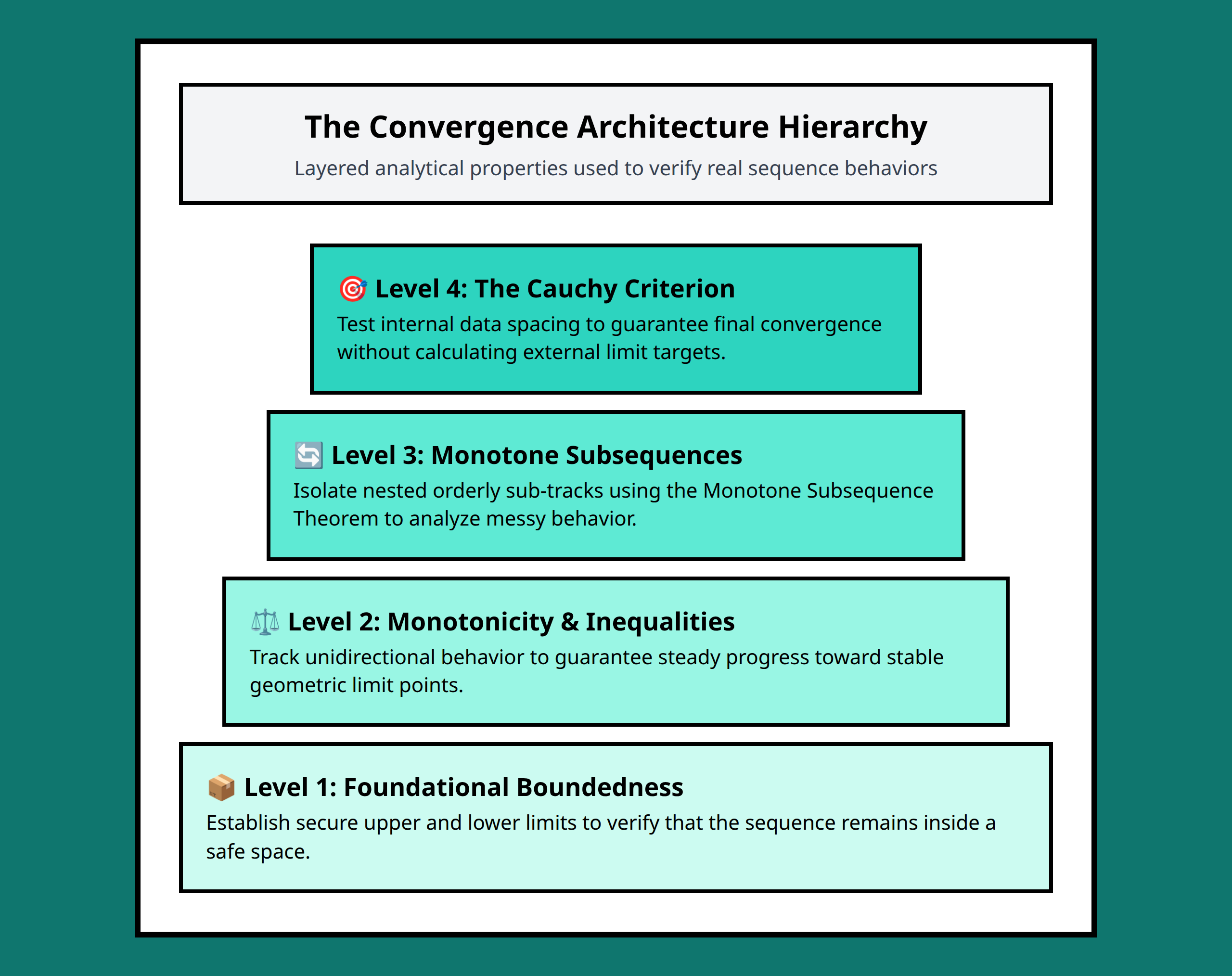
One of the most useful habits in sequence analysis is checking whether the sequence is bounded.
A bounded sequence stays inside some numerical interval. It does not run away infinitely in either direction.
I would check this early because boundedness acts like a stability filter. A sequence that grows without bound cannot converge to a finite real number. That immediately removes many possibilities.
For example, imagine a student studying the sequence:
u_n = n/(n+1)
Even before computing a limit, there is something important to notice: every term stays between 0 and 1.
That observation changes the way you think about the sequence. You stop worrying about explosive growth and begin asking a narrower question: does the sequence compress toward a specific value inside that interval?
This is where convergence starts feeling less mysterious. Bounds create control.
In practical terms, this is similar to diagnosing a system in engineering or software monitoring. If a metric remains inside a stable operating range, you investigate refinement and stabilization. If the metric shoots upward uncontrollably, you investigate failure.
The mathematical logic is surprisingly similar.
Monotone Sequences Reveal Direction
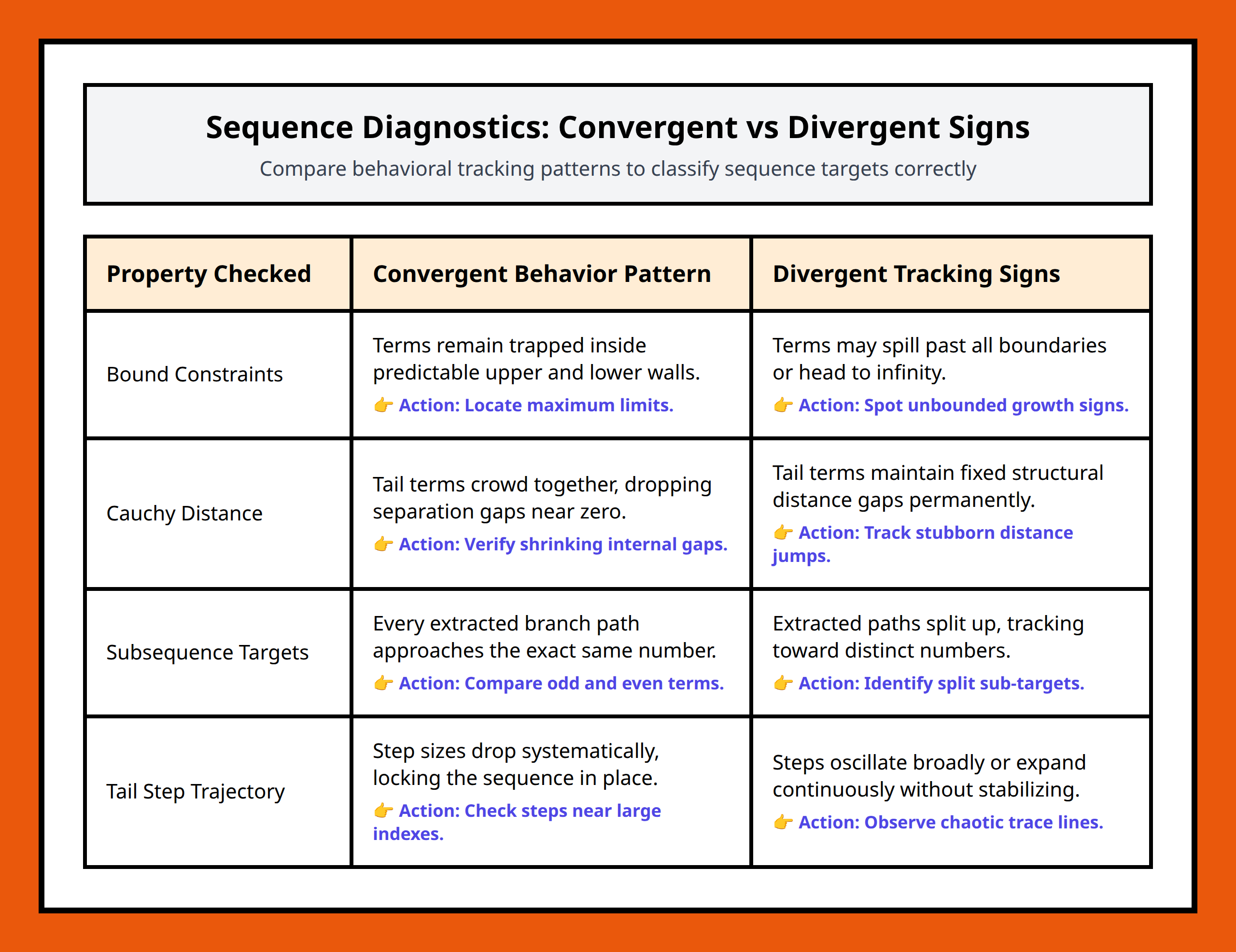
Boundedness alone is not enough.
A sequence can stay bounded forever and still fail to converge. The classic example is a sequence that oscillates endlessly between values.
This is why monotonicity matters.
A monotone sequence consistently moves in one direction. It is either increasing or decreasing.
When boundedness and monotonicity appear together, convergence becomes much easier to understand logically.
An increasing sequence that also has an upper bound cannot keep rising forever. At some point it is forced into compression near a limiting value.
I think this is one of the most important conceptual shifts in early analysis. Convergence is not magic. It often comes from restrictions interacting with movement.
The sequence is trying to move upward, but the bound prevents escape. The result is stabilization.
A simple everyday analogy helps here. Imagine slowly filling a container with water while the container has a fixed height. The water level can continue rising, but only within a confined range. Eventually the remaining upward movement becomes smaller and smaller.
That is very close to the logic behind monotone bounded convergence.
Inequalities Are the Hidden Infrastructure of Convergence
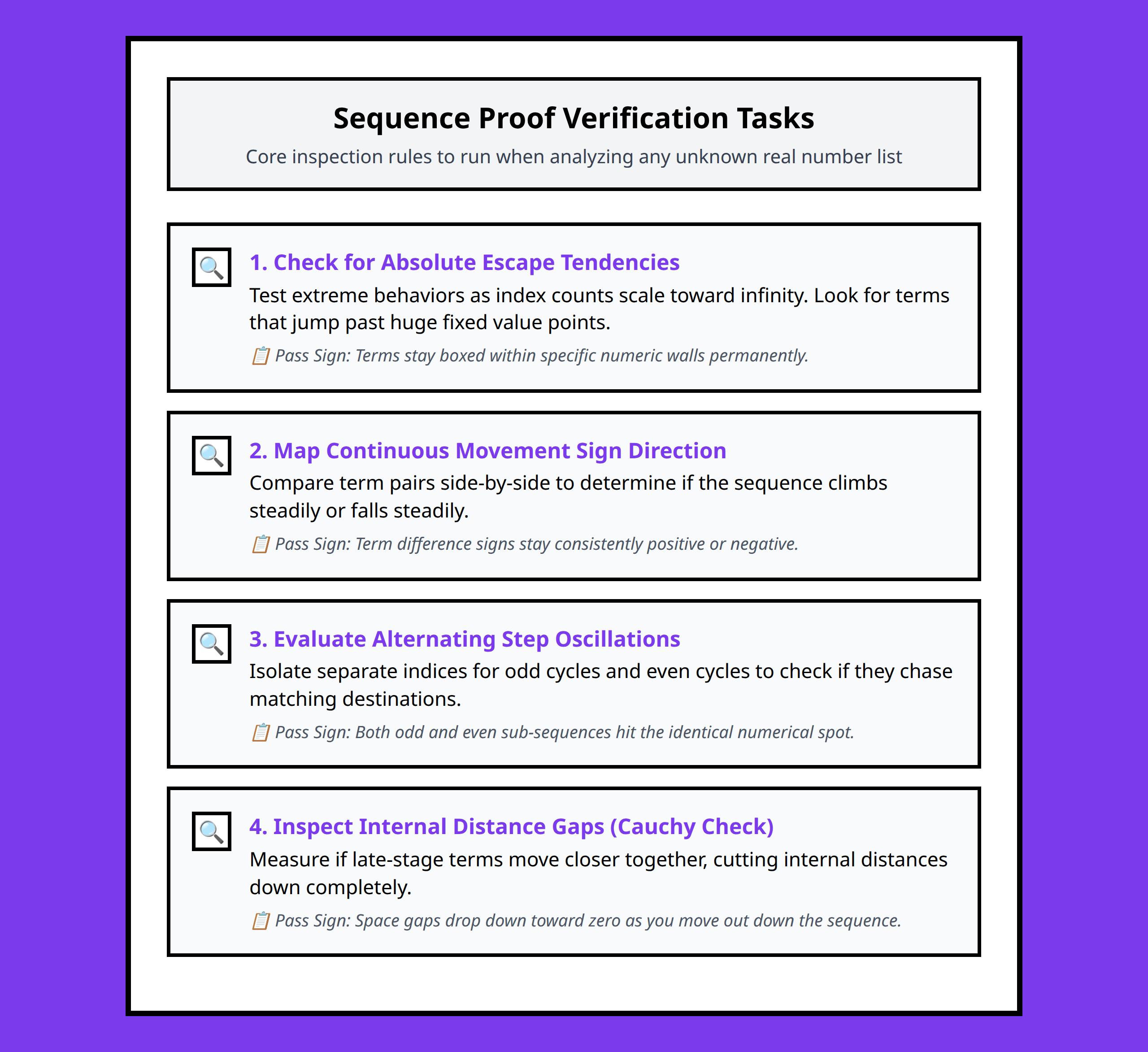
Students often treat inequalities as side tools used only inside proofs. I think that misses their real role.
Inequalities are the infrastructure that makes convergence analysis possible.
Nearly every important convergence argument depends on controlling distances between terms, comparing quantities, or trapping a sequence inside numerical boundaries.
For example, when proving convergence, you repeatedly encounter statements like:
- a term is smaller than a shrinking quantity
- a sequence stays between two bounds
- the difference between terms approaches zero
- one sequence dominates another
These are inequality-based relationships.
Without inequalities, convergence would become mostly intuition without verification.
I think many students struggle because they learn limit rules before they learn what the rules are actually controlling. The inequalities explain the control mechanism.
This becomes especially visible in squeeze-style reasoning. A sequence trapped between two convergent sequences often inherits convergence because the inequalities force compression.
The logic is mechanical once you see it clearly.
Subsequences Can Expose Hidden Problems
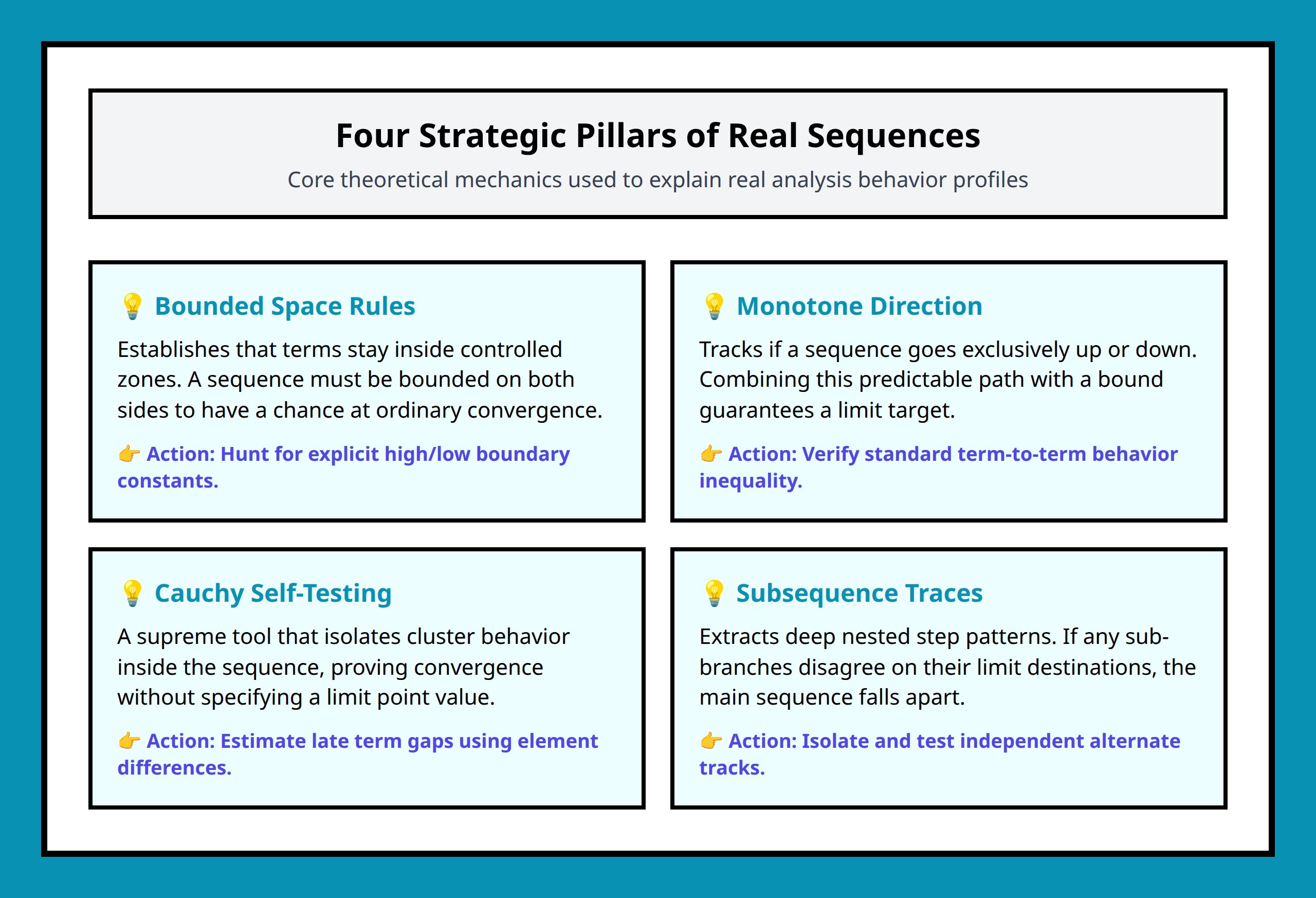
One of the most useful diagnostic tools in sequence analysis is the subsequence.
A subsequence selects terms from the original sequence while preserving order. At first, this sounds technical and minor. In practice, it is powerful.
Subsequences help reveal whether apparent convergence is real or deceptive.
Consider a sequence that alternates between two distant behaviors. Looking at the entire sequence may feel confusing. But once you separate even-indexed and odd-indexed terms into subsequences, the instability becomes obvious.
I like subsequences because they work almost like stress tests.
If different subsequences approach different values, the original sequence cannot converge to a single limit.
This is also psychologically useful for learners. Instead of staring at a complicated formula and guessing, you start asking investigative questions:
- What happens if I isolate certain terms?
- Do all parts of the sequence behave consistently?
- Is there hidden oscillation?
That shift from memorization to diagnosis is where real understanding begins.
The Cauchy Criterion Explains Convergence From the Inside
The Cauchy criterion is one of the deepest ideas in elementary analysis because it changes how convergence is viewed.
Instead of asking whether a sequence approaches an external limit, the Cauchy perspective asks whether the terms become arbitrarily close to each other.
That is a major conceptual shift.
I think many students first encounter the Cauchy criterion as a formal definition to survive on an exam. But its practical meaning is much simpler:
If the terms of a sequence eventually crowd tightly together, the sequence is stabilizing internally.
This avoids depending on guessing the limit first.
Imagine watching a group of runners on a track from very far away. You may not know exactly where they will stop, but if the runners keep clustering into an increasingly tight pack, you already know something important about their behavior.
That is essentially the Cauchy viewpoint.
The criterion becomes especially valuable when explicit limits are difficult to compute directly. Instead of searching for the destination immediately, you analyze the shrinking distances between terms.
I would argue this is one of the moments where analysis starts feeling like system diagnosis rather than symbolic manipulation.
Recursive Sequences Show How Convergence Becomes Dynamic
Recursive sequences make the architecture of convergence even clearer because each term depends on previous terms.
Now the sequence behaves more like a process unfolding over time.
In many recursive problems, the important questions become:
- Does the recursion remain bounded?
- Does it move consistently upward or downward?
- Do consecutive terms become closer together?
- Does the process stabilize around a fixed value?
A student working late on homework might compute ten recursive terms on a calculator and notice the numbers slowly clustering around a value like 2 or 3. At that moment, the convergence stops feeling abstract. The recursion starts behaving like a feedback system settling into equilibrium.
That is why recursive sequences are so useful pedagogically. They force you to combine all the earlier tools together:
- bounds
- inequalities
- monotonicity
- distance control
- stabilization logic
The separate concepts stop looking separate.
Why Memorized Limit Tricks Eventually Fail
Memorized rules work for familiar exercises. They fail when the structure changes.
I have seen this happen repeatedly when students move from computational calculus into real analysis. Suddenly the problem is not “compute the limit” but “justify the behavior.”
A purely memorized approach struggles there because the problems are no longer pattern-matching exercises.
What actually survives is structural thinking.
If I were helping someone rebuild their intuition for convergence, I would focus less on collecting formulas and more on asking a small set of repeated diagnostic questions:
- Is the sequence bounded?
- Is it monotone?
- Do inequalities control its behavior?
- Do subsequences expose instability?
- Do terms become close to each other internally?
Those questions connect almost every major convergence idea into one coherent framework.
Once convergence becomes a system of relationships instead of a bag of tricks, difficult problems stop feeling random. You begin to see why the sequence behaves the way it does, and that understanding lasts much longer than memorized rules ever will.
References:
- https://www.youtube.com/watch?v=kjr2Op_EG5I
- https://www.youtube.com/watch?v=VNoHcFoawTg
- https://www.youtube.com/watch?v=o0-GSTDCtnw
- https://www.youtube.com/watch?v=PzeCGelnheE
- https://faculty.buffalostate.edu/cunnindw/417Sec3-6.pdf
- https://www.scribd.com/document/909878989/Lecture-08
- https://campaigns.dmu.edu/uploaded-files/6uXL65/7AD240/calculus__test-for__convergence.pdf
- https://math.stackexchange.com/questions/3422525/proving-convergence-using-cauchy-sequences
- https://math.stackexchange.com/a/3422563
- https://web.williams.edu/Mathematics/lg5/B43W13/LS16.pdf
- https://imai.fas.harvard.edu/teaching/files/Sequences.pdf
- https://www.classcentral.com/subject/cauchy-sequences
- https://ocw.mit.edu/courses/18-100b-real-analysis-spring-2025/mit18_100b_s25_lec06.pdf
- https://www.reddit.com/r/learnmath/comments/exp735/when_is_a_cauchy_sequence_not_convergent/