
As network automation grows, inventory management often becomes the real operational bottleneck. Consistent device metadata, grouping, and inheritance matter more than individual scripts because orchestration depends on reliable inventory structure.
I think many engineers underestimate inventory problems because early automation usually starts small. A few devices, a short Python script, and maybe a basic device list inside the code can work surprisingly well at first.
The problem is that scaling changes the nature of automation. Eventually, the biggest issue is no longer whether the script works. The issue becomes whether the automation system knows enough about the environment to execute safely and consistently.
That shift is where inventory management stops feeling like a minor detail and starts becoming core infrastructure.
Why Small Automation Habits Become Dangerous at Scale
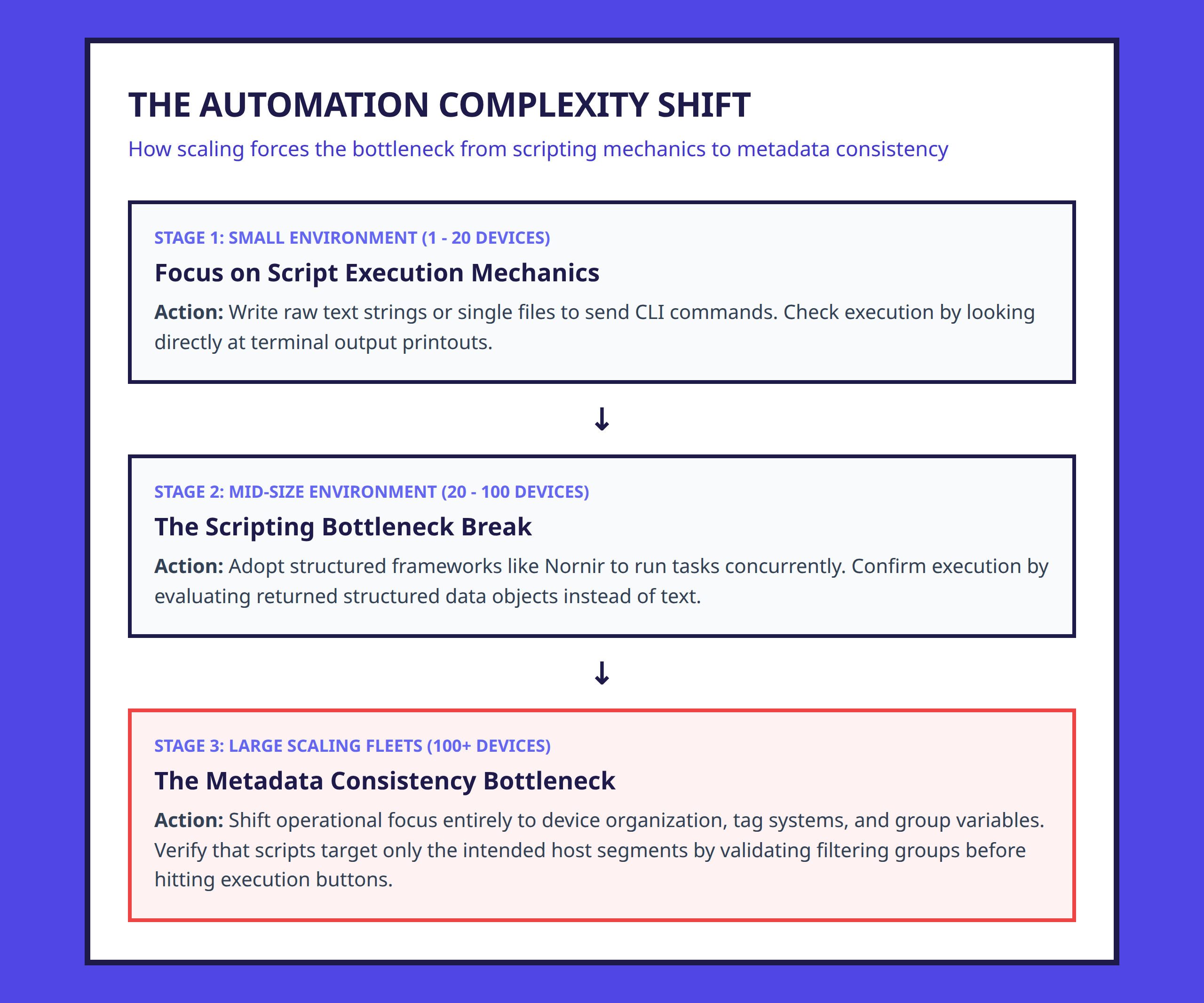
In smaller environments, engineers often store device details directly inside scripts:
- IP addresses
- credentials
- platform types
- site labels
I understand why this happens. It feels faster initially.
But once the device count grows, those shortcuts create operational friction everywhere.
A realistic situation might involve a team managing 15 branch routers manually at first. Adding a few new devices every month does not seem like a problem. Then eventually the environment reaches 200 devices spread across multiple regions and hardware vendors.
At that point, engineers start asking questions the original scripts were never designed to answer:
- Which devices belong to a specific region?
- Which routers use a particular OS version?
- Which devices should receive this change?
- Which systems are production versus lab?
Without structured inventory data, orchestration becomes risky very quickly.
Nornir Treats Inventory as an Operational System
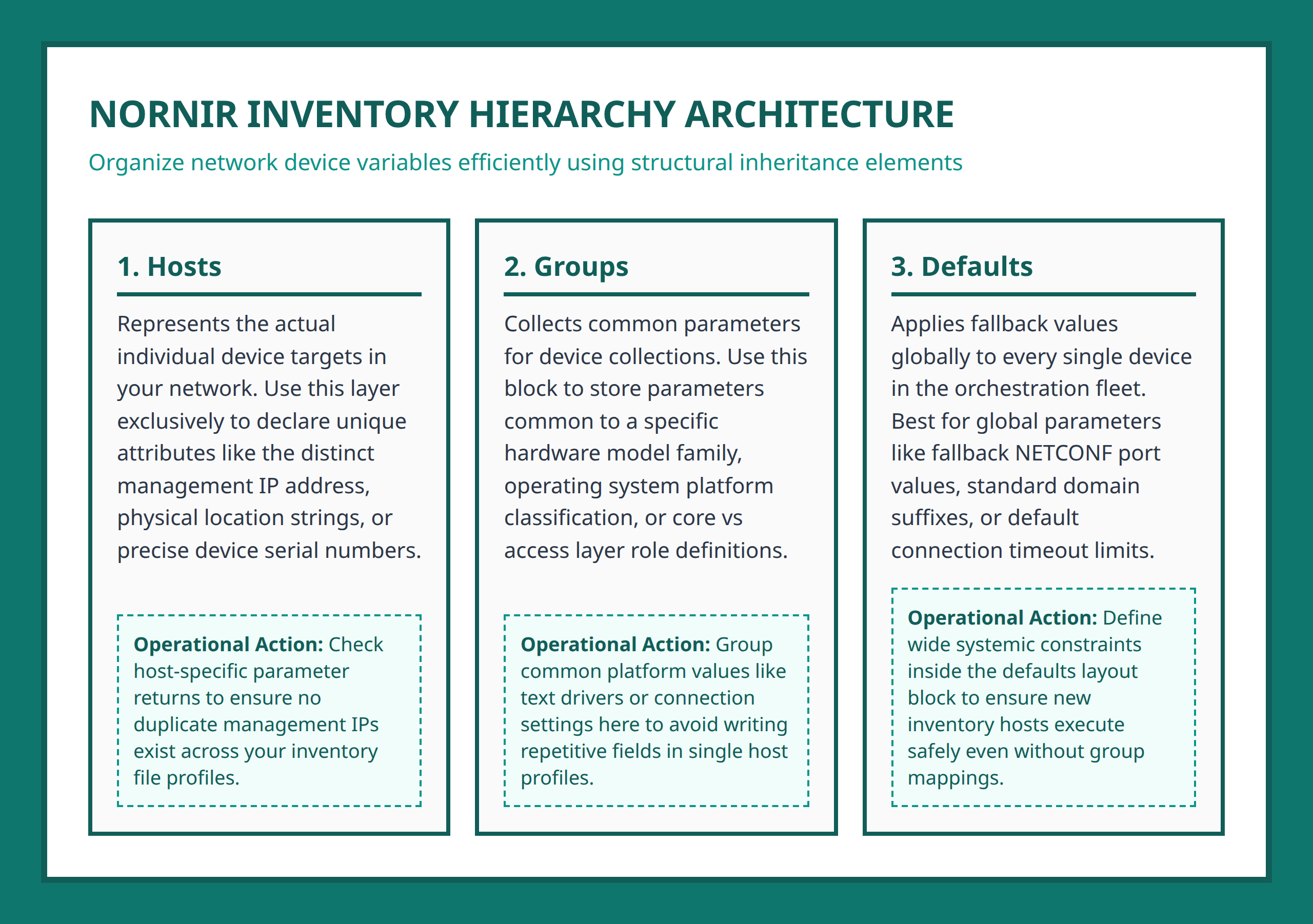
One thing I find important about Nornir is that it treats inventory management as a first-class operational component rather than an afterthought.
Instead of embedding everything into Python scripts, Nornir separates device information into structured inventory layers:
- hosts
- groups
- defaults
This architecture matters because it reduces duplication and improves consistency across automation workflows.
A host might define device-specific information:
router1: hostname: 10.1.1.1 groups: - branch Meanwhile, shared operational attributes can live at the group level:
branch: platform: ios username: admin Operationally, that inheritance model changes how automation scales. Instead of updating credentials or metadata across hundreds of scripts or devices manually, engineers update shared structures once.
That is not just cleaner. It is safer. fileciteturn7file0
Inventory Quality Determines Orchestration Quality
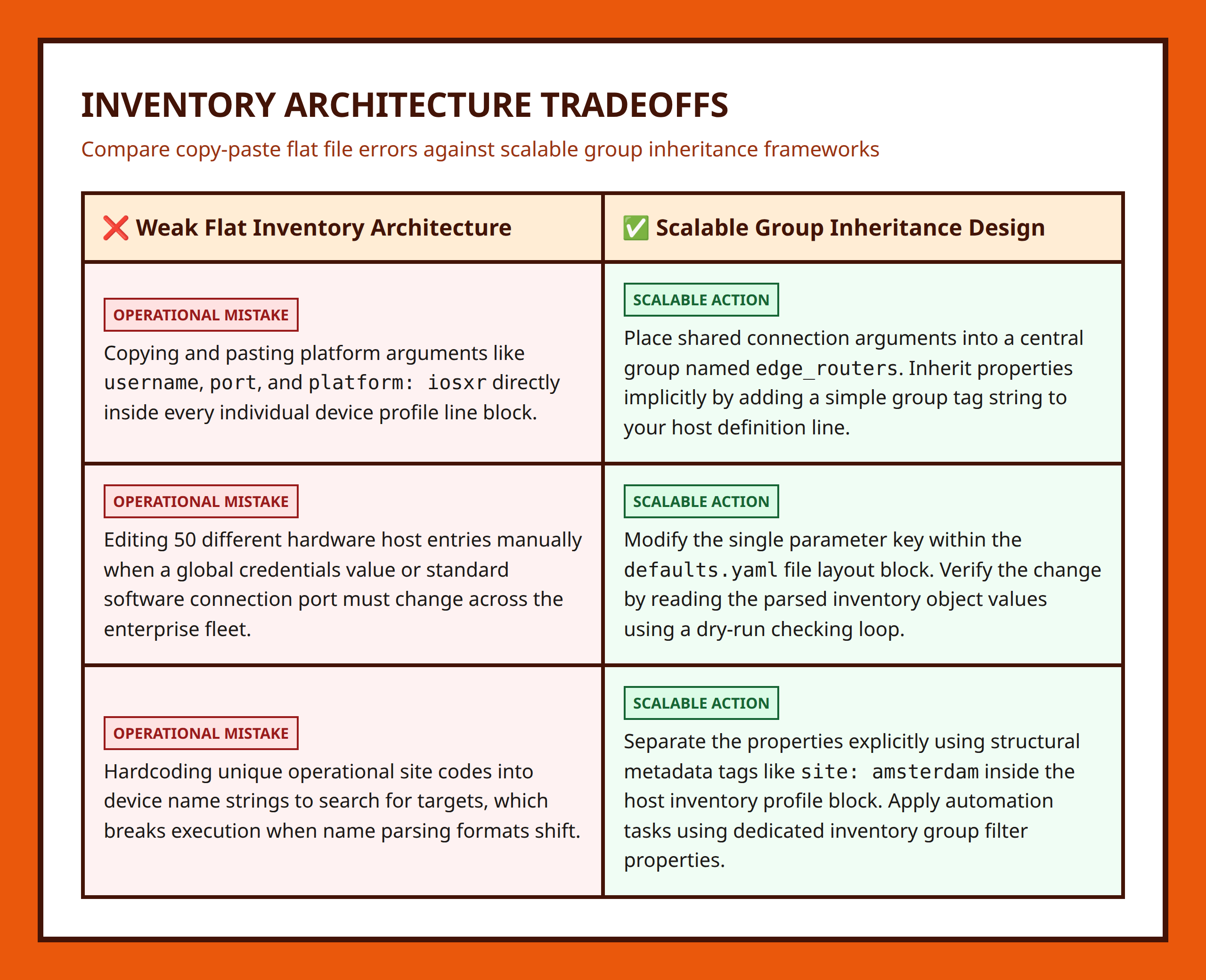
I think many automation failures blamed on “bad scripts” are actually inventory problems.
The orchestration layer depends entirely on inventory accuracy.
If metadata is inconsistent, automation decisions become inconsistent too.
For example, imagine two branch routers that should belong to the same operational group. If one device is missing a location tag or platform assignment, filtering workflows may skip it entirely during configuration updates or compliance checks.
The automation technically runs successfully, but operationally the result is incomplete.
That kind of partial automation failure is difficult to notice because nothing visibly crashes. The inconsistency quietly accumulates over time.
Filtering Depends on Reliable Metadata
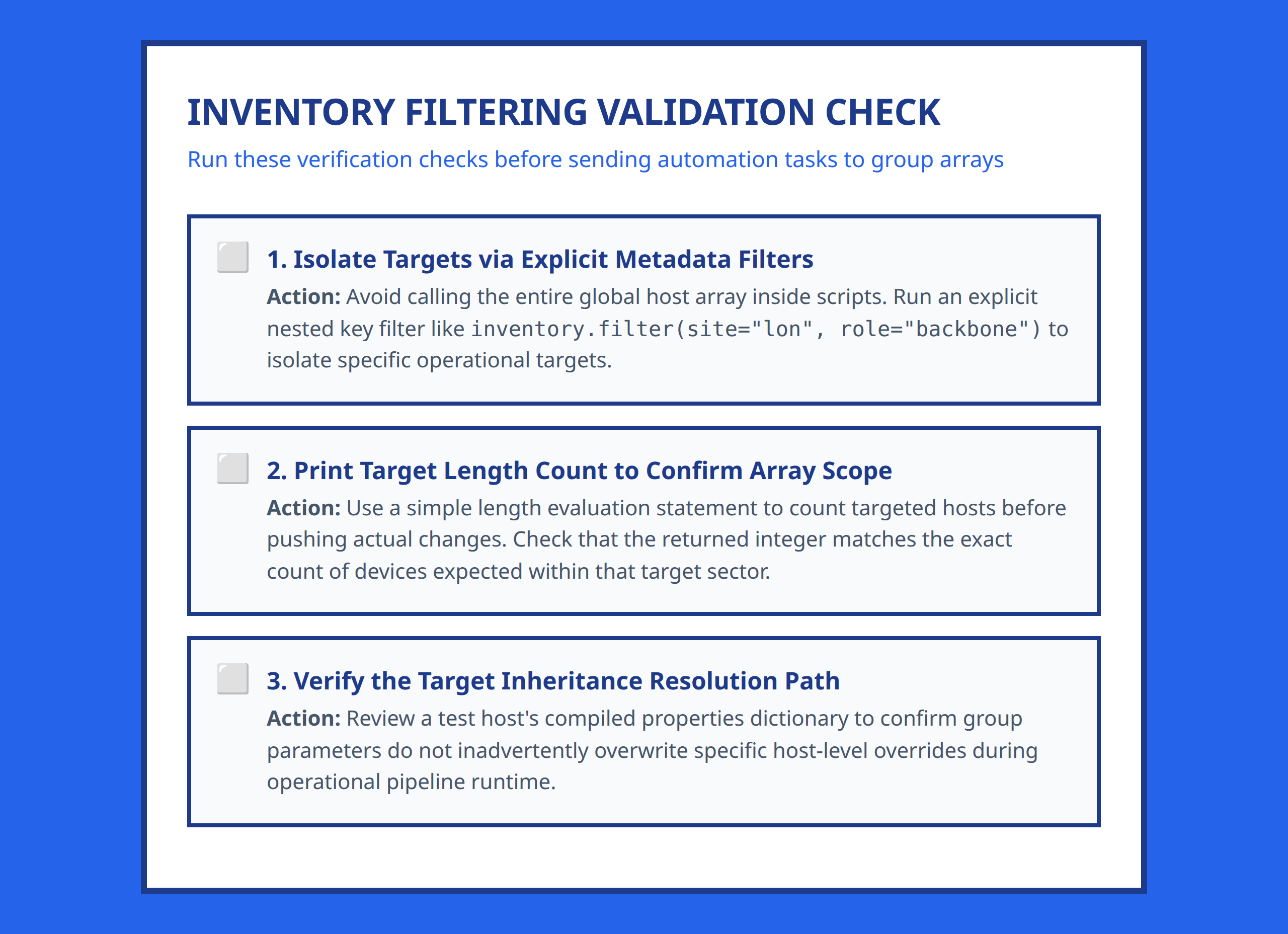
Filtering becomes one of the most important operational features once environments grow.
Instead of targeting devices manually, engineers can define workflows around metadata:
- site
- vendor
- device role
- environment type
A filtering workflow might look simple:
nr.filter(site="singapore") But operationally, this depends completely on inventory discipline.
If site labels are inconsistent across devices, the automation workflow becomes unreliable. One mislabeled router may receive the wrong configuration or avoid validation entirely.
I would pay close attention to this area before scaling automation aggressively. Once orchestration relies heavily on filtering, metadata consistency becomes just as important as Python logic.
Defaults and Inheritance Reduce Operational Drift
One operational problem large environments constantly fight is drift.
Different teams update devices differently. Credentials change unevenly. Platform definitions vary slightly between engineers. Over time, inconsistencies multiply.
The defaults and inheritance structure inside Nornir helps reduce that drift by centralizing common operational values.
I think this matters because inventory systems are not only about organization. They are also about standardization.
When automation depends on shared assumptions, those assumptions need to live somewhere stable and reusable.
Otherwise, every new workflow reintroduces inconsistency.
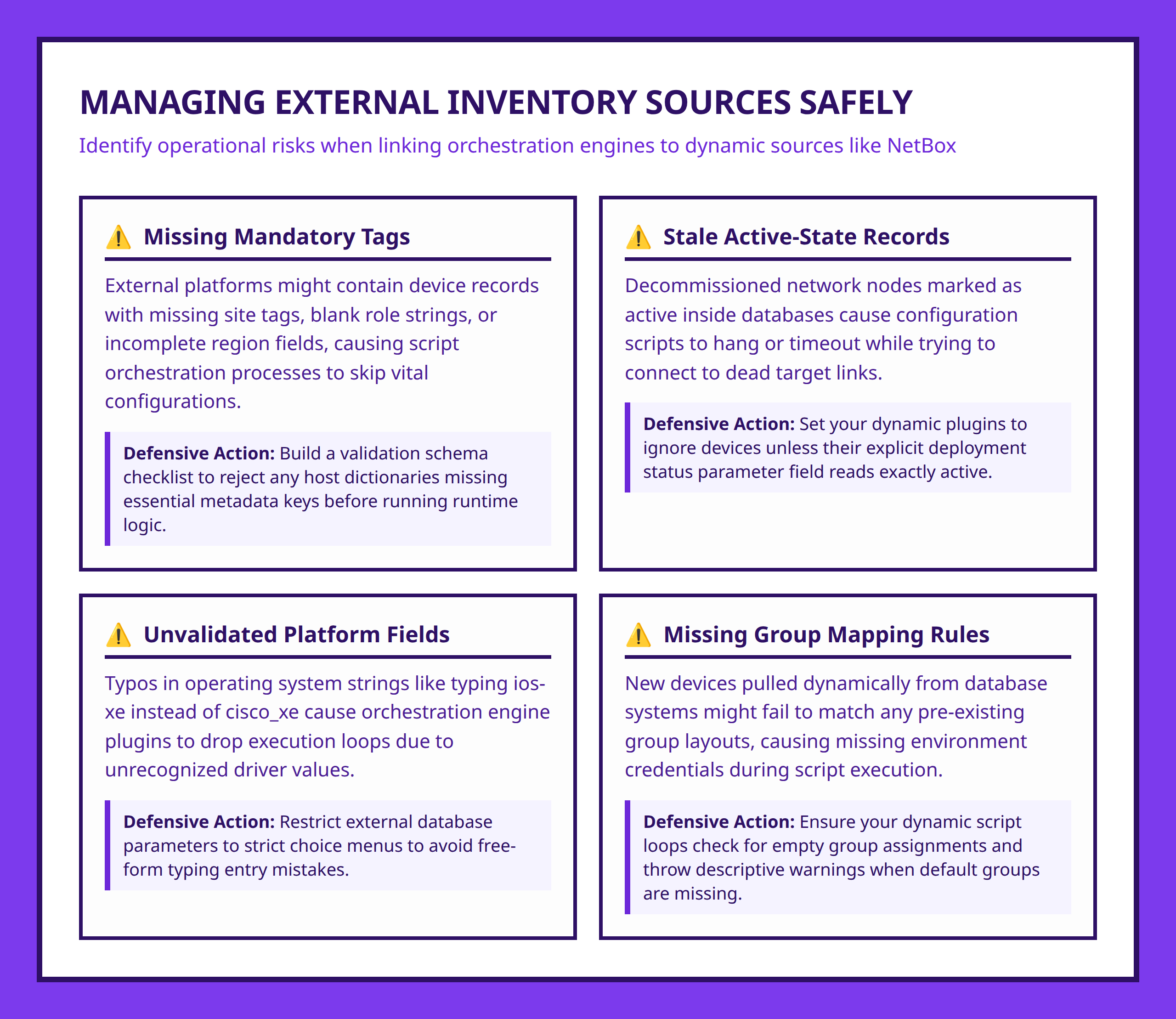
External Inventory Sources Become Attractive for a Reason
As environments continue scaling, many teams eventually move beyond static YAML files toward external inventory systems.
I would not rush into that transition too early. Smaller environments can operate perfectly well with structured YAML inventory.
But the motivation for external inventory systems becomes easier to understand once device metadata starts changing frequently across teams or environments.
The important operational lesson is not the specific inventory platform. The important lesson is that automation quality depends heavily on inventory reliability.
Once inventory becomes inaccurate, orchestration quality degrades regardless of how advanced the automation scripts appear.
The Real Scaling Problem Is Organizational, Not Technical
What stands out to me most is that inventory management exposes a deeper truth about automation scaling.
Most scaling problems are not caused by Python syntax limitations.
They are caused by operational inconsistency:
- unclear ownership
- inconsistent metadata
- duplicate definitions
- poor grouping strategy
- unreliable inventory updates
That is why inventory eventually becomes the bottleneck.
Automation frameworks like Nornir can execute workflows efficiently, but only if the inventory system reflects the environment accurately.
And honestly, that is the point where automation starts looking less like scripting and more like infrastructure operations management itself. fileciteturn7file0
References:
- https://www.fntsoftware.com/en/blog/why-inventory-is-the-missing-link-to-true-network-autonomy
- https://www.infosysbpm.com/blogs/communication-service-providers/network-inventory-management-automation.html
- https://www.thefastmode.com/expert-opinion/46326-why-network-inventory-is-critical-for-autonomous-networks
- https://www.vegam.ai/blog/inventory-management-automation
- https://firecell.io/optimizing-stock-management-with-automation-a-comprehensive-guide/
- https://www.turn-keytechnologies.com/blog/warehouse-network-trends
- https://www.deskera.com/blog/future-inventory-control/
- https://vocal.media/journal/how-automation-is-transforming-inventory-management-across-industries
- https://gluware.com/from-personal-wins-to-enterprise-impact-how-network-automation-delivers-business-value/
- https://www.linkedin.com/top-content/supply-chain-management/automation-tools-for-supply-chain-efficiency/improving-inventory-management-through-automation/
- https://www.tredence.com/blog/inventory-management-challenges-optimization-strategies
- https://www.ascm.org/topics/inventory-management/
- https://www.lengow.com/get-to-know-more/the-role-of-technology-in-inventory-management/
- https://www.aptean.com/fr/insights/blog/challenges-of-inventory-management