
NAPALM reduces one of the biggest operational problems in network automation: inconsistent device behavior across vendors. By standardizing how engineers retrieve data and apply configurations, it makes automation workflows more predictable and scalable.
I’ve seen many automation efforts start well and then slowly become harder to maintain as more device types enter the environment. The first few scripts usually work because the network is relatively uniform. The problems appear later, when one automation workflow suddenly needs to support Cisco, Juniper, Arista, or older hardware running slightly different operating systems.
That is where NAPALM becomes valuable. Its biggest contribution is not simply automation. It is operational consistency.
The Hidden Cost of Vendor Differences
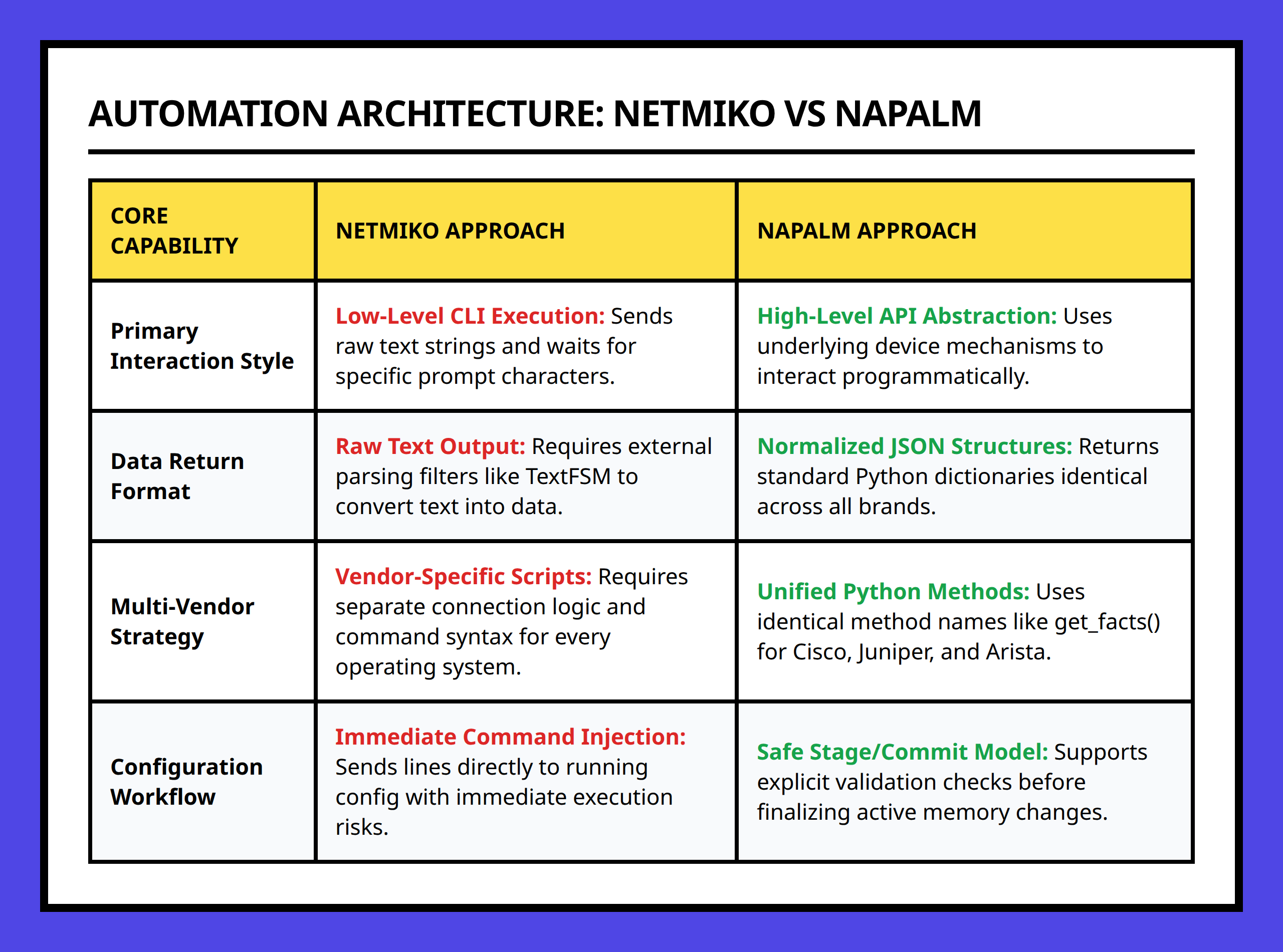
Most engineers already understand that different vendors use different CLI syntax. What becomes more frustrating is how those differences affect automation logic.
A simple operational task can quickly become messy:
- One vendor formats interface data differently.
- Another uses different naming conventions.
- A third returns unexpected output fields.
- A firmware update changes command formatting.
At first, these issues seem manageable. But over time, automation scripts start accumulating exceptions, conditional checks, and vendor-specific parsing logic.
I think this is the point where many engineers realize they are no longer automating network operations. They are maintaining automation workarounds.
That distinction matters.
Why NAPALM Feels Different from SSH-Based Automation
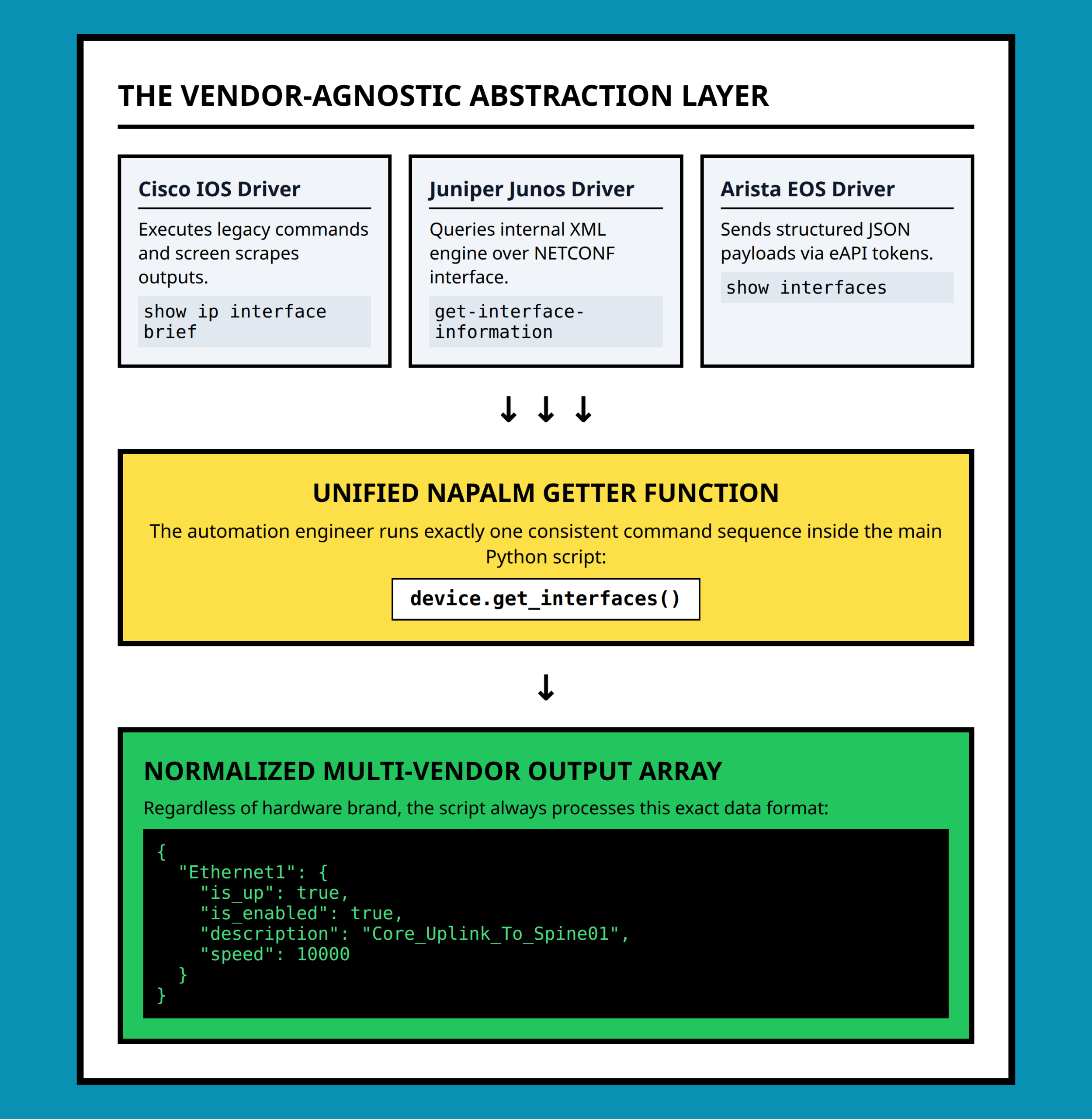
Traditional SSH automation tools still rely heavily on raw CLI interaction. The workflow often depends on sending commands and parsing text output manually.
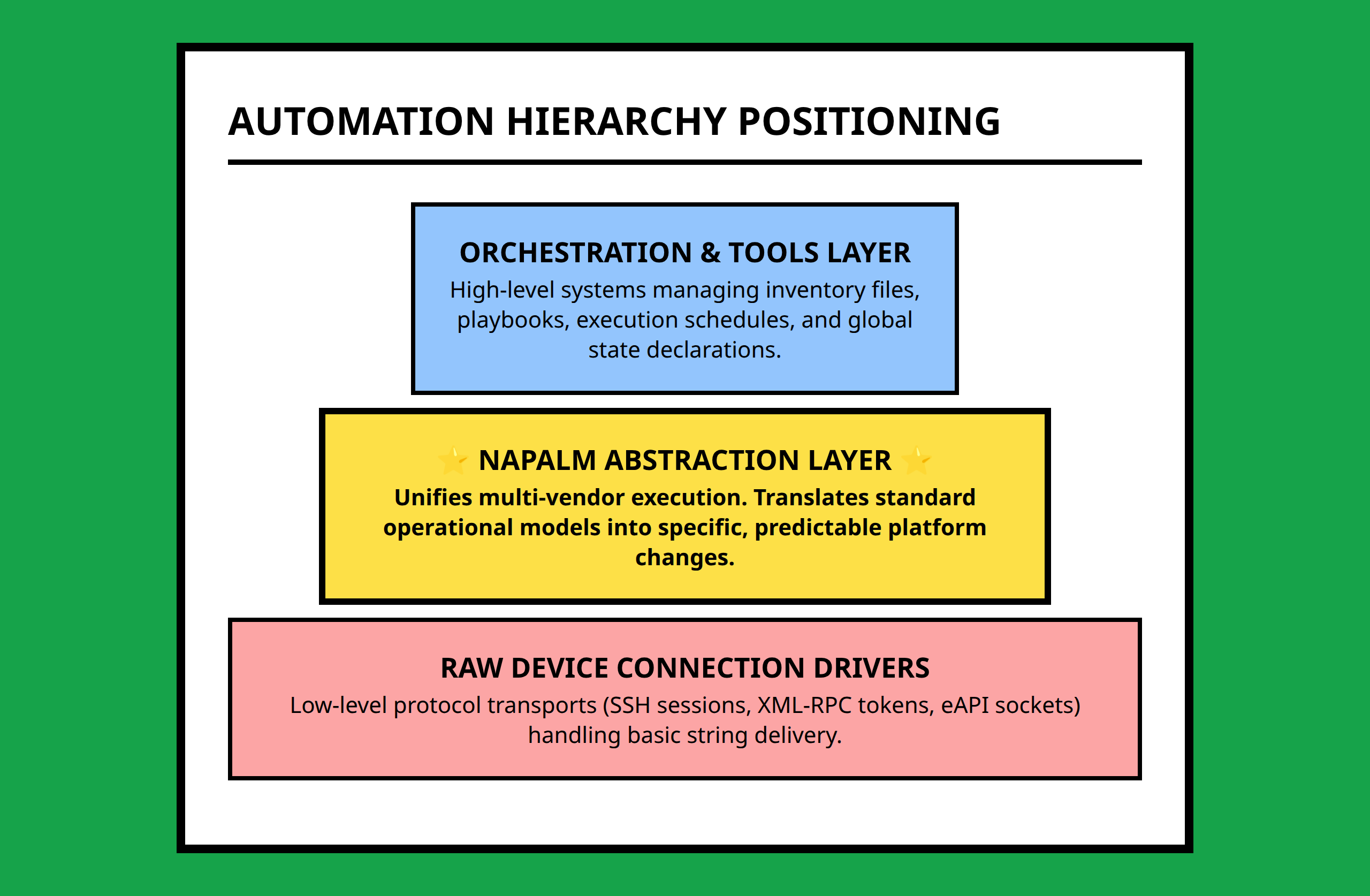
NAPALM changes the operational model by introducing abstraction.
Instead of focusing on vendor-specific commands, NAPALM provides standardized methods that return structured information in predictable formats. Operationally, this means the engineer spends less time worrying about how each vendor formats output and more time focusing on the network state itself.
For example, retrieving interface information becomes less about parsing text and more about working with normalized data structures.
I find that shift important because it changes how automation scripts are designed. The script no longer revolves around command syntax differences. It revolves around operational intent.
Structured Data Makes Automation More Stable
One of the strongest ideas behind NAPALM is that automation becomes easier when data is returned in structured formats like Python dictionaries.
Instead of scraping lines of CLI output, the automation workflow receives organized key-value data that can be iterated through consistently.
A small example illustrates the difference clearly.
Imagine checking whether interfaces are operationally up across several vendors.
With raw CLI parsing, the script often needs:
- vendor-specific commands
- regex patterns
- spacing adjustments
- special-case handling
With structured data, the logic becomes much simpler:
for interface, details in interfaces.items(): if details['is_up']: print(interface) The important thing is not the Python syntax itself. The important thing is that the automation logic remains stable even when the underlying vendor changes.
That stability is what allows automation to scale operationally.
Consistency Matters More Than Clever Automation
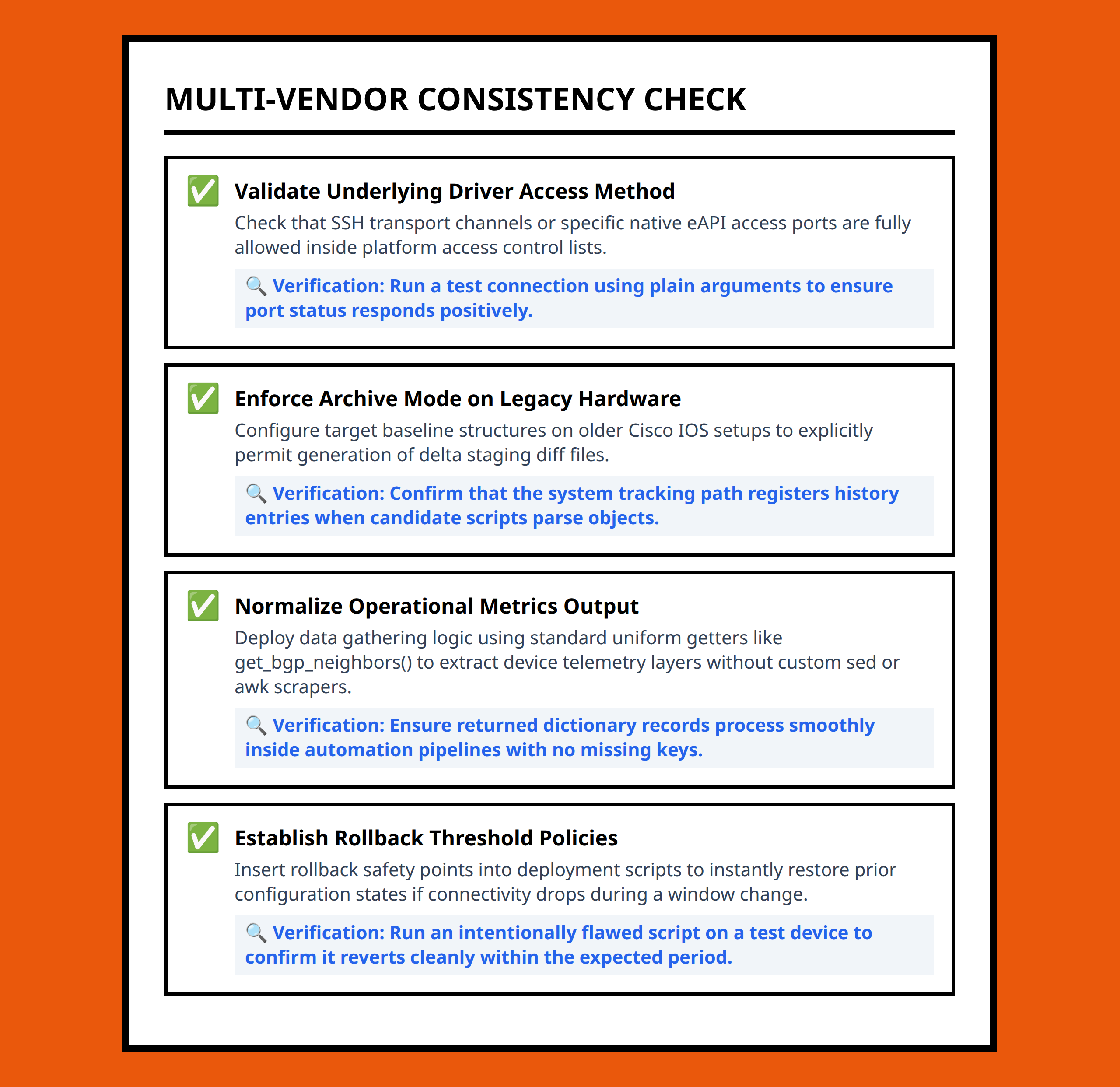
I think many engineers initially focus too much on making automation powerful and not enough on making it predictable.
Predictability matters more.
A modest workflow that behaves consistently across different vendors is often more valuable than a highly advanced script that constantly breaks because of formatting differences.
A realistic situation might involve a network team managing branch infrastructure after a merger. Suddenly the environment includes multiple hardware vendors, older operating systems, and inconsistent configurations.
The technical challenge is not necessarily difficult networking. The challenge is maintaining reliable operational workflows across inconsistent systems.
That is exactly the type of problem NAPALM addresses well.
Configuration Management Becomes Safer
NAPALM also improves consistency during configuration changes.
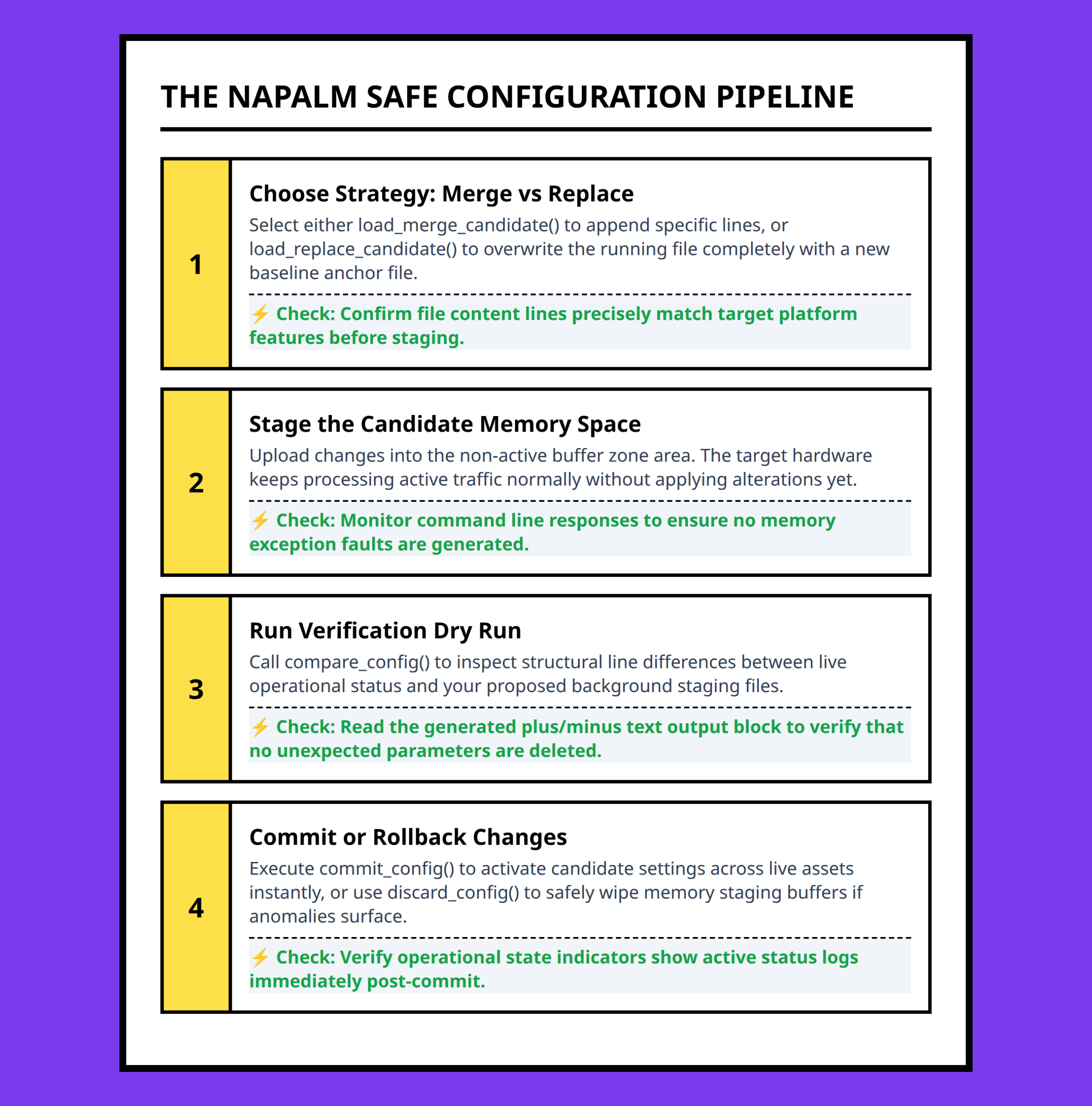
One detail I appreciate is its staged configuration workflow. Instead of immediately pushing changes live, the process allows engineers to:
- load candidate configurations
- compare differences
- review pending changes
- commit or discard updates
This introduces operational discipline into automation.
In practice, that matters because automation mistakes scale quickly. A typo applied manually affects one device. A typo inside automation can affect dozens of devices within seconds.
The merge and replace workflow helps reduce that operational risk by encouraging verification before committing changes.
Vendor Abstraction Changes How Engineers Think
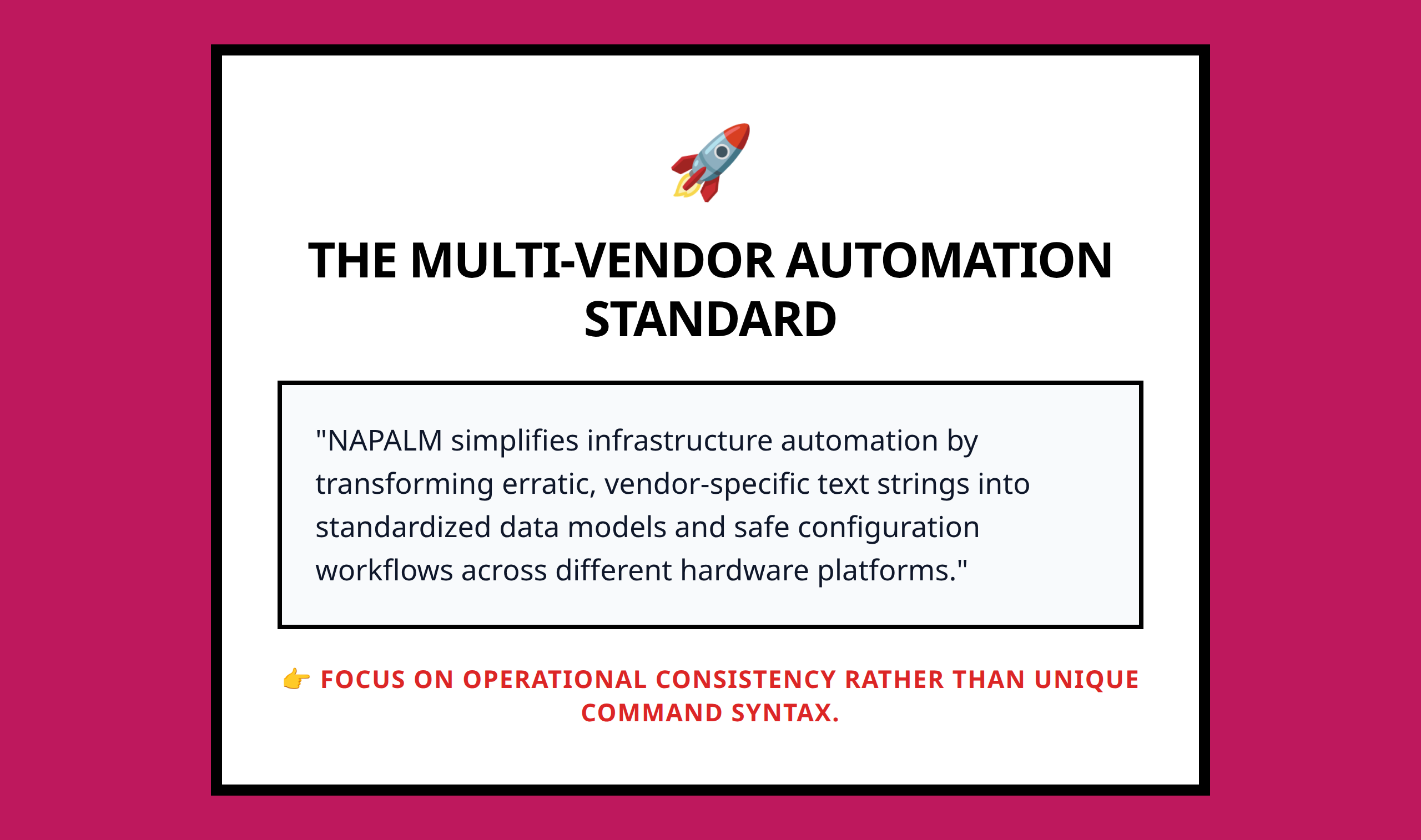
What I find most interesting about NAPALM is that it changes the engineer’s mental model.
Instead of thinking:
“Which CLI command works on this vendor?”
The engineer starts thinking:
“What operational information do I need?”
That shift sounds subtle, but operationally it is significant.
The automation workflow becomes centered around network intent rather than device syntax. Once that happens, scripts become easier to maintain, easier to extend, and easier to reuse across environments.
Why NAPALM Often Becomes a Bridge Technology
I would not describe NAPALM as the final destination for network automation. What makes it valuable is that it acts as a bridge between traditional CLI operations and more advanced automation ecosystems.
Engineers who are comfortable with SSH-based workflows can gradually move toward structured data and normalized automation patterns without immediately diving into large orchestration systems or API-heavy architectures.
That gradual transition matters because operational teams rarely modernize everything at once.
Most environments evolve incrementally.
And honestly, that is where NAPALM feels most practical to me. It helps automation become operationally consistent before it becomes operationally complex.
References:
- https://www.youtube.com/shorts/HzXqYb5ehDc
- https://www.youtube.com/watch?v=QnXhCzaSvBw
- https://www.youtube.com/watch?v=AgSoXvaOcTg
- https://orhanergun.net/napalm-vs-other-automation-tools-comparison
- https://www.techtarget.com/searchnetworking/feature/Network-pros-need-NAPALM-Ansible-network-automation-skills
- https://python-automation-book.readthedocs.io/en/1.0/13_napalm/01_intro.html
- https://stackstorm.com/2017/04/11/ensuring-network-configuration-consistency-stackstorm-napalm/
- https://blog.paessler.com/network-automation-from-manual-chaos-to-automated-peace-of-mind
- https://medium.com/@hmbali96/python-for-network-automation-practical-napalm-netmiko-paramiko-efc21ee15ccb
- https://docs.saltproject.io/en/3006/topics/network_automation/index.html
- https://www.linkedin.com/pulse/when-combined-netmiko-napalm-nornir-becomes-your-ultimate-bfw0c
- https://codingnetworks.blog/en/napalm-network-automation-python-making-configurations-in-a-multivendor-network/
- https://developer.cisco.com/codeexchange/github/repo/napalm-automation/napalm/
- https://www.ibm.com/think/topics/network-automation
- https://www.fortinet.com/resources/cyberglossary/network-automation