
Structured data turns routine network tasks into scalable, repeatable automation. Unlike raw CLI parsing, it provides normalized outputs that are easier to process, iterate over, and integrate into multi-device workflows.
For years, I relied on SSH scripts to pull command outputs from Cisco devices. Parsing CLI text with regex or string operations works for a handful of devices, but the moment I needed to scale, I ran into inconsistencies, edge cases, and manual cleanup.
Structured data changes that dramatically. By normalizing outputs into Python-friendly dictionaries, NAPALM allows automation to scale across devices and vendors without repeatedly handling text quirks or device-specific variations.
The Limits of CLI-Centric Automation
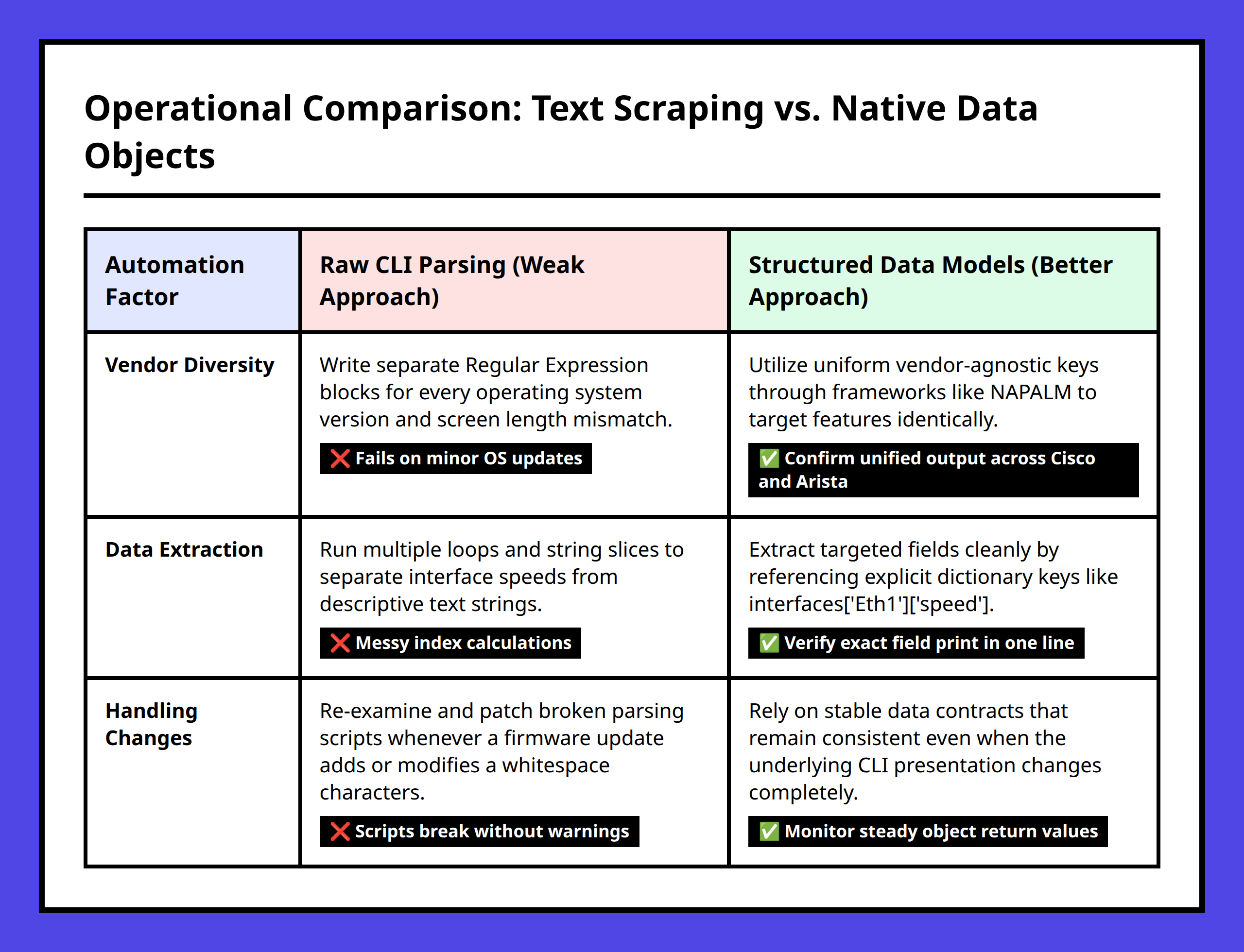
Raw CLI parsing works initially because you can extract exactly what you need from a small, known set of devices. But even small variations in spacing, formatting, or firmware versions quickly break scripts. I remember having to update a parser just because a new IOS update changed one header line — a small tweak that caused hours of troubleshooting.
These fragile scripts make automation brittle. Every new device or vendor adds a layer of complexity, and managing these exceptions often becomes more work than running commands manually. Structured data solves this by providing a consistent, predictable output format regardless of the underlying device.
NAPALM’s Vendor-Agnostic Approach
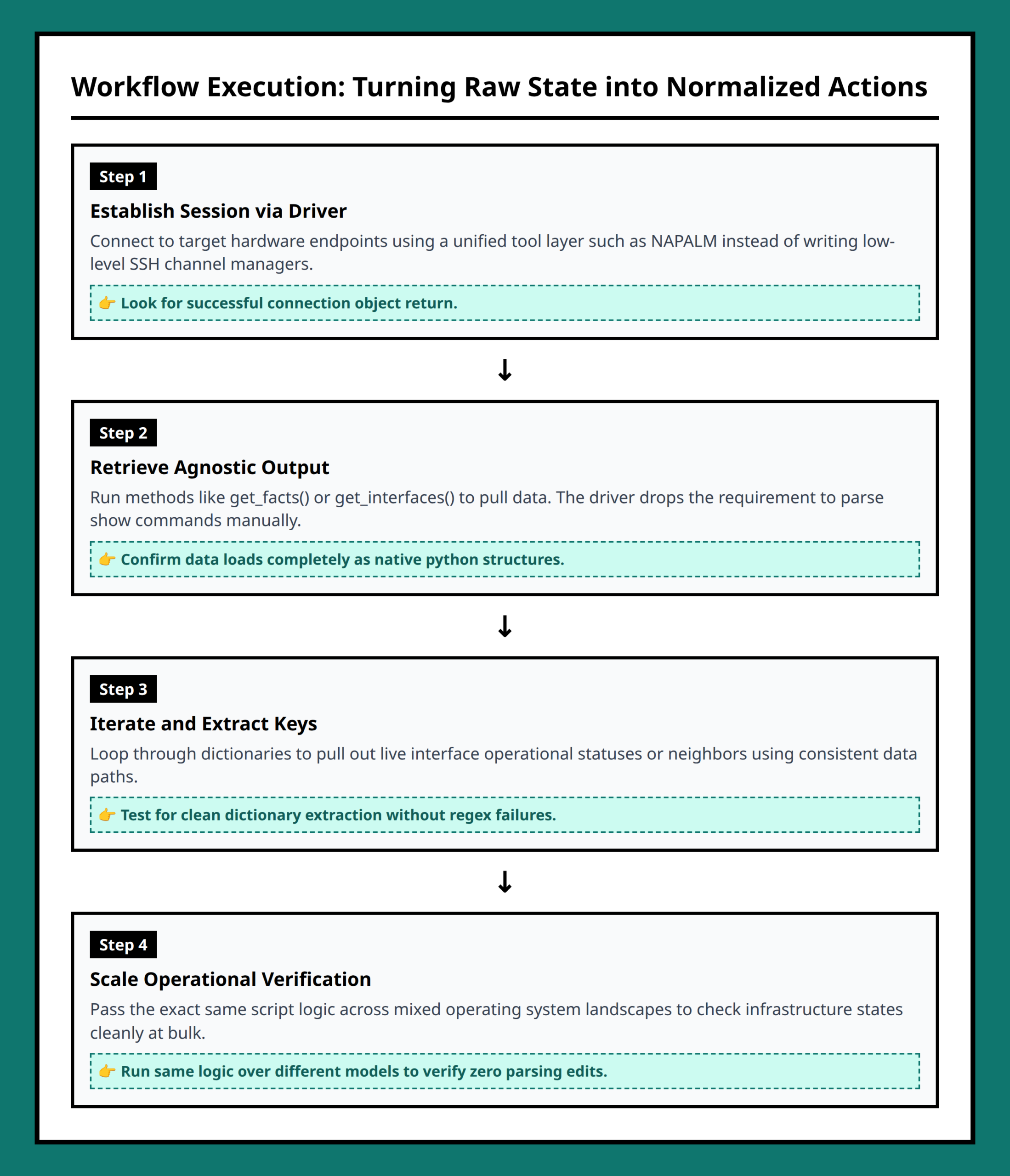
NAPALM converts device outputs into structured, normalized data. Operationally, this means I can query interface status, routing tables, or VLAN assignments across multiple devices and vendors without rewriting parsing logic.
The real power shows up when combining multiple outputs. For example, instead of merging text from five devices manually, I can iterate through dictionaries, check statuses, or filter results programmatically:
for host, data in devices.items(): for interface, details in data['interfaces'].items(): if details['is_up']: print(f"{host}: {interface} is up") Even small scripts like this save hours compared to string-based CLI parsing. More importantly, the logic is reusable and reliable across environments.
Dictionaries as Automation-Friendly Structures
Dictionaries allow me to store device information in hierarchical structures, making it easy to navigate, filter, or transform data. Iterating over a dictionary is predictable, unlike trying to extract fields from irregular CLI text.
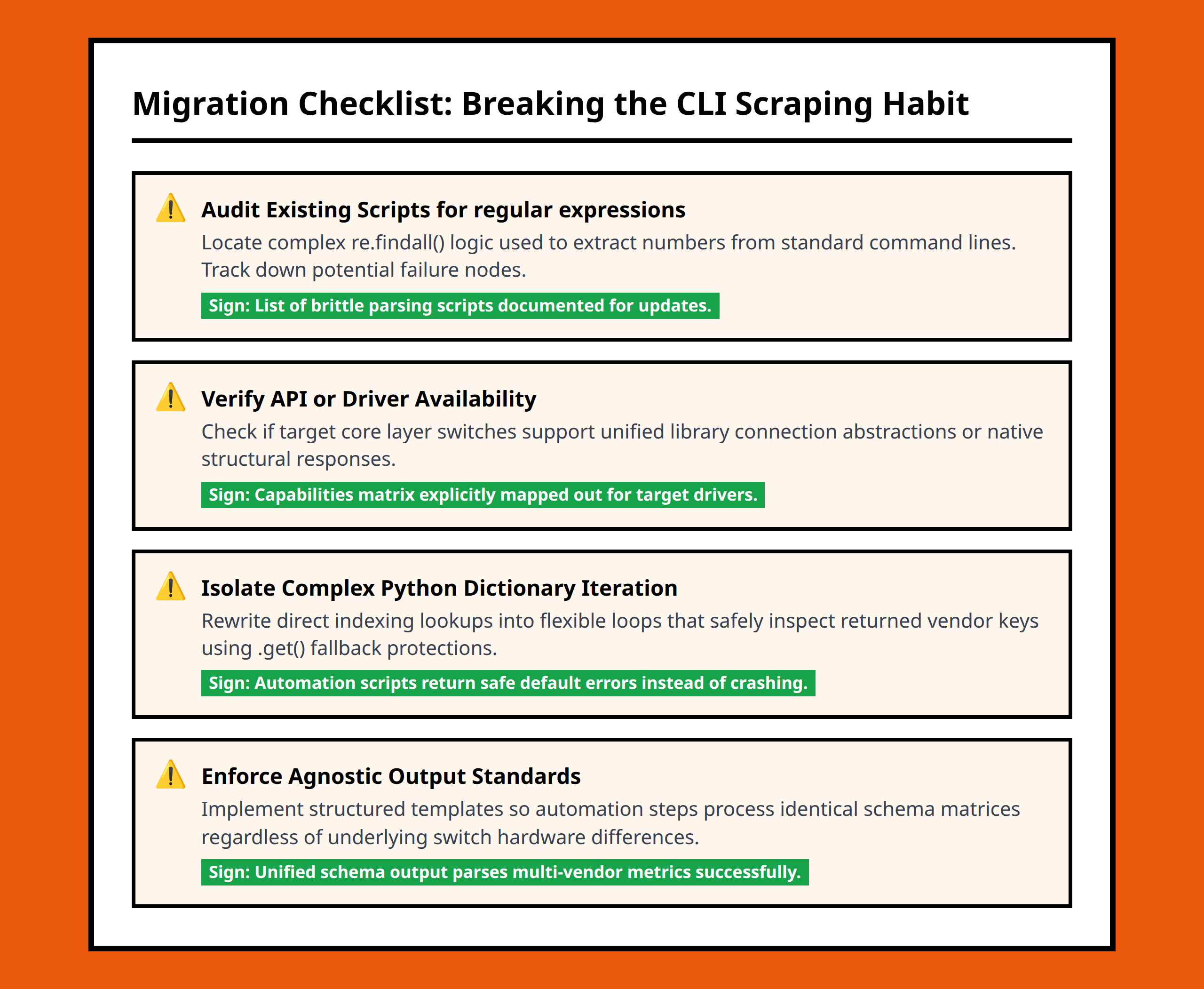
This is particularly useful when combining operational checks with configuration verification or when generating reports for multiple devices. Once I started storing outputs in dictionaries, loops and conditional checks became natural extensions of my scripts, without needing brittle text parsing logic.
Iteration and Extraction Patterns
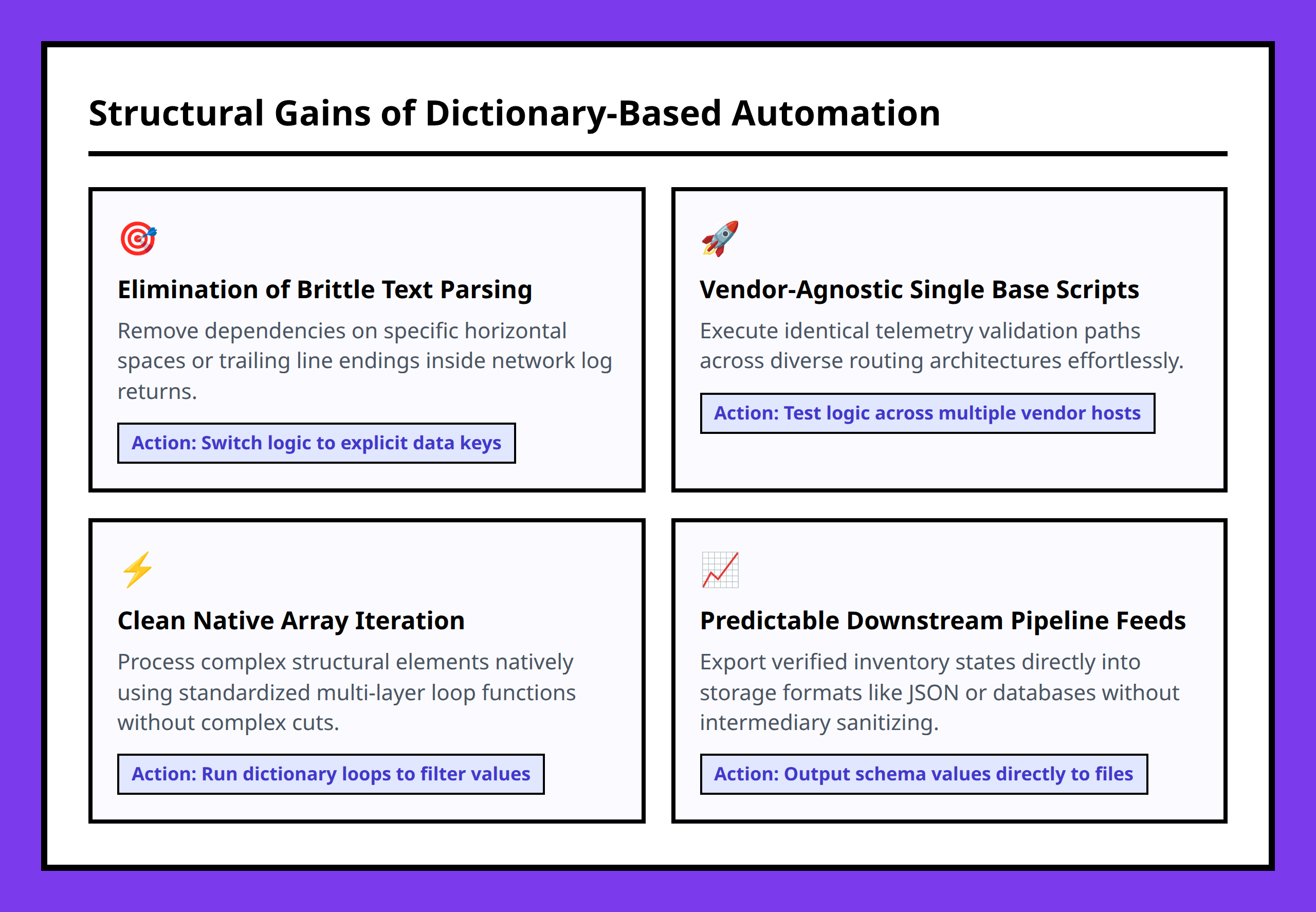
Structured data also simplifies iteration. Instead of multiple regex passes or fragile string splits, I can reliably loop over keys and values. For example, extracting all active interfaces or VLANs becomes a single, clean operation:
active_intfs = [intf for intf, info in device['interfaces'].items() if info['is_up']] This one line replaces dozens of lines of parsing logic, reducing errors and making scripts easier to maintain.
Operational Benefits and Scalability

Structured data enables true scalability. Whether I’m working with five or fifty devices, the same logic applies. Scripts become readable, maintainable, and predictable. Automation stops being brittle and starts being a tool I can rely on for ongoing operations rather than a one-off solution.
The shift from CLI parsing to structured data also aligns naturally with future automation. Once outputs are normalized, integrating with orchestration frameworks, monitoring systems, or dashboards becomes straightforward.
By adopting structured data early, I can focus on solving network problems and scaling automation rather than constantly fixing broken parsers. That’s the fundamental operational difference — structured data is not just a convenience; it transforms how network automation is designed and executed.
References:
- https://www.itential.com/blog/company/automation-strategy/end-to-end-network-automation-is-more-than-cli-scripting/
- https://packetpushers.net/blog/formatted-cli-data-is-not-good-enough-for-automation/
- https://www.linkedin.com/posts/roger-perkin-network-automation-architect_networkautomation-ansible-python-activity-7407348783300112384-7duj
- https://codilime.com/blog/network-automation-and-orchestration-guide-to-tools-and-challenges/
- https://www.reddit.com/r/ansible/comments/126p5u4/do_cli_parse_is_recommended_way_for_network/
- https://www.reddit.com/r/networking/comments/jsnwm8/what_do_you_use_automationpython_for_and_what_do/
- https://www.reddit.com/r/networkautomation/comments/1p119db/parsing_dilemma/
- https://networktocode.com/blog/parsing-strategies-intro/
- https://medium.com/@mas_40032/why-ai-native-network-operations-are-inevitable-10d74eaf47e0
- https://www.networkershome.com/fundamentals/python-networking/cli-parsing-textfsm-ttp-genie/
- https://www.metalsoft.io/post/network-abstraction
- https://www.redhat.com/en/blog/the-network-cli-is-dead-long-live-xml-just-kidding
- https://blog.paessler.com/network-automation-from-manual-chaos-to-automated-peace-of-mind
- https://prezi.com/p/ygjgagokxqwr/ccna-3-module-14-network-automation/
- https://www.ibm.com/think/topics/network-automation