
Embodiment science is changing how many educators think about intelligence, attention, and learning. The biggest shift is surprisingly simple: students do not learn with their brains alone. Their bodies, emotions, movement, relationships, and physical environments shape thinking at every stage.
I keep coming back to one uncomfortable question: why do so many school reforms produce only temporary improvements?
Schools adopt new curricula, new assessments, new technology platforms, and new teaching frameworks. Yet classrooms often end up looking remarkably similar a few years later. Students still spend most of the day sitting still, listening, memorizing, and proving knowledge through written recall.
What interests me about embodiment science is that it questions something deeper than policy or curriculum design. It questions the model of human intelligence that modern schooling quietly assumes.
The Hidden Assumption Behind Traditional Schooling
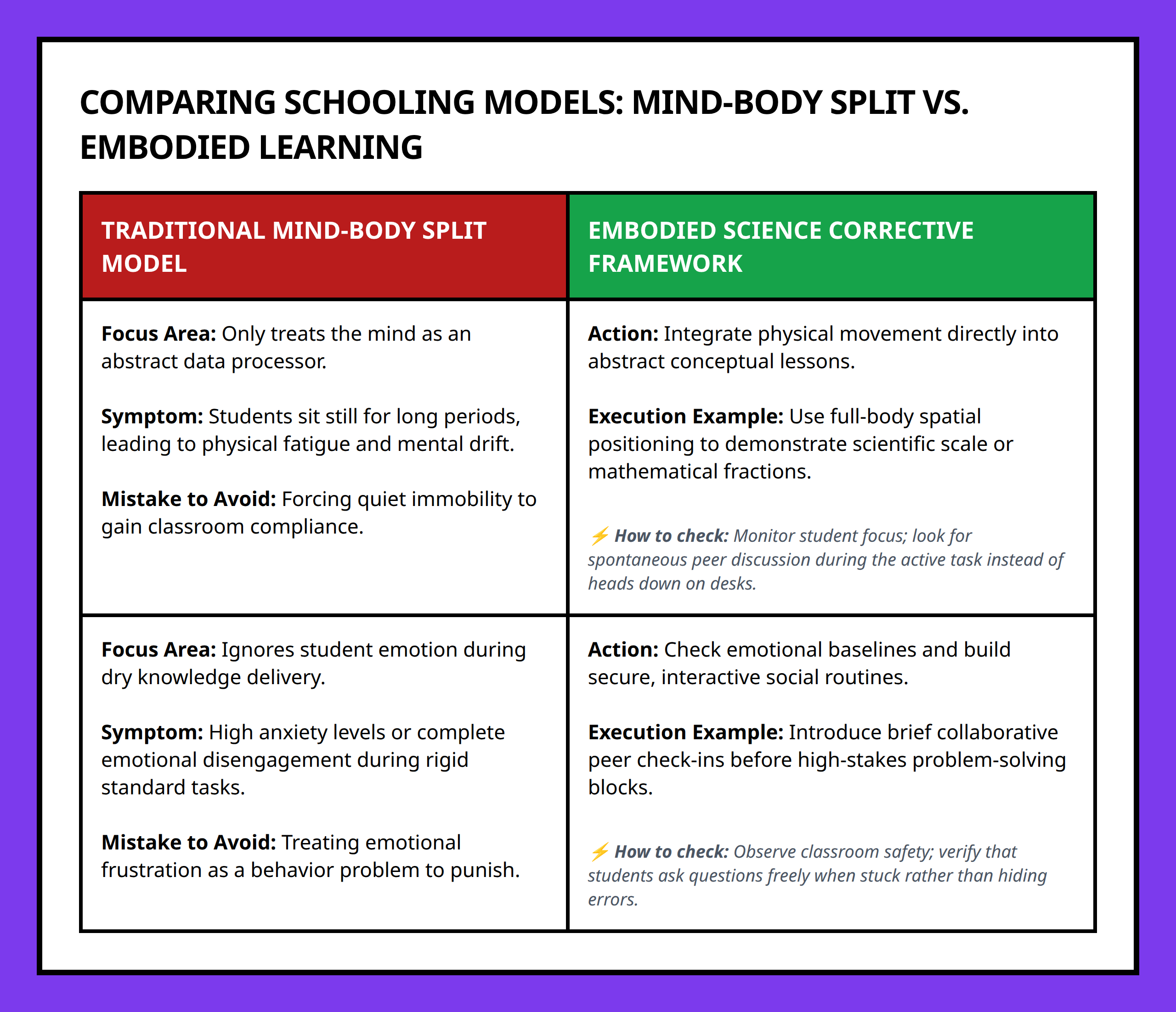
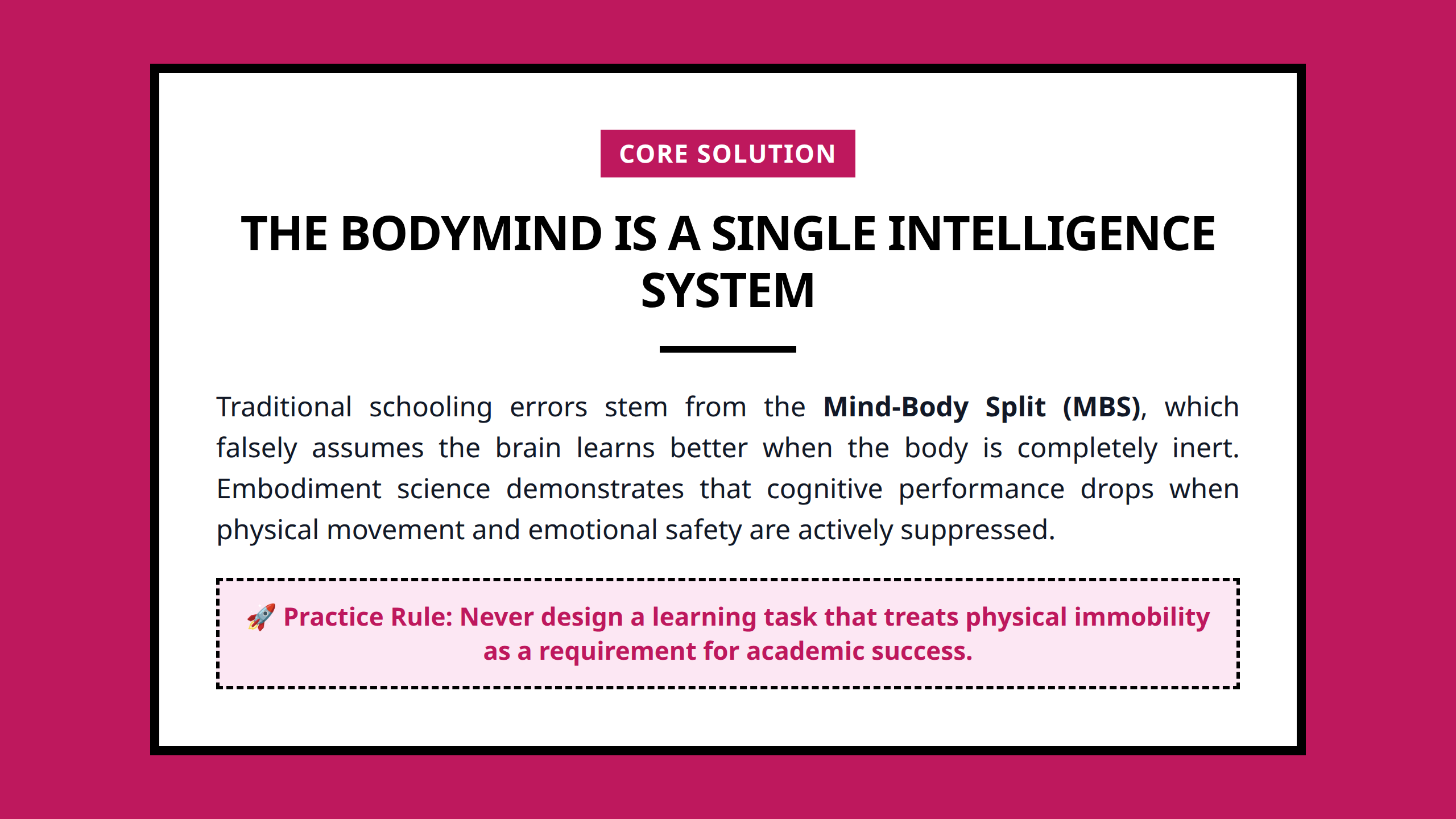
Many classrooms still operate as if the mind and body are separate systems.
The “real” learning is treated as mental activity: reasoning, remembering, analyzing, and explaining. The body becomes secondary. Movement is controlled. Emotion is managed. Physical awareness is mostly ignored unless it becomes disruptive.
You can see this assumption everywhere once you start looking for it.
A good student is often described as someone who sits still, focuses quietly, absorbs information efficiently, and reproduces it accurately during tests. Subjects connected to abstract thinking usually receive higher status than subjects involving movement, physical expression, or sensory engagement.
I do not think this structure survives because teachers are careless. In many cases, teachers are working hard inside a system built around a very old idea of intelligence.
The problem is that embodiment science increasingly suggests this model is incomplete.
Learning Is Not Just a Brain Activity
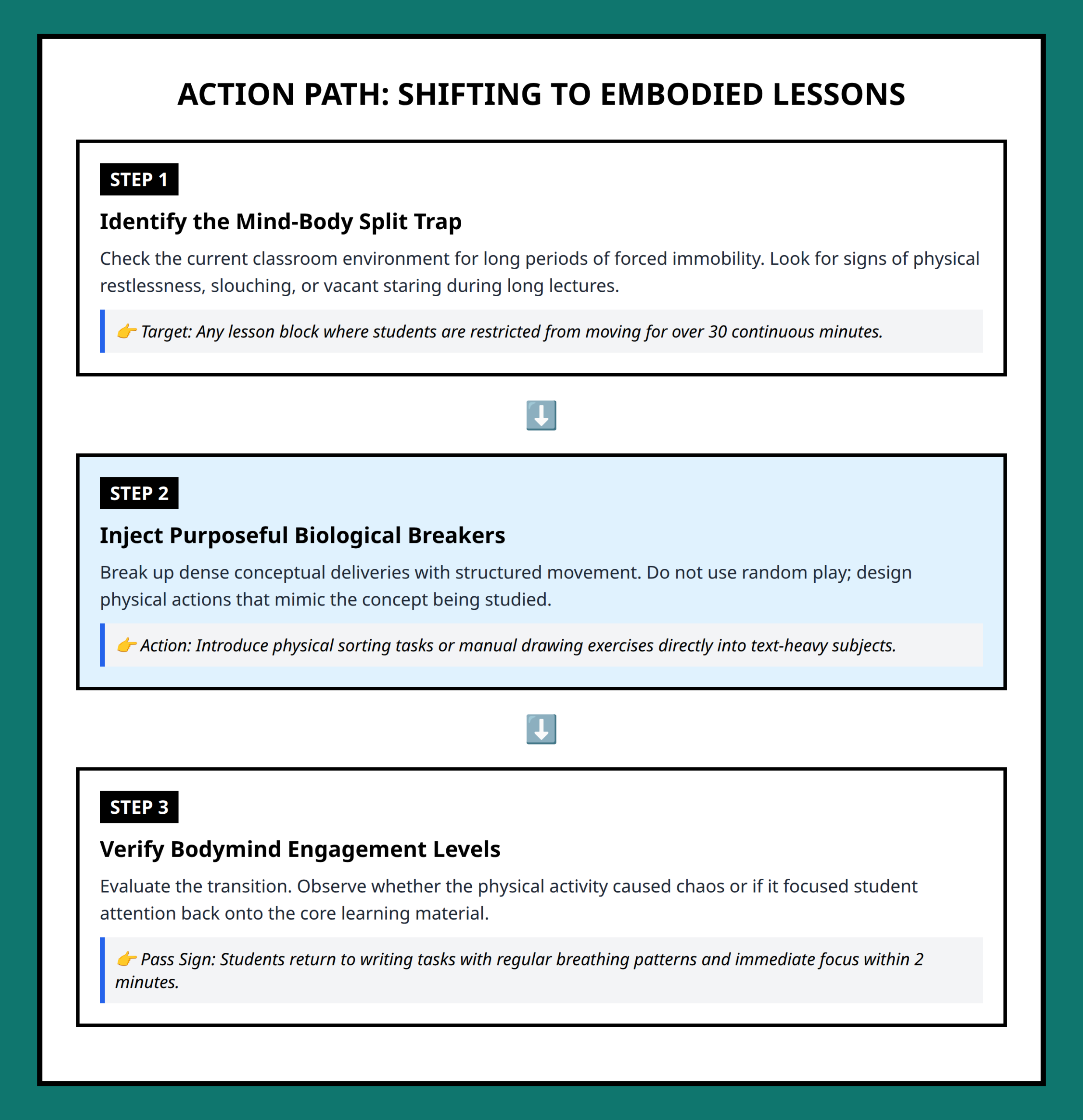
Embodiment science studies how thinking depends on the interaction between the brain, body, emotions, environment, and social relationships.
This changes the picture of learning in several important ways.
First, cognition is not isolated from physical experience. Movement, posture, gesture, breathing, and bodily sensations influence attention, memory, emotional regulation, and decision-making.
Second, emotions are not distractions from thinking. They shape what people notice, what they remember, and how they interpret situations.
Third, intelligence develops through interaction with environments and other people, not only through private mental processing.
I think this matters because traditional schooling often treats these factors as secondary. Schools may allow movement breaks or social-emotional activities, but they frequently remain add-ons rather than foundations.
That distinction is important.
There is a big difference between occasionally allowing movement and designing learning around the reality that human thinking is embodied from the start.
Why Many Students Become Disengaged
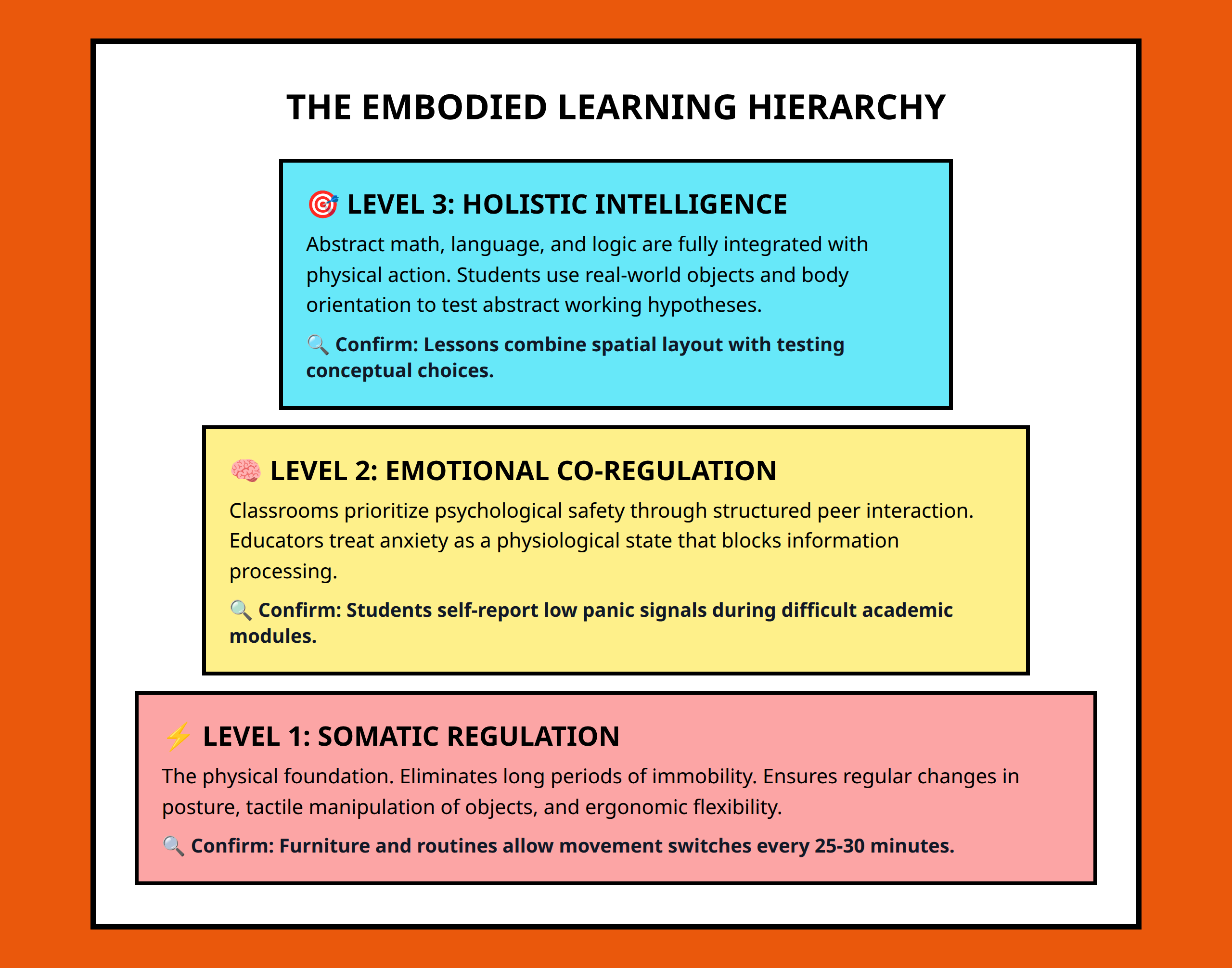
One of the strongest parts of embodiment science is how clearly it explains student disengagement.
When students are required to suppress movement, ignore internal signals, disconnect emotion from learning, and focus almost entirely on abstract symbolic tasks for long periods, some students adapt successfully. Many do not.
I would pay attention here to what happens in ordinary classrooms, not extreme situations.
Picture a middle-school student who spends six hours moving between short academic periods. Each class demands rapid switching between unrelated subjects. Most success depends on listening, writing, recalling information, and avoiding mistakes under time pressure.
That student may not look “disengaged” immediately. But over time, the body often signals strain before the student can fully explain it intellectually.
- Restlessness increases
- Attention weakens
- Anxiety rises
- Emotional shutdown appears
- Curiosity narrows
- Learning becomes performance management instead of exploration
Embodiment science does not reduce all school problems to classroom design. But it does argue that systems built around disembodied learning can unintentionally work against how human beings naturally process experience.
The Problem With Treating Intelligence as Fixed
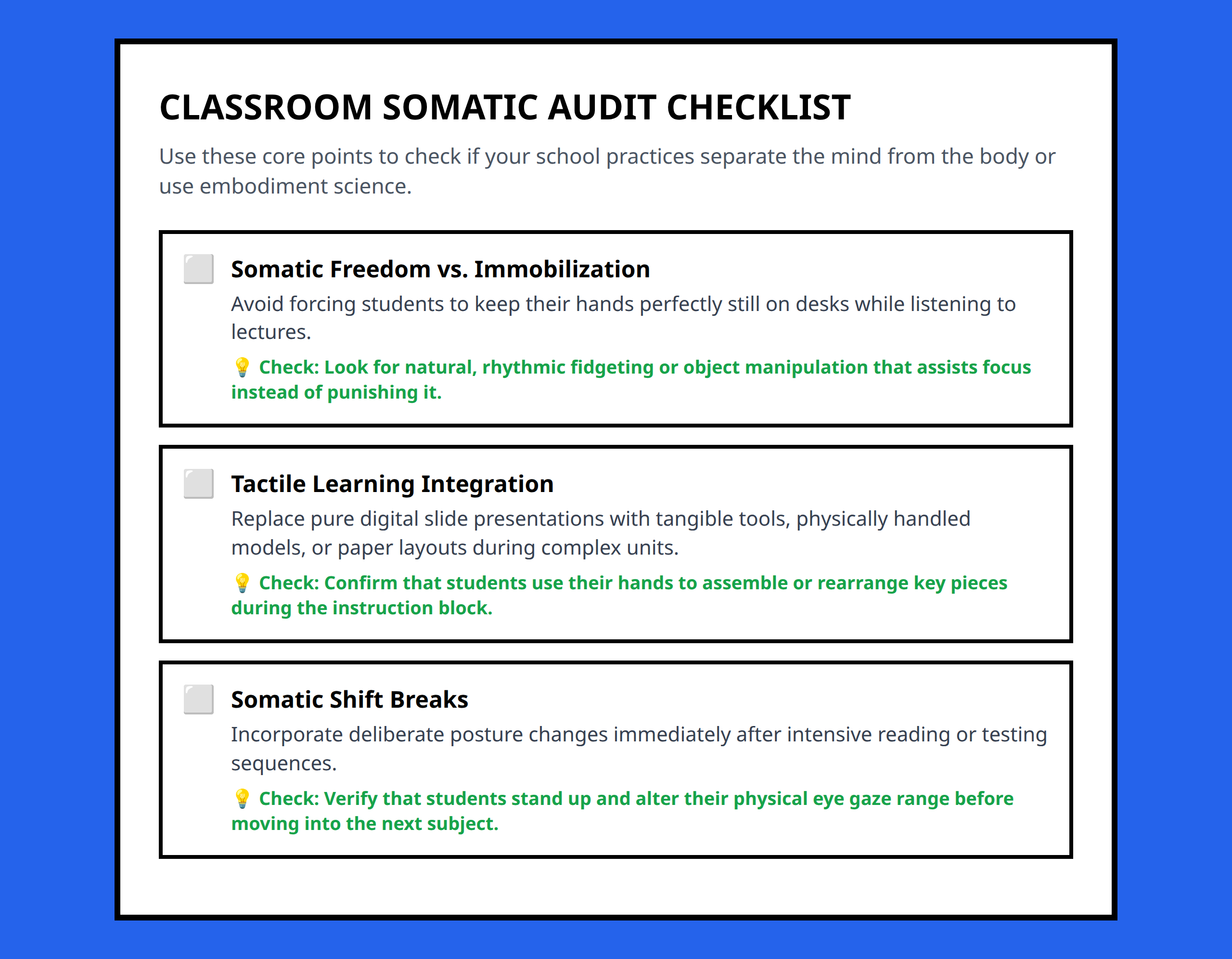
Traditional schooling often assumes that students possess a relatively fixed level of intellectual ability.
That assumption affects everything:
- grouping systems
- expectations
- testing structures
- teacher judgments
- student identity
What I find more useful in the embodiment perspective is the idea that intelligence develops through lived interaction.
Students are not only learning subject content. They are also learning how to think, how to respond emotionally, how to regulate attention, how to collaborate, and how to interpret themselves as learners.
This means schools shape cognitive habits at a biological and behavioral level, not just an academic one.
For example, a student repeatedly trained to avoid mistakes at all costs may become highly cautious intellectually. Another student constantly rewarded for rapid correct answers may learn to prioritize speed over reflection.
Those patterns do not stay inside the classroom. They become part of how people approach uncertainty outside school.
I think this is one reason some academically successful people still struggle with real-world judgment, adaptability, or collaboration. Memorizing information and performing well on standardized assessments are not the same thing as developing broad practical intelligence.
Why Physical Environment Matters More Than Schools Often Admit
One practical implication of embodiment science is that classroom environments are not neutral containers for learning.
Physical space changes cognition.
That includes:
- how students move
- whether they can interact naturally
- how much sensory variation exists
- whether attention is constantly compressed
- how emotionally safe the environment feels
I notice that many school improvement discussions focus heavily on curriculum alignment or test outcomes while treating physical experience as secondary.
But embodiment science suggests that the body is continuously gathering information from the environment.
A classroom that allows almost no movement communicates one message about learning. A classroom where students manipulate objects, shift positions, collaborate physically, and use space actively communicates another.
This does not mean every classroom should become chaotic or constantly active.
That misunderstanding appears often whenever embodied learning is discussed. Embodiment is not simply “more movement.” It is designing learning experiences that recognize cognition as connected to action, sensation, emotion, and social interaction.
Interoception May Be the Most Overlooked Skill in Schools
One concept I think deserves much more attention is interoception.
Interoception refers to awareness of internal bodily signals: breathing, tension, heartbeat, energy levels, discomfort, calmness, emotional shifts, and physical stress responses.
Many students move through school with very little guidance on recognizing these signals.
Instead, they are often taught to override them.
A tired student pushes through exhaustion. An anxious student suppresses stress before presentations. A restless student learns to stay motionless even when movement might improve concentration.
Embodiment science argues that stronger interoceptive awareness supports better emotional regulation, decision-making, and adaptability.
I think this changes how educators should think about “focus.”
Focus is not only a mental discipline problem. Sometimes it is an unrecognized physiological problem.
A student who cannot regulate attention may also be struggling with overload, stress, sensory fatigue, or emotional dysregulation.
Once schools start viewing learning through that lens, classroom practice changes naturally.
What Embodied Learning Looks Like in Practice
The practical side of embodiment science is more grounded than many people expect.
It does not require abandoning academic rigor.
What changes is the relationship between knowledge and lived experience.
In practice, embodied classrooms often include:
- more movement during thinking processes
- greater use of gesture and physical modeling
- learning tied to real-world contexts
- stronger social interaction during problem-solving
- attention to emotional climate
- activities involving sensory engagement
- reflection on physical and emotional states during learning
I would also pay attention to pacing.
Traditional schooling frequently forces abrupt cognitive switching. Students may move from algebra to literature to chemistry to history within a few hours, each with different expectations and little integration.
Embodied approaches often emphasize continuity, immersion, and deeper engagement with fewer disconnected tasks.
That shift may sound small, but it changes how students experience learning psychologically.
The Real Challenge Is Cultural, Not Technical
The hardest part of changing schooling is probably not finding new techniques.
The harder challenge is changing what schools believe intelligence looks like.
As long as intelligence is treated mainly as abstract academic performance, embodied approaches will remain secondary. They will appear as enrichment programs, optional wellness activities, or temporary innovations instead of structural priorities.
I think this explains why many reforms disappear after leadership changes. The deeper assumptions stay untouched.
If schools continue to define success mainly through narrow forms of information retention and written assessment, the wider bodymind dimensions of learning will keep getting squeezed out.
That tension becomes especially visible when schools face pressure around testing, rankings, and university admissions. Under pressure, systems often retreat toward what is easiest to measure.
Unfortunately, some of the most important dimensions of learning are not the easiest to quantify.
The Most Important Shift May Be Conceptual
The biggest lesson I take from embodiment science is not that schools need more movement breaks or flexible seating.
The deeper lesson is that human intelligence is not purely intellectual.
Thinking emerges through relationships between body, emotion, environment, memory, attention, social interaction, and action. Once schools recognize that fully, classroom practice stops being about delivering information efficiently and starts becoming an apprenticeship in how to engage with the world intelligently.
That changes what educators notice.
A fidgeting student may not simply be “off task.” A quiet classroom may not always be a deeply engaged classroom. A student with average test scores may still possess strong practical judgment, emotional awareness, or adaptive intelligence that traditional systems barely recognize.
I would not treat embodiment science as a fashionable classroom trend. I would treat it as a warning that many schools are still built around an outdated understanding of how people actually learn.
And once you see that clearly, it becomes difficult to believe that better test preparation alone will solve the deeper problem.
References:
- https://www.sciencedirect.com/science/article/pii/S0742051X25004135
- https://www.centerforengagedlearning.org/embodiment-in-learning-on-location-why-mindful-movement-matters/
- https://www.routledge.com/Bodies-of-Learning-How-Embodiment-Science-Transforms-Education/Claxton-Poel/p/book/9781032677576
- https://www.linkedin.com/posts/jonathan-boymal-448b5870_the-newly-released-bodies-of-learning-how-activity-7465154097902522368-j74m
- https://pmc.ncbi.nlm.nih.gov/articles/PMC6779792/
- https://www.taylorfrancis.com/books/mono/10.4324/9781032678245/bodies-learning-guy-claxton-emily-poel
- https://researchschool.org.uk/essex/news/embodied-learning-moving-away-from-the-slides
- https://carleton.ca/teachingresources/engaging-your-students/embodied-learning/
- https://www.frontiersin.org/journals/education/articles/10.3389/feduc.2025.1568744/full
- https://www.structural-learning.com/post/embodied-cognition
- https://www.tandfonline.com/doi/full/10.1080/00038628.2025.2523265
- https://asu.elsevierpure.com/en/publications/embodiment-for-education/
- https://www.integrationtraining.co.uk/blog/2013/04/science-of-embodiment/