
Nornir helps network engineers scale automation by organizing devices, tasks, and workflows into a structured orchestration framework that works reliably across large environments.
I think many engineers experience the same turning point with automation. The first few scripts feel exciting because they save time immediately. Running commands against two or three routers with Netmiko feels simple and efficient.
The problems appear later.
Once the environment grows beyond a handful of devices, the automation itself starts becoming difficult to manage. At that stage, the challenge is no longer sending commands. The challenge is coordinating workflows across dozens or hundreds of systems consistently.
Why Device-by-Device Scripts Eventually Break Down
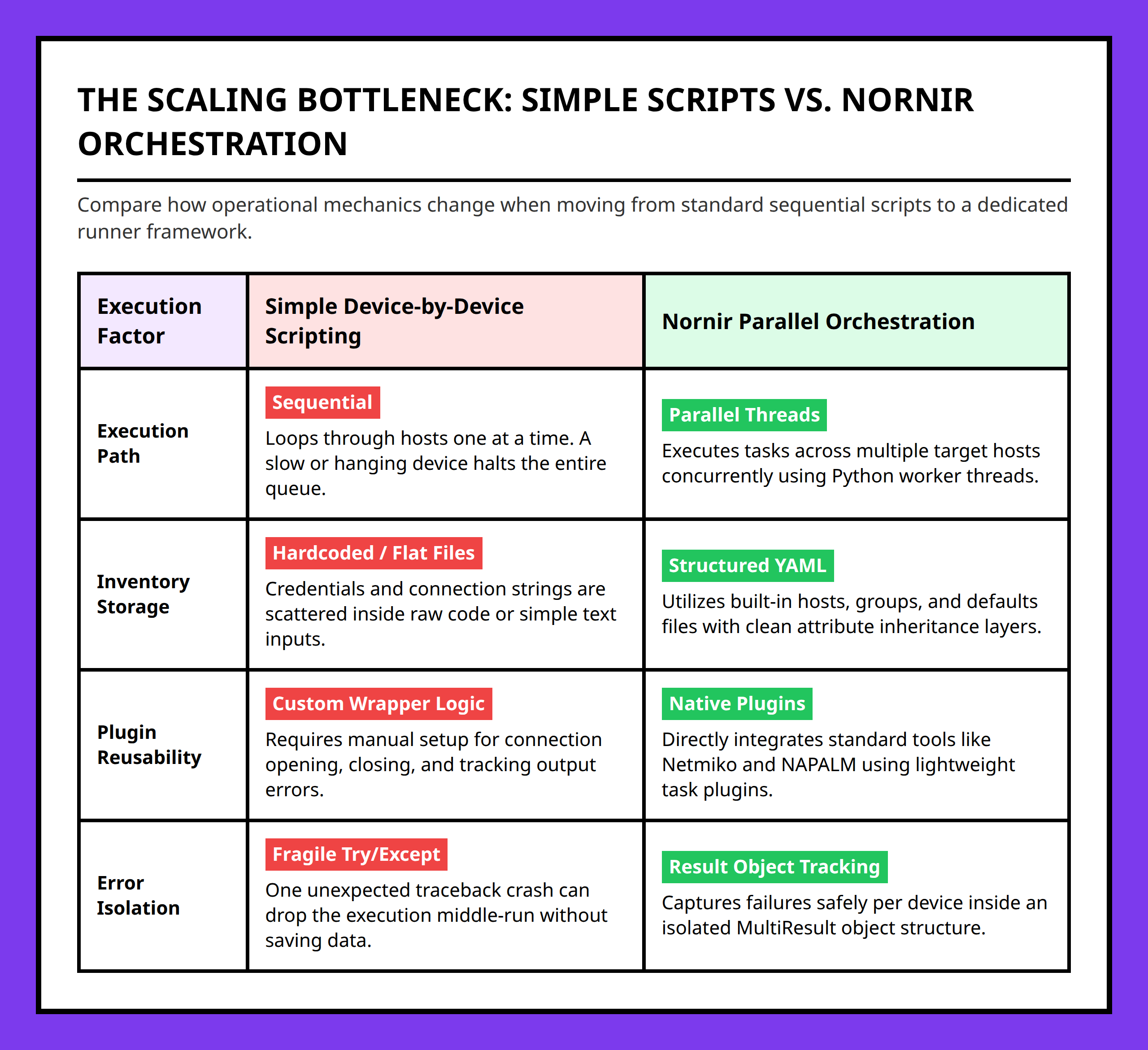
Most early automation scripts are written around individual devices. A script logs into a router, runs commands, prints output, and disconnects.
That model works surprisingly well at small scale.
But operational pressure changes once the network grows. Suddenly the engineer needs to:
- group devices by location
- target only certain vendors
- apply changes to subsets of devices
- reuse credentials safely
- run tasks concurrently
- track failures consistently
I think this is where many engineers accidentally create fragile automation systems without realizing it. Small scripts slowly turn into large procedural files filled with loops, conditionals, inventory spreadsheets, and copied connection logic.
The automation technically works, but operationally it becomes difficult to maintain.
Nornir Changes the Focus from Scripts to Workflows
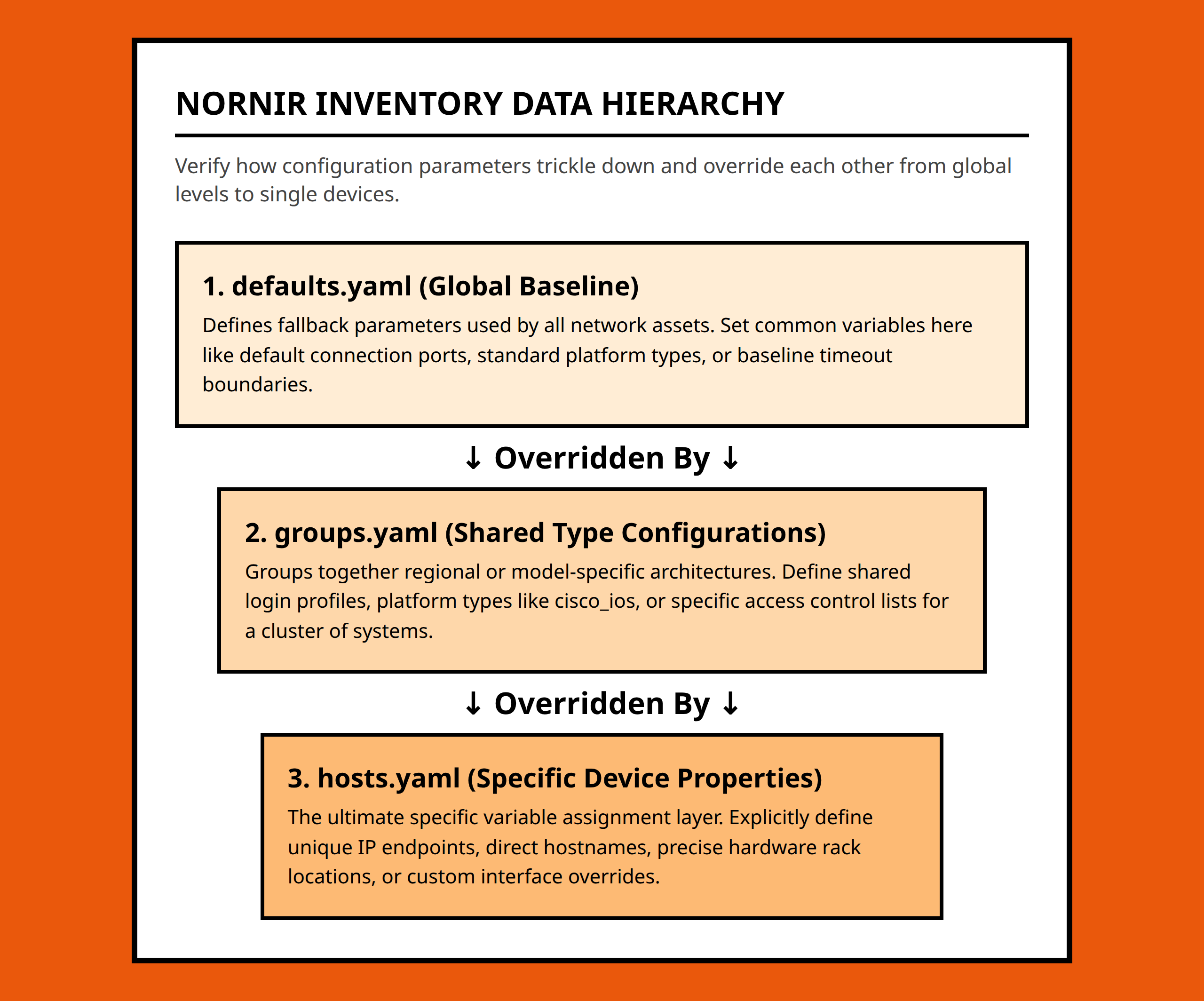
What makes Nornir different is that it treats automation as orchestration rather than isolated scripting.
Instead of building everything manually inside one Python file, Nornir separates important operational layers:
- inventory
- grouping
- filtering
- task execution
- parallel processing
I find this separation important because it mirrors how engineers already think about large environments operationally.
A network team rarely thinks:
“Run this command on router 17.”
They usually think:
“Run this workflow against all branch routers in Singapore.”
Nornir supports that operational mindset directly.
Inventory Management Becomes the Foundation
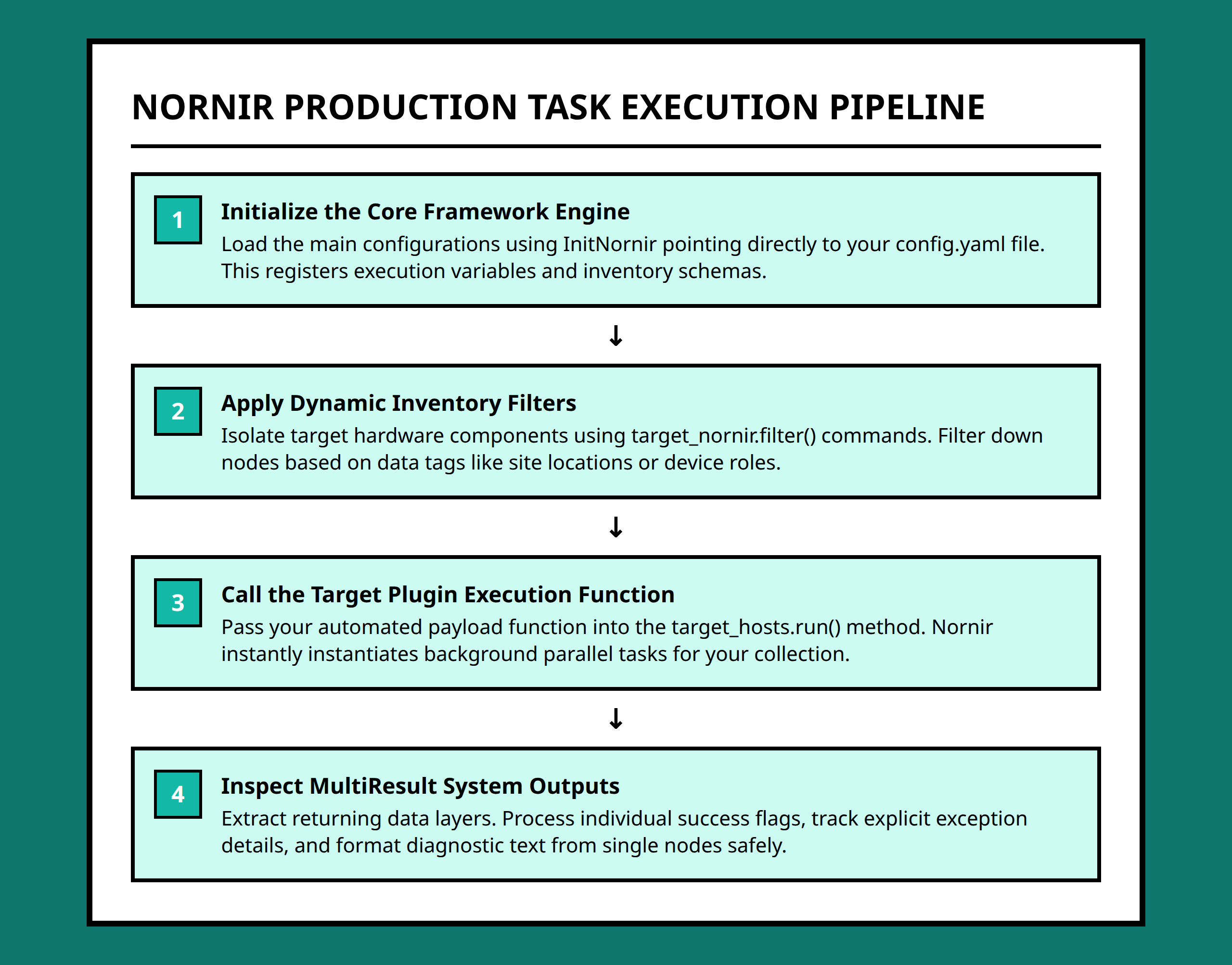
One of the biggest ideas behind Nornir is that inventory management matters just as much as the automation logic itself.
Instead of hardcoding device details into scripts, Nornir stores inventory information externally using YAML files.
A simplified inventory structure might include:
hosts: router1: hostname: 10.1.1.1 groups: - branch groups: branch: platform: ios username: admin password: cisco At first glance, this may look like a small implementation detail. Operationally, though, it changes everything.
The automation workflow no longer depends on manually editing scripts every time a device changes. Inventory becomes reusable infrastructure.
I would pay close attention to this if managing a growing environment. Once engineers stop embedding operational data directly into scripts, automation becomes much easier to scale safely.
Grouping and Filtering Reduce Operational Risk
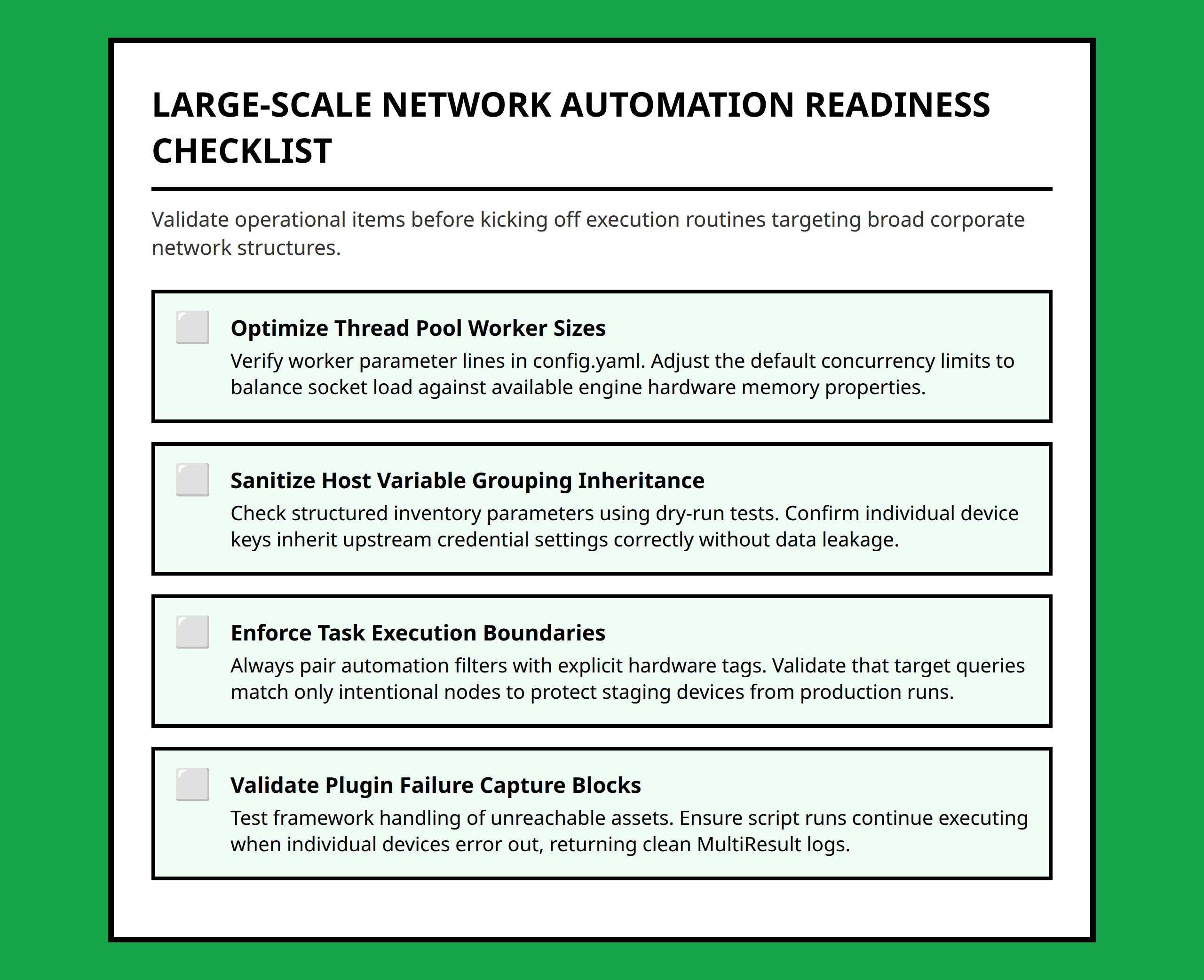
I think filtering is one of the most underrated parts of scalable automation.
Without filtering, automation becomes dangerous very quickly.
A realistic situation might involve an engineer preparing to update NTP settings across branch routers. Running the task against the wrong device group could accidentally affect core infrastructure or lab systems.
Nornir reduces this risk by allowing workflows to target specific subsets of devices intentionally.
For example:
branch_devices = nr.filter(site="singapore") That kind of filtering sounds simple, but operationally it creates much safer automation boundaries.
The larger the environment becomes, the more valuable that control becomes.
Parallel Execution Changes Automation Speed
One limitation of traditional sequential scripts is speed.
If a script connects to devices one at a time, execution slows dramatically as environments grow. Waiting for 100 devices sequentially introduces unnecessary delays even when the workflow itself is straightforward.
Nornir improves this through parallel task execution.
I think this matters for more than convenience. Faster execution changes how automation fits into operations.
A verification workflow that once took an hour manually can complete in minutes across large environments. That speed encourages engineers to automate routine validation tasks more often because the operational overhead becomes smaller.
And importantly, the engineer does not need to manually build complex threading systems. Nornir handles much of the orchestration internally.
Plugins Make Existing Automation Reusable
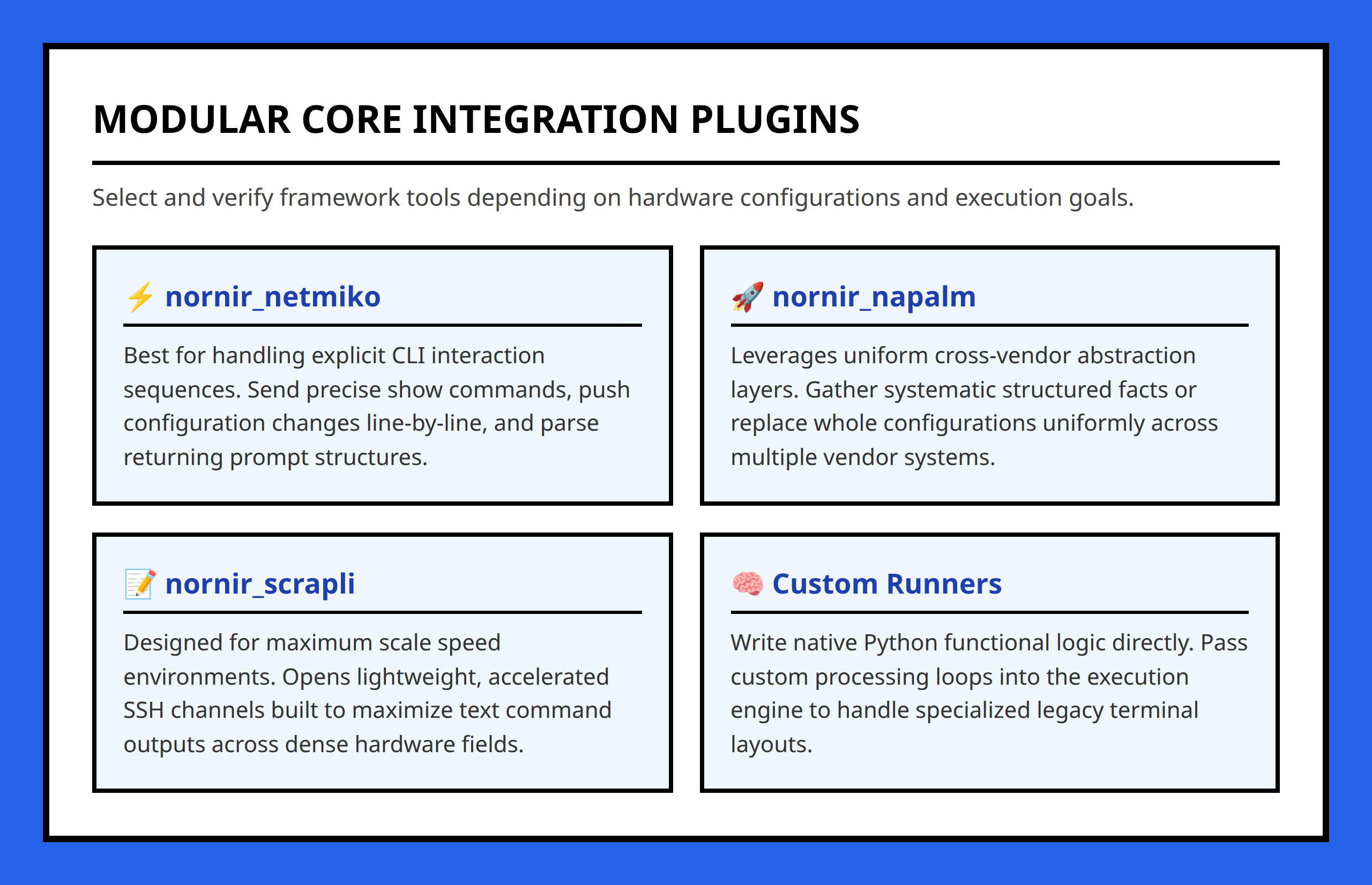
Another practical advantage is that Nornir integrates well with tools engineers may already use.
Instead of replacing existing workflows completely, Nornir often orchestrates them.
For example, engineers can continue using:
- Netmiko for SSH interactions
- NAPALM for structured operational data
- custom Python functions for validation
I think this flexibility is one reason Nornir feels approachable operationally. It does not force teams into a rigid ecosystem immediately.
Instead, it organizes and coordinates existing automation building blocks more effectively.
Scaling Automation Is Really About Reducing Complexity
One thing I would emphasize is that scaling automation is not only about handling more devices.
It is about reducing operational complexity as environments grow.
Without orchestration, engineers often end up maintaining:
- duplicated scripts
- hardcoded credentials
- manual device lists
- inconsistent execution logic
- vendor-specific exceptions
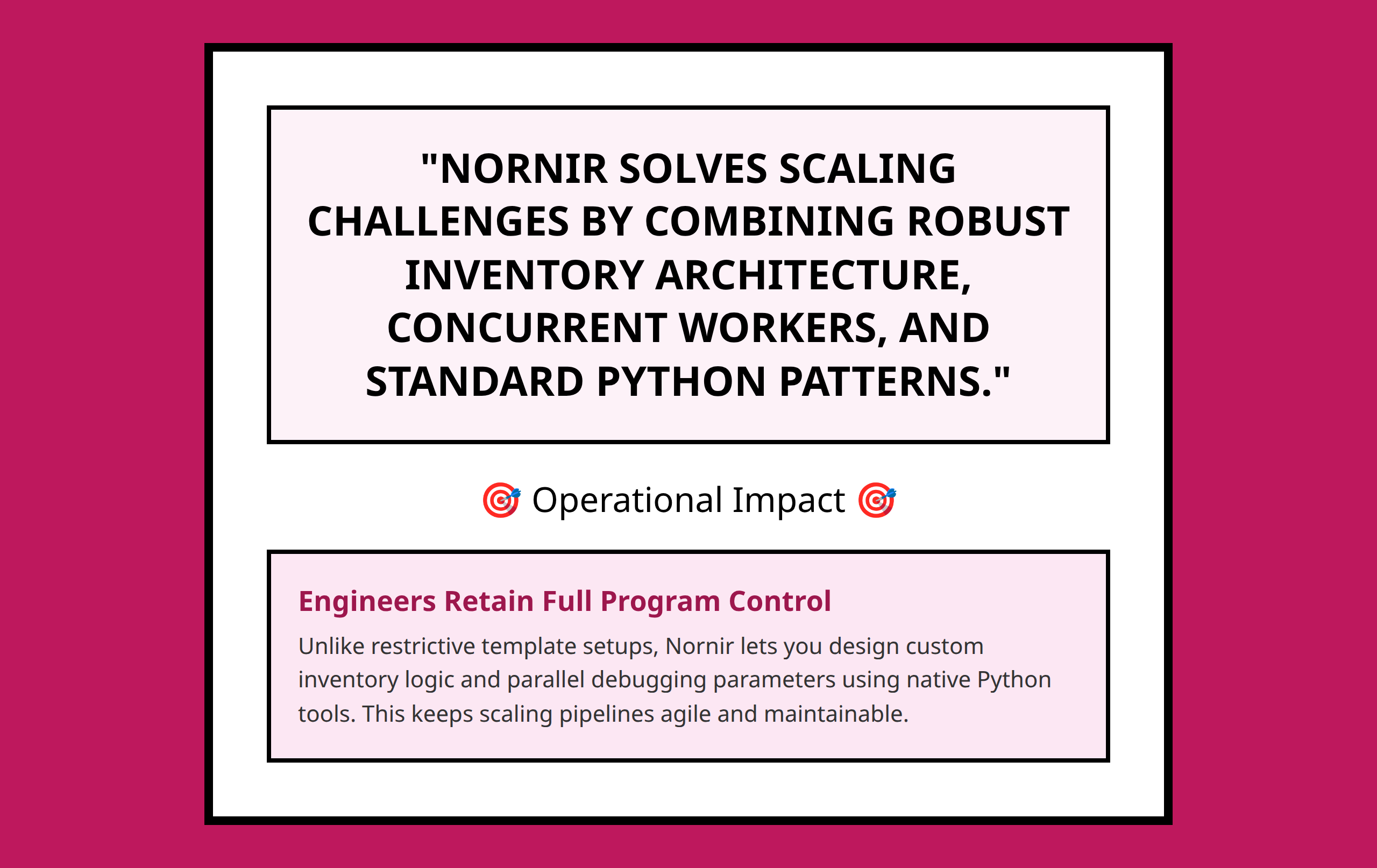
Nornir addresses these problems by introducing structure around automation workflows.
The framework encourages engineers to think operationally:
- How should devices be grouped?
- Which tasks should run together?
- What information belongs in inventory?
- How should failures be isolated?
Those questions matter because operational scale is rarely limited by Python syntax. It is usually limited by organizational complexity.
Why Nornir Feels Like a Production-Oriented Framework
What stands out to me most is that Nornir feels designed for long-term operational use rather than quick demonstrations.
Small scripts optimize for simplicity. Nornir optimizes for maintainability.
That distinction becomes increasingly important once automation moves from personal experimentation into real infrastructure operations.
I would not introduce orchestration too early for beginners. But once automation starts touching large inventories, multiple teams, or recurring workflows, structured orchestration stops feeling optional.
At that point, the biggest challenge is no longer writing commands. It is managing automation itself in a way that remains predictable as the environment grows. fileciteturn5file0
References:
- https://www.youtube.com/shorts/CkvVvVNpSkM
- https://www.youtube.com/watch?v=yrjupsuY5ss
- https://www.youtube.com/watch?v=tERBjiB-Lv8
- https://orhanergun.net/scaling-network-automation-nornir-python
- https://netodata.io/complete-guide-to-nornir-network-automation-for-engineers/
- https://github.com/nornir-automation/nornir/issues/264
- https://campusnetworkengineering.com/posts/practical-automation-series-part-2/
- https://networkjourney.com/automating-network-operations-with-cisco-nornir/
- https://devangnp.github.io/blog/nornir-learning/
- https://advnetmanagement.com/network-configuration-and-automation-tools/nornir/
- https://www.reddit.com/r/networking/comments/12u2wmr/zero_to_hero_network_automation_what_does_your/
- https://www.reddit.com/r/networking/comments/12u2wmr/zero_to_hero_network_automation_what_does_your/jh5b026/
- https://www.reddit.com/r/networking/comments/xfxo1v/how_would_you_automate_changing_1_line_of_config/
- https://www.reddit.com/r/networking/comments/1ah5db3/network_automation_dilemma_only_solution_a_slow/
- https://www.ciscolive.com/c/dam/r/ciscolive/global-event/docs/2025/pdf/CISCOU-1056.pdf