
Many students approach limits as a collection of formulas and tricks. The deeper structure is usually hidden inside inequalities, bounds, and comparison logic. Once those ideas become visible, difficult limit problems often become much easier to reason through.
I used to think inequalities were mostly technical details added to proofs because mathematics demanded rigor. Then I noticed something uncomfortable: every time a limit problem became genuinely difficult, inequalities suddenly became central again.
At first that felt repetitive. Later it started looking intentional.
The more I studied sequences, bounded sets, supremum and infimum, and convergence arguments, the more obvious the pattern became. Limits are rarely controlled directly. They are controlled indirectly through comparison, restriction, and numerical confinement.
Most Limit Problems Are Really Control Problems
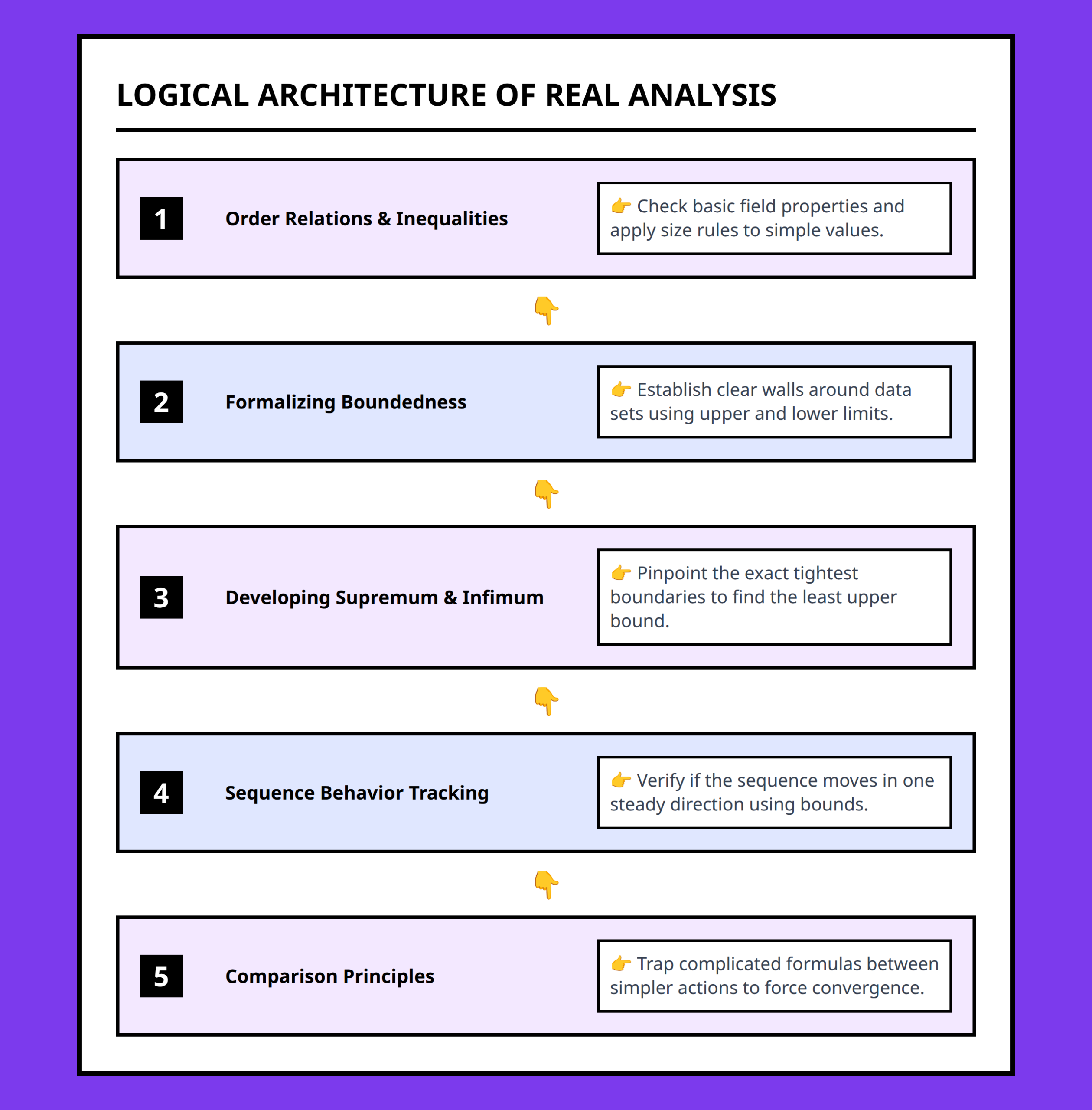
Students often see a limit problem and immediately search for an algebraic manipulation.
Sometimes that works. But many important problems cannot be solved cleanly through symbolic rearrangement alone. What matters instead is controlling the behavior of the quantity.
This is where inequalities enter naturally.
If I know a sequence stays trapped between two shrinking quantities, I already know something powerful about its behavior. If I know a function never escapes a bounded interval, the problem changes from “What could happen?” to “What are the remaining possibilities?”
That is a completely different mindset.
I think many students struggle because they view limits as prediction problems. In practice, analysis often treats them as restriction problems.
You are not always trying to compute behavior directly. Sometimes you are trying to eliminate instability until only one behavior remains possible.
Boundedness Is More Important Than It First Appears
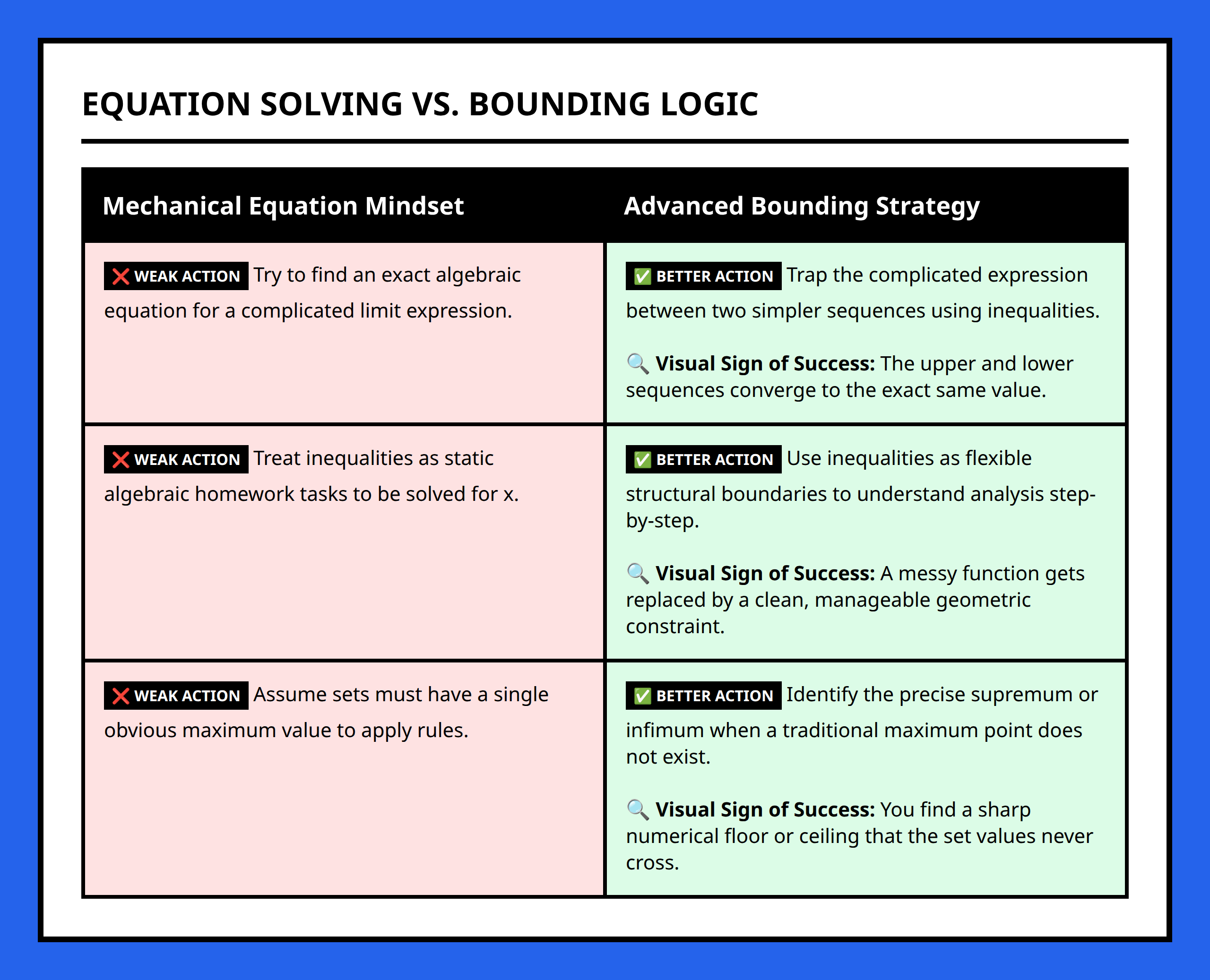
The idea of boundedness looks simple at first. A set or sequence stays inside fixed numerical limits.
But boundedness quietly changes the structure of many arguments in analysis.
An unbounded sequence can drift indefinitely. A bounded sequence cannot. That immediately narrows the range of possible behaviors.
I would pay attention to this distinction early because it appears repeatedly across convergence theory.
Take a sequence like:
u_n = n/(n+1)
Every term stays between 0 and 1.
That observation matters before any formal limit computation begins. The sequence is already operating inside a controlled environment.
Now compare that with:
u_n = n
There is no upper restriction. The sequence keeps expanding without compression.
A realistic way to picture this is to imagine monitoring a temperature sensor in a server room. If the readings fluctuate but always remain inside a safe operating range, you investigate stabilization patterns. If the readings rise without bound, the diagnosis changes immediately.
Mathematical boundedness works similarly. It tells you whether the system is even capable of settling into controlled behavior.
Supremum and Infimum Reveal Why Bounds Matter Structurally
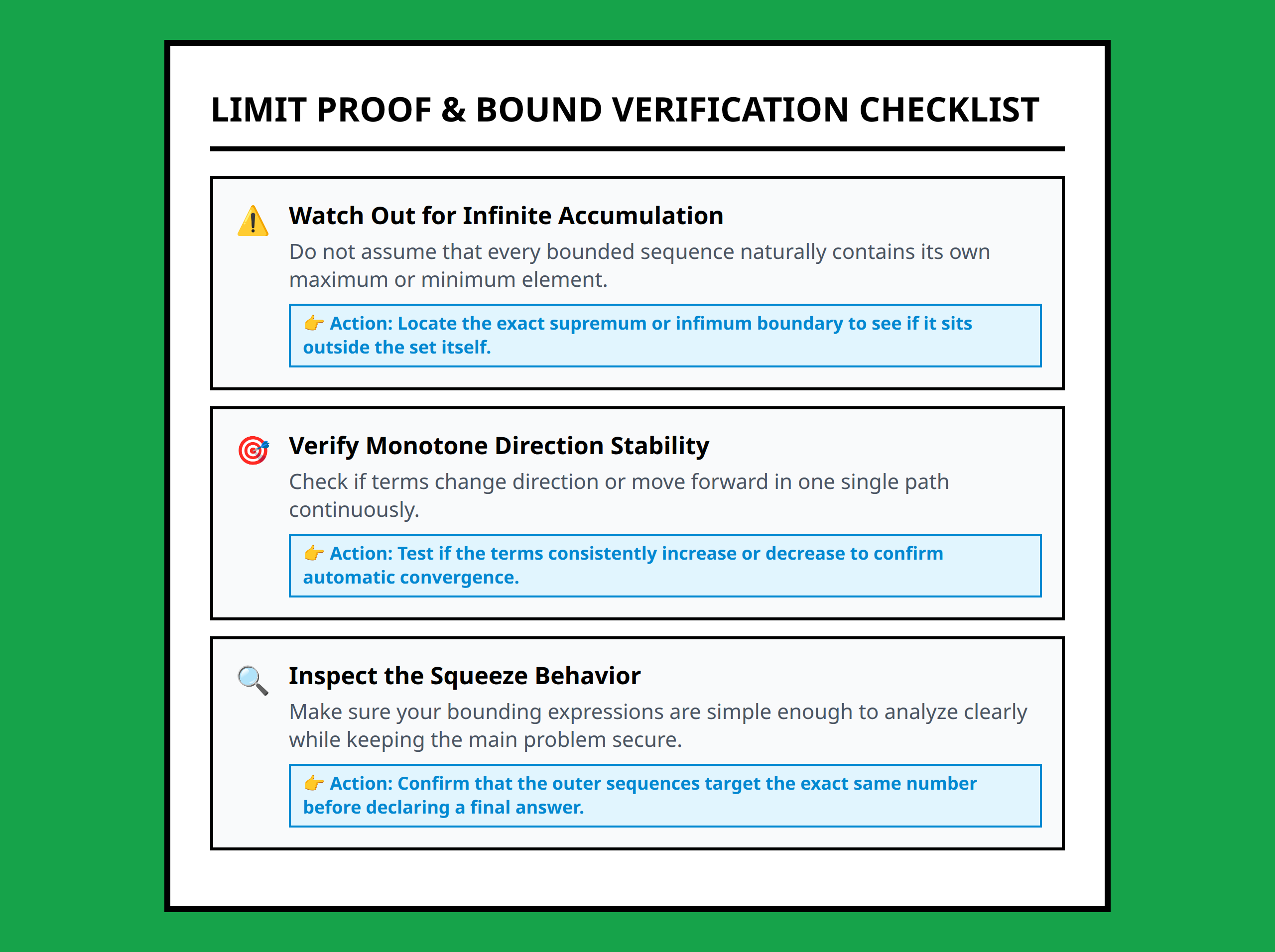
One reason inequalities become so important is that analysis does not rely only on maximum and minimum values.
The ideas of supremum and infimum push the reasoning further.
I think this is one of the first moments where real analysis stops feeling like advanced algebra and starts feeling conceptually different.
A set may not contain its largest possible value, yet it can still have a least upper bound.
For example, the interval:
[0,1)
does not contain 1, but 1 still acts as the supremum.
This matters because analysis often studies behavior near boundaries rather than exactly at them.
The supremum acts like a limiting wall that sequences or sets can approach indefinitely.
I would not treat supremum and infimum as vocabulary definitions to memorize. They explain why bounding arguments remain meaningful even when extrema do not exist directly inside the set.
That distinction becomes extremely important once convergence enters the picture.
Inequalities Create Compression Inside Limit Problems
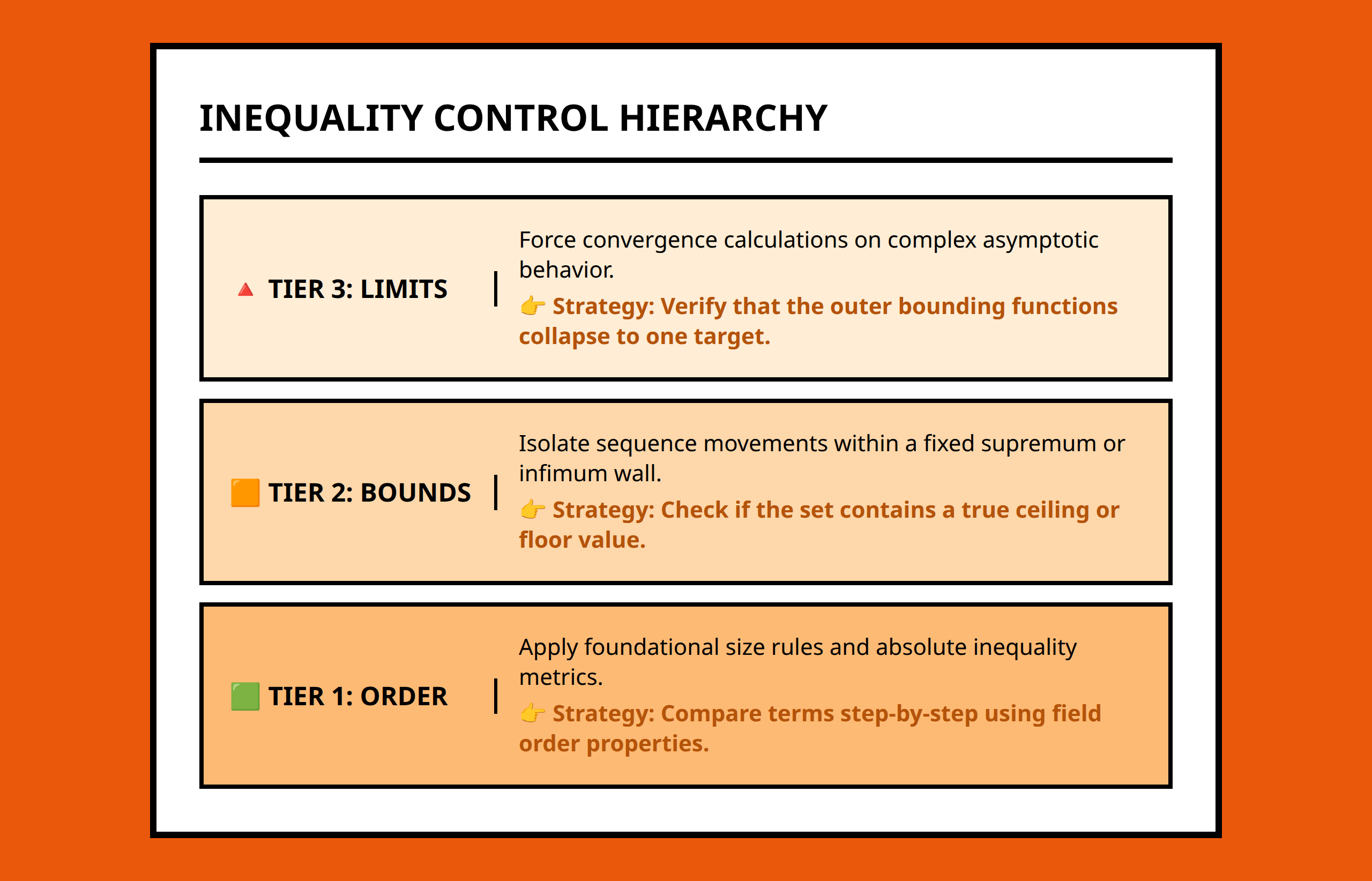
One of the most practical uses of inequalities is compression.
A difficult expression becomes manageable once it is trapped between simpler quantities.
This appears repeatedly in sequence analysis and comparison arguments.
For example, suppose a sequence satisfies:
0 ≤ u_n ≤ 1/n
The exact formula for u_n may be messy or difficult to analyze directly. But the inequality already reveals the essential behavior.
Since:
1/n → 0
the sequence is forced toward zero as well.
I like this kind of argument because it shifts attention away from symbolic complexity and toward behavioral restriction.
In practice, this is similar to estimating travel time during heavy traffic. You may not know the exact arrival minute, but if navigation apps consistently narrow the range between 20 and 22 minutes, the uncertainty becomes manageable.
The inequalities compress the possibilities.
Comparison Logic Is Really About Behavioral Similarity
Comparison arguments become much easier once you stop treating them like isolated proof techniques.
The underlying question is simple:
Does one quantity behave similarly enough to another known quantity that their long-term behavior becomes linked?
This idea appears throughout limits, sequences, and series.
I would look less at the exact formulas and more at the dominant behavior.
For large values of n, some terms become negligible while others control the expression. Comparison logic helps identify which part actually drives the asymptotic behavior.
This is especially useful in complicated rational expressions or nested inequalities.
Students sometimes try to manipulate every symbol equally. But many successful convergence arguments work by identifying which terms matter structurally and which terms fade into irrelevance.
That is not a trick. It is a form of asymptotic judgment.
Monotone Sequences Show How Bounds Produce Stability
One of the clearest examples of inequalities supporting convergence appears in monotone sequences.
An increasing sequence with an upper bound cannot increase indefinitely. A decreasing sequence with a lower bound cannot decrease forever.
The inequalities force stabilization.
I think this idea becomes much more intuitive when viewed dynamically.
Imagine filling a glass with water using smaller and smaller pours. The water level keeps increasing, but the container creates a hard restriction. Eventually the growth becomes compressed near the upper boundary.
That is extremely close to the logic behind monotone bounded convergence.
The sequence is not converging because of algebraic luck. It is converging because directional movement and structural restriction interact together.
Once I started seeing convergence this way, many proofs stopped feeling arbitrary.
Why Difficult Proofs Usually Depend on Small Inequalities
Students often expect advanced analysis to depend on sophisticated formulas.
Surprisingly, many difficult proofs depend on relatively small inequalities repeated carefully.
The triangle inequality, comparison inequalities, distance bounds, and ordering relations appear constantly because they provide reliable control over uncertain behavior.
I would even say inequalities act like the steering system of analysis.
Without them, you may still have intuition, but you lose precision. The argument drifts.
With them, abstract behavior becomes measurable and constrained.
This is why inequalities appear repeatedly across topics that initially seem unrelated:
- limits
- bounded sets
- convergence
- Cauchy sequences
- monotonicity
- supremum arguments
They are not decorative additions to proofs. They are the mechanism that keeps the reasoning stable.
The Real Shift Happens When You Stop Chasing Exact Values First
I think one of the biggest turning points in learning analysis happens when you stop asking only:
“What is the exact limit?”
and start asking:
- What controls this behavior?
- What restricts this sequence?
- What can the expression not do?
- What comparisons reveal the long-term structure?
That shift changes the role of inequalities completely.
They stop looking like side calculations and start looking like the framework underneath the entire argument.
Once that perspective settles in, many difficult limits become less about clever tricks and more about patiently building enough control that the answer has nowhere else to go.
References:
- https://math.stackexchange.com/questions/382757/why-is-the-definition-of-limit-difficult-to-understand-at-first
- https://math.stackexchange.com/a/382779
- https://math.stackexchange.com/questions/1937903/is-in-general-incorrect-taking-limits-of-inequalities
- https://math.stackexchange.com/questions/4794399/why-do-inequalities-work
- https://www.quora.com/Why-is-understanding-limits-so-crucial-in-calculus-and-how-can-you-get-a-head-start-on-this-concept
- https://betterexplained.com/articles/why-do-we-need-limits-and-infinitesimals/
- https://www.reddit.com/r/learnmath/comments/1n96v5f/is_limits_genuinely_harder_than_differentiation/
- https://www.youtube.com/watch?v=9MD4iqkXER0
- https://www.revisiondojo.com/blog/why-are-inequalities-with-functions-so-easy-to-mess-up-in-ib-maths
- https://math.libretexts.org/Bookshelves/Algebra/Elementary_Algebra_(LibreTexts)/02:_Linear_Equations_and_Inequalities/2.07:_Introduction_to_Inequalities_and_Interval_Notation
- https://www.khanacademy.org/math/algebra-home/alg-absolute-value/alg-absolute-value-inequalities/v/absolute-value-inequalities
- https://www.quora.com/What-is-the-importance-of-learning-the-concept-of-limits
- https://www.pearson.com/channels/beginning-algebra/learn/patrick/2-linear-equations-and-inequalities/solving-linear-inequalities
- https://www.jirka.org/ra/html/sec_factslimsseqs.html