
SELinux audit logs are not just error messages. They are one of the most important operational tools for understanding why Android security decisions fail and how to refine policies safely without weakening the system blindly.
One thing I notice when developers first work with SELinux is how quickly the logs start looking overwhelming. A service fails. An app crashes. A denial appears in the console with unfamiliar labels, contexts, and permission names. The natural reaction is often to disable enforcement temporarily or allow more access than necessary.
That usually creates bigger problems later.
What changed my view of SELinux debugging was realizing the audit system is designed to explain the security model operationally. The logs are not random warnings. They are structured descriptions of what the kernel observed, what policy blocked, and which parts of the system interacted incorrectly.
Takeaways
- SELinux audit logs show exactly which access attempts failed and why.
- The Linux audit subsystem connects kernel security decisions to readable diagnostic events.
- SELinux denials include subjects, objects, permissions, and security contexts.
- Policy development becomes an iterative workflow driven by audit interpretation.
- Blindly allowing denials without understanding contexts can weaken Android security quickly.
The audit system exists because security failures need visibility
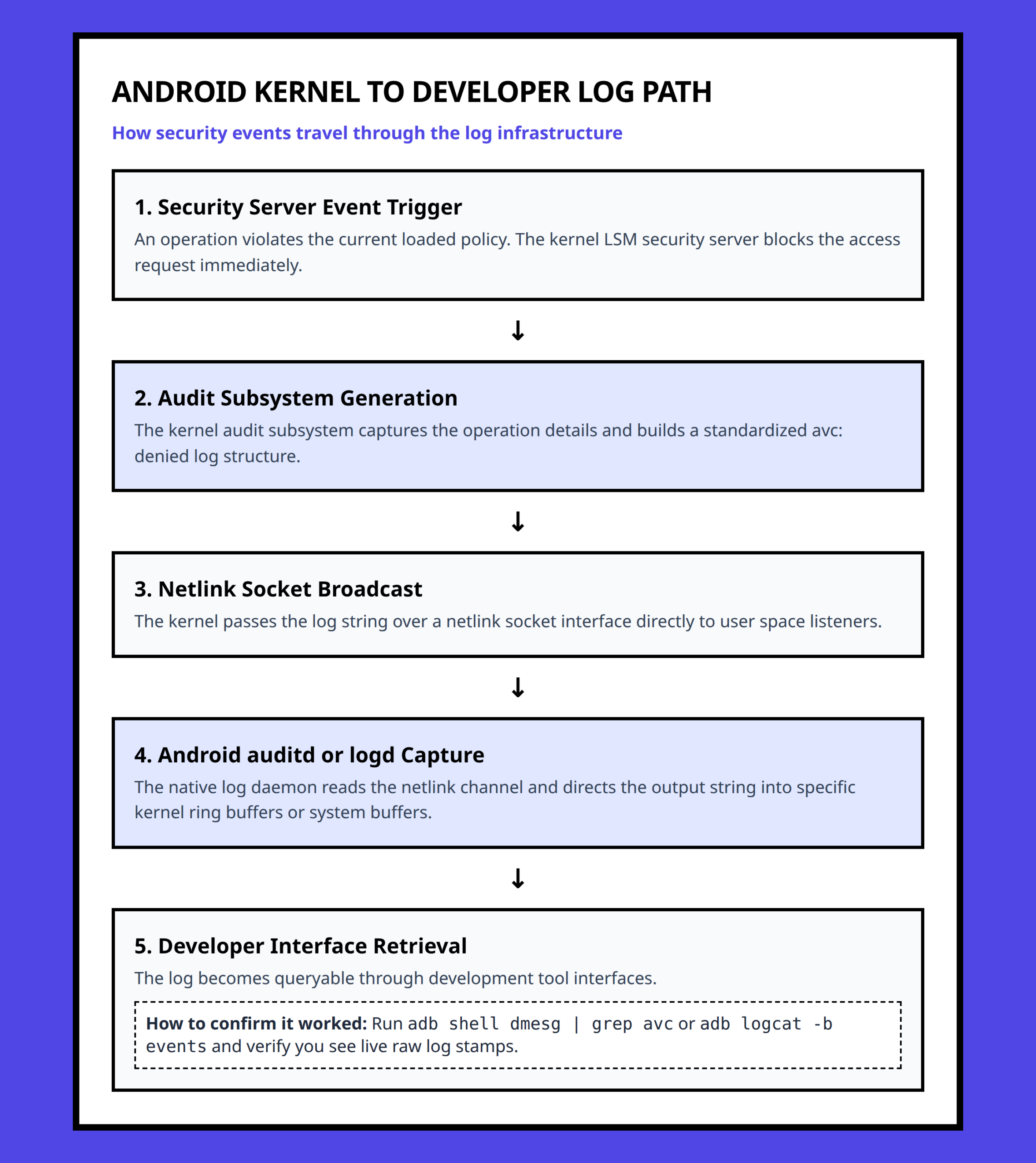
SELinux enforcement happens deep inside the Linux kernel.
Without logging, blocked operations would often look like mysterious application failures. A service might refuse to start. A hardware feature might stop responding. An app could fail silently during initialization.
The audit subsystem exists to expose those decisions in a structured way.
Instead of simply denying access invisibly, the kernel generates audit events describing:
- Which process attempted the operation
- Which object was targeted
- What permission was requested
- Why policy denied the action
I think this visibility is one reason SELinux became manageable in practice. Modern Android systems are too complex for developers to debug security behavior through trial and error alone.
The logs turn invisible policy enforcement into something operational teams can reason about.
auditd acts like a bridge between the kernel and developers
The Linux audit framework includes userspace components that collect and manage audit events.
One important component is auditd, the audit daemon.
The kernel generates audit records internally, but auditd helps move those records into usable logging systems where developers and administrators can inspect them.
This matters because SELinux denials are often only one small part of a larger operational issue.
Imagine a custom Android ROM where Wi-Fi initialization suddenly fails after enabling enforcing mode. The user may only notice that wireless networking stopped working. The actual cause could involve denied socket access, incorrect file labeling, or blocked service communication.
Without audit visibility, developers would spend large amounts of time guessing.
I think many people underestimate how important diagnostic infrastructure is for security systems. Strict security enforcement without clear diagnostics becomes difficult to maintain safely.
A SELinux denial contains much more information than most beginners realize
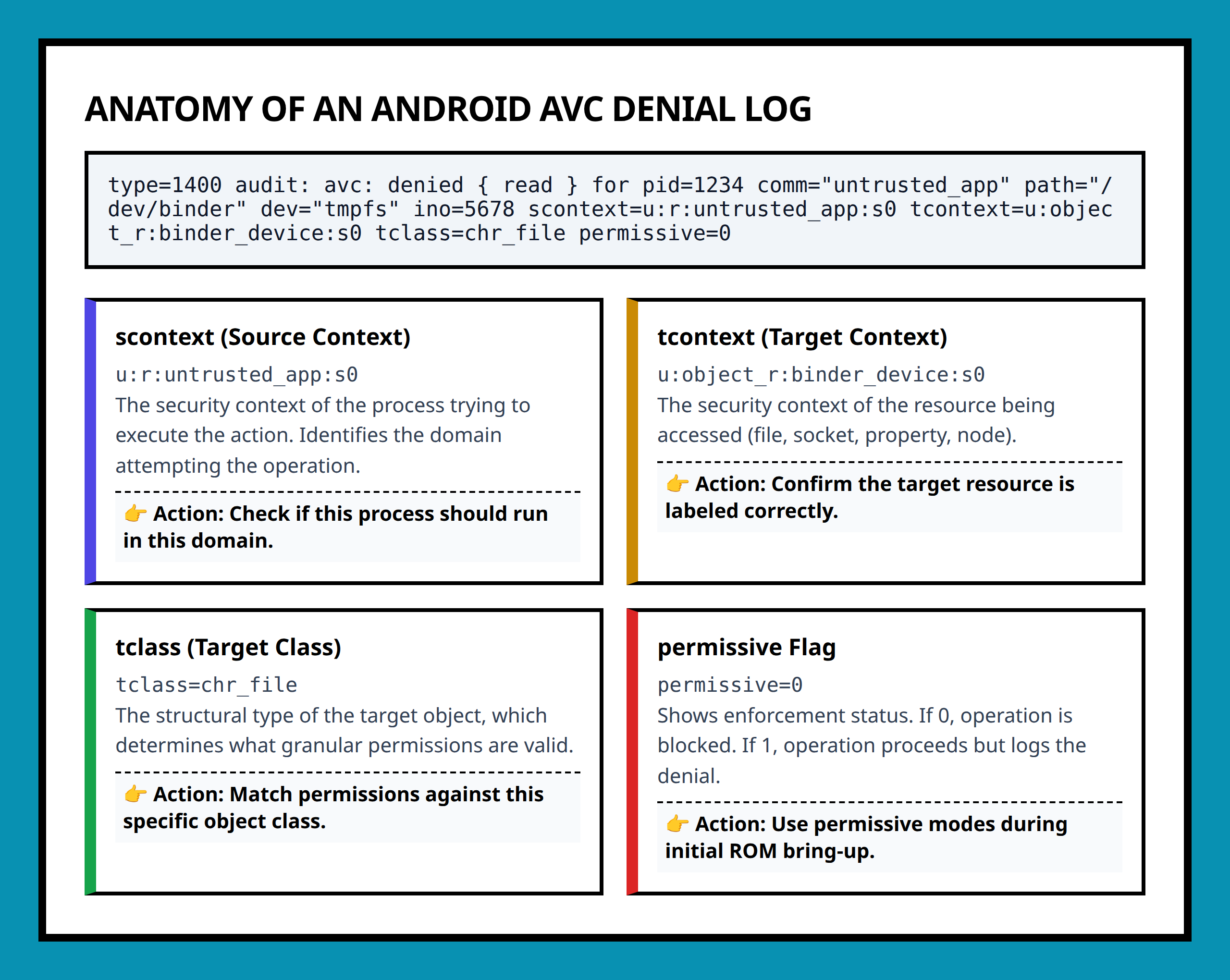
At first glance, SELinux denial logs often look unreadable.
A typical denial may contain:
- Process names
- Permission types
- Source contexts
- Target contexts
- Object classes
- Kernel timestamps
Beginners often focus only on the word “denied.”
I would actually start somewhere else: identifying the relationship between the subject and the object.
That relationship usually explains the real policy problem.
A denial is fundamentally describing this:
Process X attempted operation Y against object Z under security context rules that forbid the interaction.
Once you start reading denials this way, the logs become much more useful.
Security contexts are the key to understanding SELinux behavior
One of the most important operational skills is learning how to interpret SELinux security contexts.
Contexts typically identify domains, object labels, and security roles associated with the operation.
A denial log may show something like:
- A source context representing the calling process
- A target context representing the resource being accessed
- An object class describing the resource type
I think this is where SELinux debugging starts becoming practical instead of abstract.
The contexts tell you:
- Who initiated the request
- What resource was targeted
- Which security domains interacted
Without that information, developers often end up making overly broad policy changes because they cannot identify the actual boundary failure.
A common mistake is assuming a denial means the system simply needs more permission. Sometimes the real issue is incorrect labeling or an unexpected domain transition.
Good policy refinement is iterative, not automatic
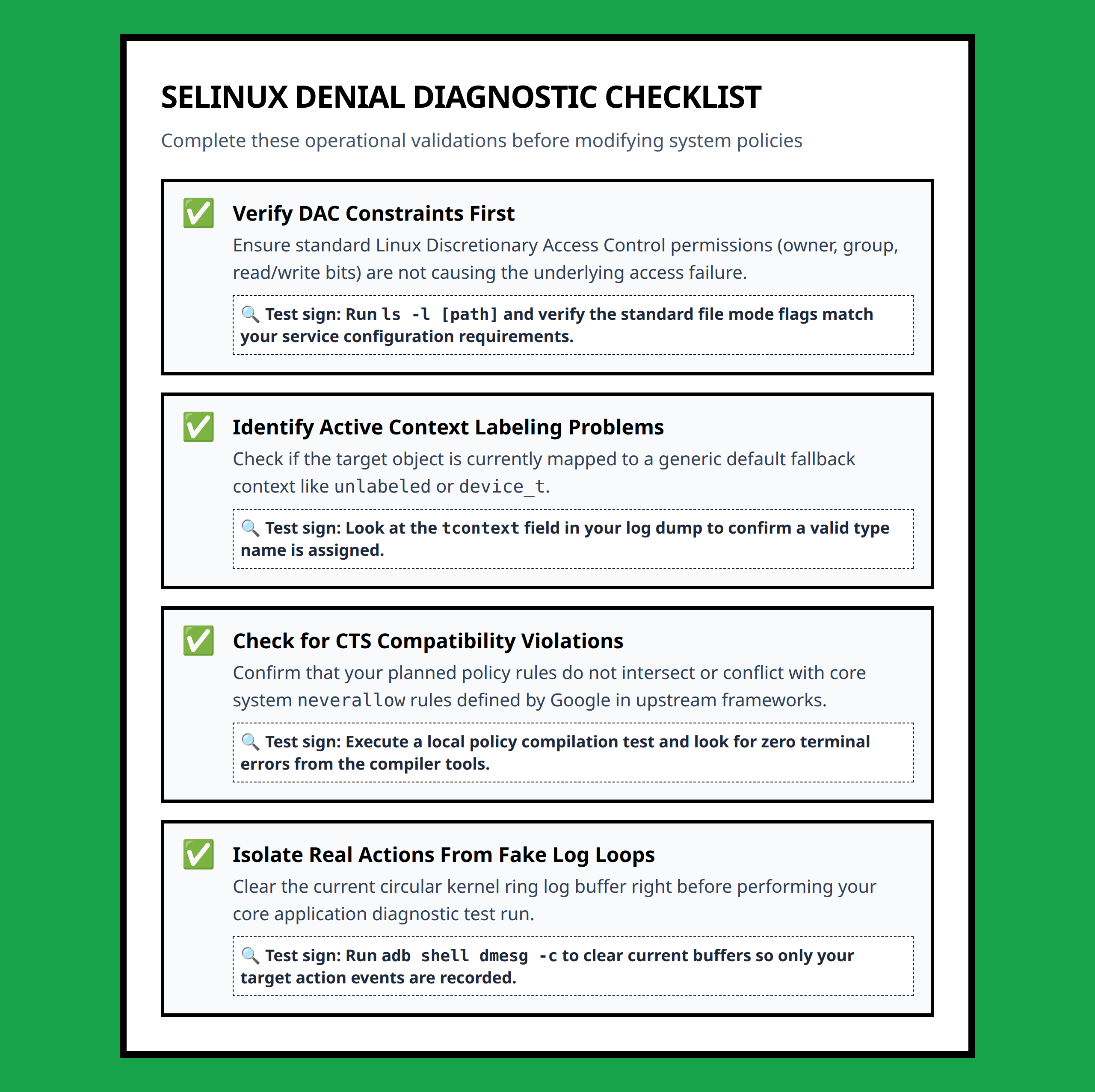
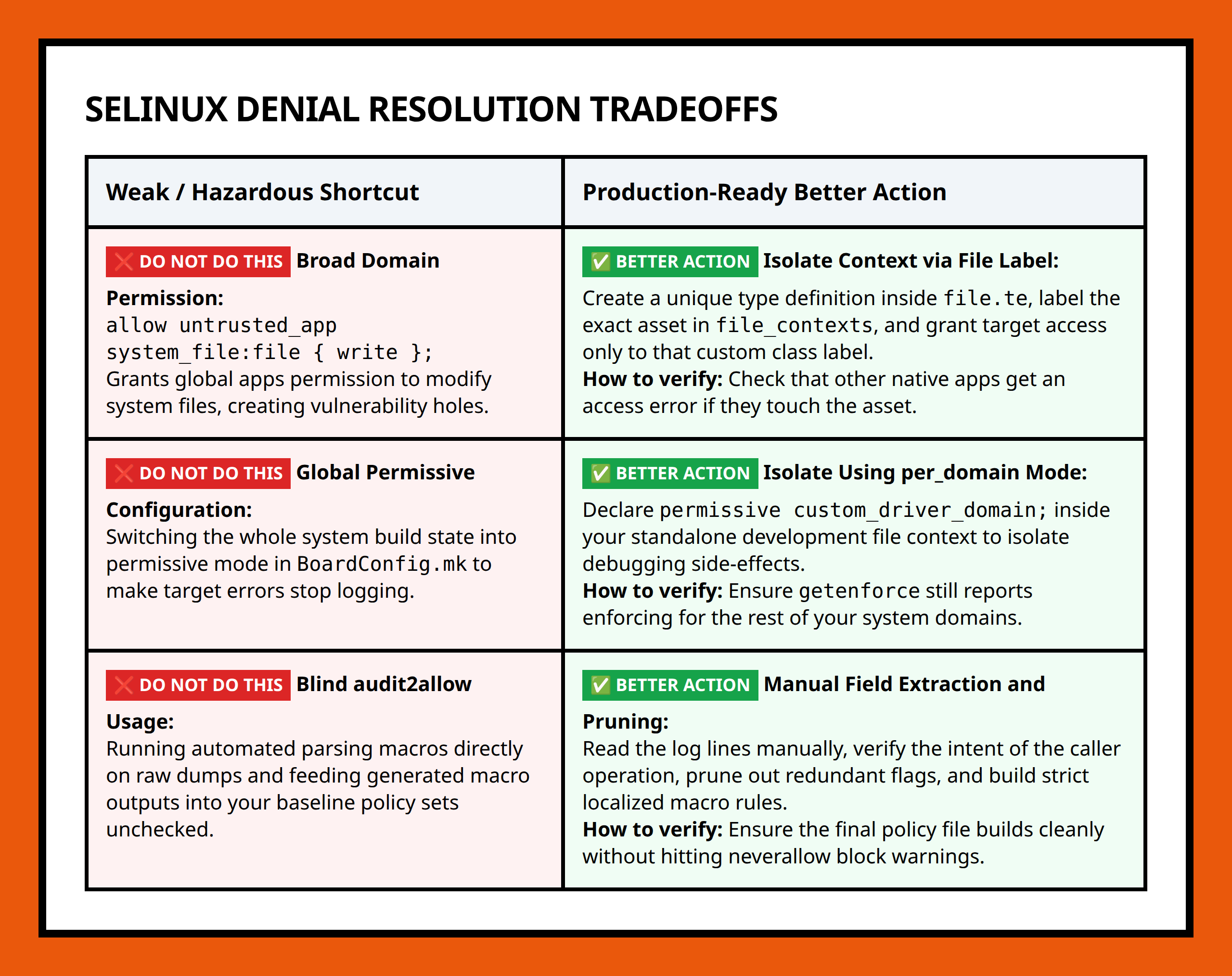
One thing I would avoid completely is treating SELinux denials like checklist items that should always be allowed immediately.
That approach usually weakens policy quality over time.
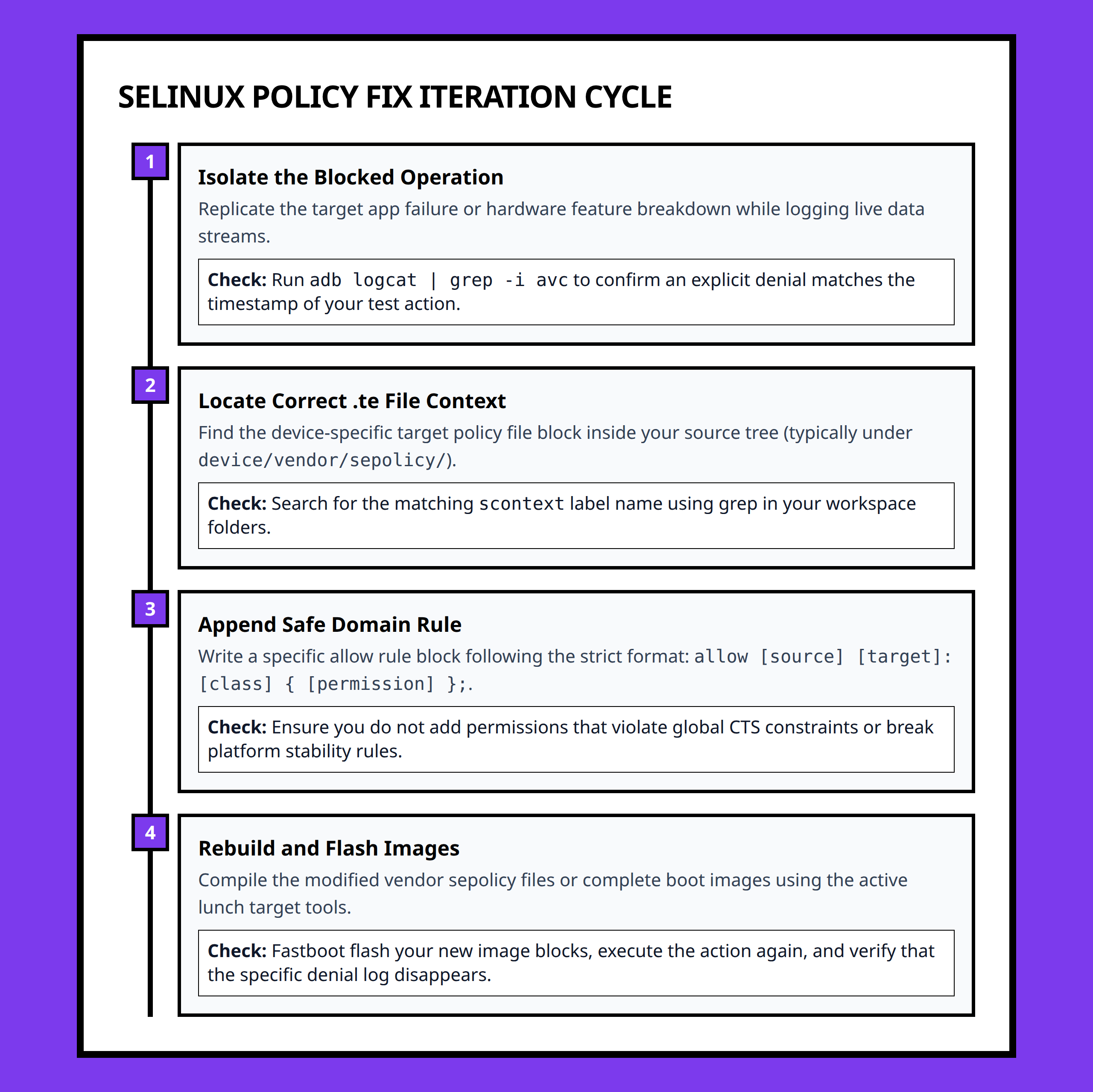
SELinux policy refinement works better as an iterative diagnostic workflow.
A safer process usually looks more like this:
- Observe the denial carefully.
- Identify the subject and object contexts.
- Determine whether the access is legitimate.
- Check whether labeling is correct.
- Refine policy narrowly if access is actually required.
- Retest and collect additional audit feedback.
I think this iterative mindset is one of the biggest differences between practical SELinux engineering and superficial troubleshooting.
The goal is not to eliminate denials as quickly as possible. The goal is to preserve meaningful isolation while enabling legitimate system behavior.
Many denials point to labeling problems instead of missing permissions
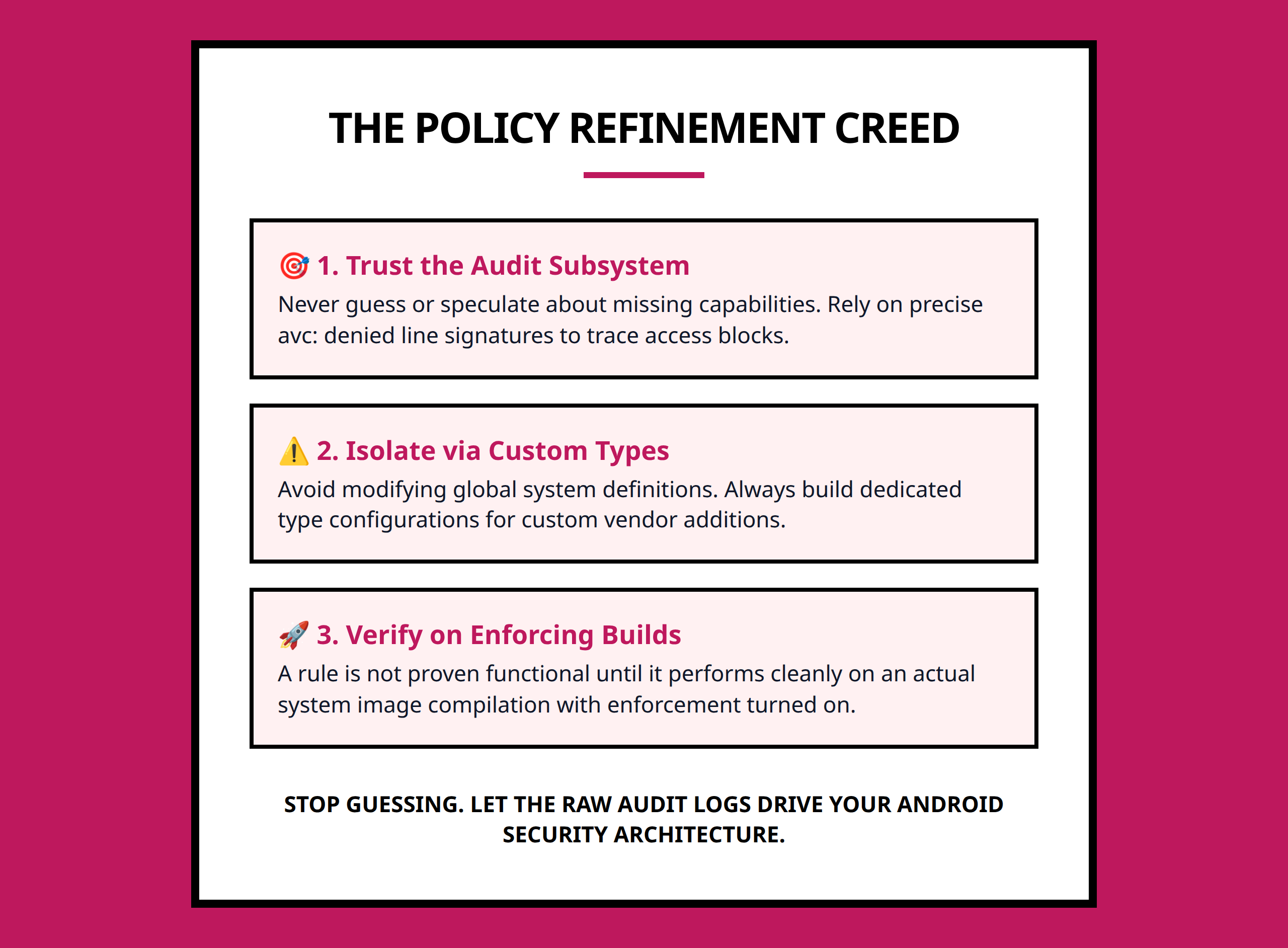
This is one area where developers often lose time unnecessarily.
A denial may initially look like a permission failure when the real issue is incorrect labeling.
For example, imagine a service trying to read a configuration file during boot.
The policy may already allow the service to access properly labeled configuration files. But if the file accidentally inherited the wrong context during packaging or filesystem setup, SELinux interprets it as a different resource type entirely.
The denial then appears even though the policy itself may already be correct.
I think this is why context interpretation matters so much. If I saw repeated denials involving unexpected object labels, I would investigate labeling consistency before expanding permissions.
Otherwise, developers risk masking the real problem behind broader access rules.
Audit logs help developers move toward enforcing mode safely
SELinux policy development often begins in permissive environments where denials are logged but not actively blocked.
This creates an important operational advantage.
Developers can observe real runtime behavior before turning on full enforcement.
That workflow matters because Android systems contain large numbers of interacting services, hardware layers, vendor components, and application domains. Trying to build policy entirely in advance would be unrealistic.
The audit system allows teams to:
- Observe actual runtime access patterns
- Identify unexpected service interactions
- Refine policies incrementally
- Reduce accidental breakage before enforcement
I think this gradual transition process explains why SELinux became operationally sustainable despite its complexity.
The logs provide continuous feedback loops instead of forcing developers to debug policy blindly.
The real value of audit logs is disciplined visibility
What stands out to me most is that SELinux audit logs are not primarily about fixing errors quickly.
They are about maintaining visibility into trust boundaries inside a complicated operating system.
Android devices now contain hundreds of interacting services, hardware interfaces, applications, and vendor components. Security policy becomes difficult to manage safely once developers lose visibility into those interactions.
Audit logs restore part of that visibility.
The danger is not that SELinux blocks too much. The larger danger is allowing developers to bypass isolation rules without understanding what the denial actually revealed about the system.
Good SELinux engineering usually looks less like permission whack-a-mole and more like careful investigation into why one component attempted an interaction in the first place.
- SELinux: A Linux security system that enforces policy-based access controls beyond traditional file permissions.
- Audit subsystem: A Linux framework that records security-related events and kernel activity.
- auditd: The Linux audit daemon that collects and manages audit records from the kernel.
- Denial: A logged event showing that SELinux blocked an attempted operation.
- Security context: A SELinux label describing the security identity and domain associated with a process or object.
- Subject: The process attempting an operation in SELinux policy evaluation.
- Object: The resource being accessed, such as a file, socket, or device.
- Object class: The SELinux category describing the type of resource involved in a denial.
- Permissive mode: A SELinux mode where denials are logged but not enforced.
- Enforcing mode: A SELinux mode where denied operations are actively blocked according to policy.
- Labeling: The assignment of SELinux security contexts to files, processes, or other system resources.
References:
- https://medium.com/@mayankzenmbm/the-complete-guide-to-selinux-in-android-from-core-concepts-to-deployment-59a3689c943c
- https://source.android.com/docs/security/features/selinux/build
- https://www.reddit.com/r/cybersecurity/comments/1qmpiju/i_built_selinuxpolicyauditor_a_high_precision/
- https://emteria.com/blog/selinux-android
- https://lineageos.org/engineering/HowTo-SELinux/
- https://access.redhat.com/articles/6999267
- https://ejaaskel.dev/fun-with-selinux/
- https://android.stackexchange.com/questions/70164/how-can-i-set-the-correct-selinux-seandroid-policy-for-an-app
- https://www.linkedin.com/pulse/understanding-selinux-android-cornerstone-security-stefano-santilli-gn91f
- https://www.ibm.com/docs/en/db2/11.5.x
- https://documentation.suse.com/sle-micro/6.0/html/Micro-selinux/index.html
- https://www.lenovo.com/ca/en/glossary/selinux/