
Derivatives are more than computation exercises; they form a structured diagnostic framework that reveals how functions increase, decrease, peak, and curve. Understanding their operational meaning makes analyzing function behavior much more practical.
I often notice students get stuck on derivative problems because they see them as symbolic drills. The real value emerges when derivatives become diagnostic tools: indicators of trends, peaks, valleys, and curvature in function behavior.
Learning to interpret first and second derivatives strategically allows you to anticipate how functions evolve across intervals instead of mechanically applying formulas.
Start by Looking at Extrema Through the First Derivative
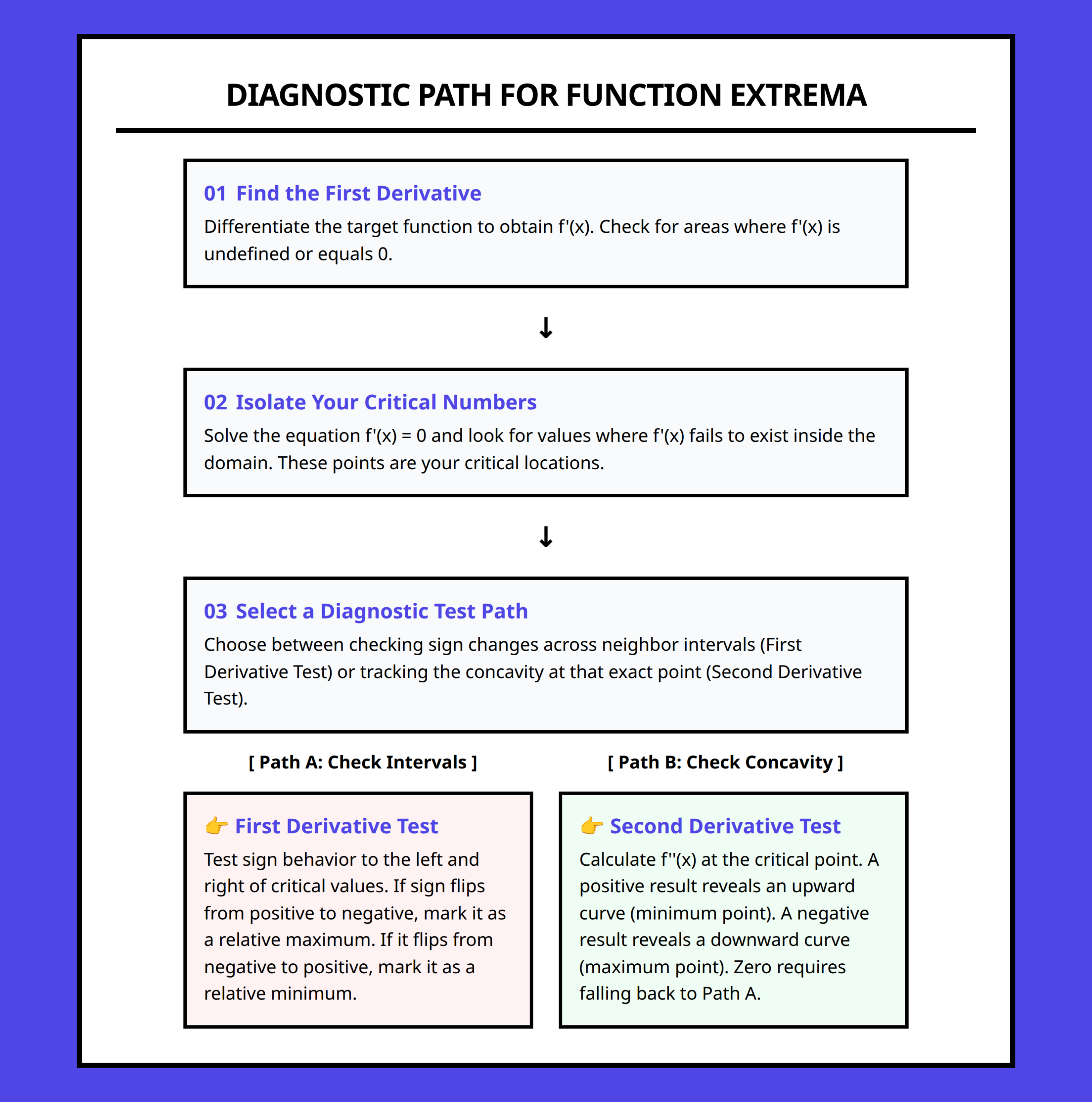
The first derivative tells you the function’s slope at any point. When the derivative is zero, the function may be at a maximum, minimum, or saddle point.
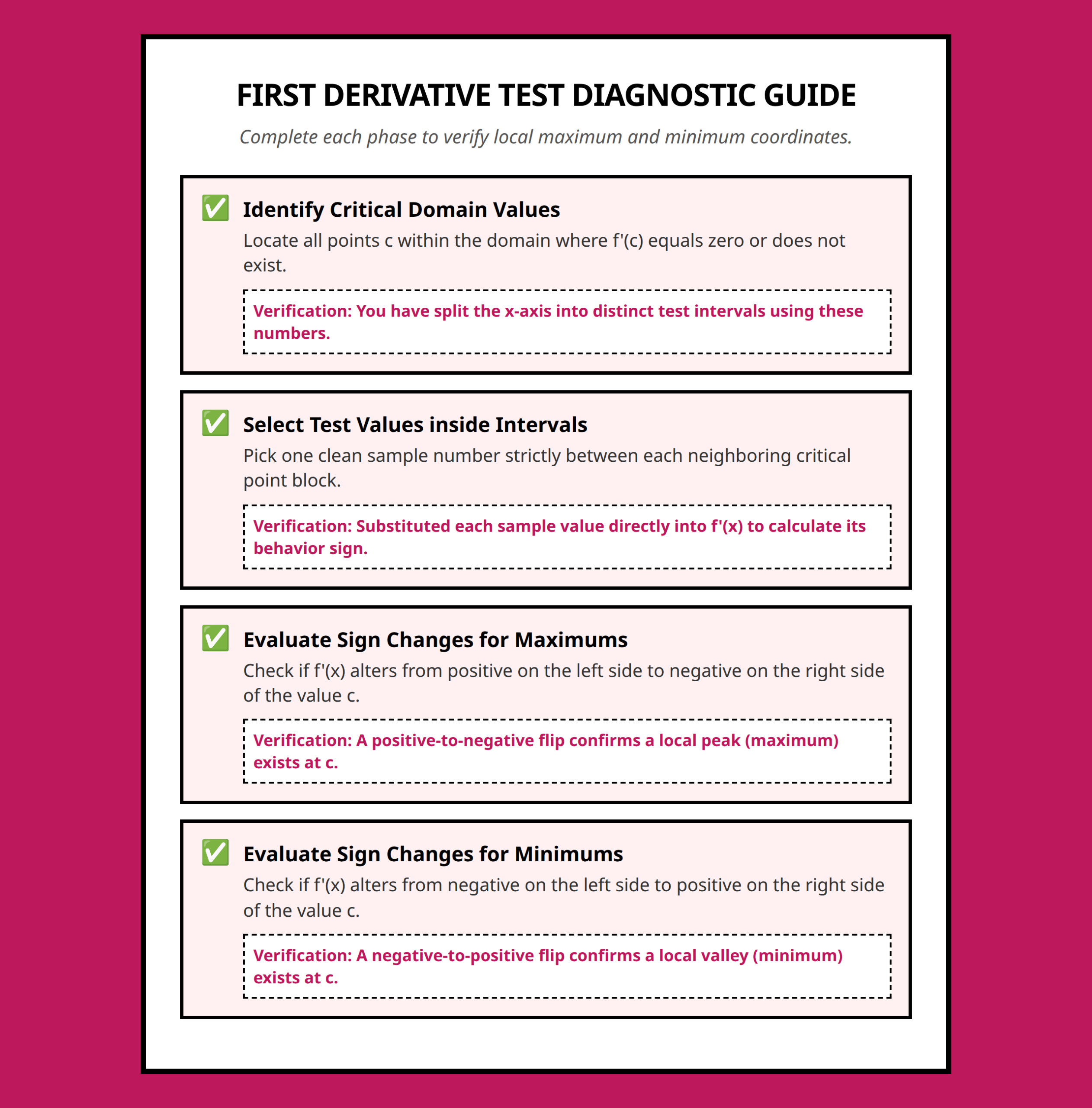
My approach is always to ask: “Where does the slope change sign?” Positive to negative indicates a peak; negative to positive indicates a trough. Observing this pattern across the function gives a first layer of behavior diagnosis.
For example, if you have f(x) with f'(x)=0 at several points, tracking the slope on either side of these points reveals which ones correspond to local maxima or minima. This is the essence of the first derivative test.
Monotonicity Helps Predict Trends
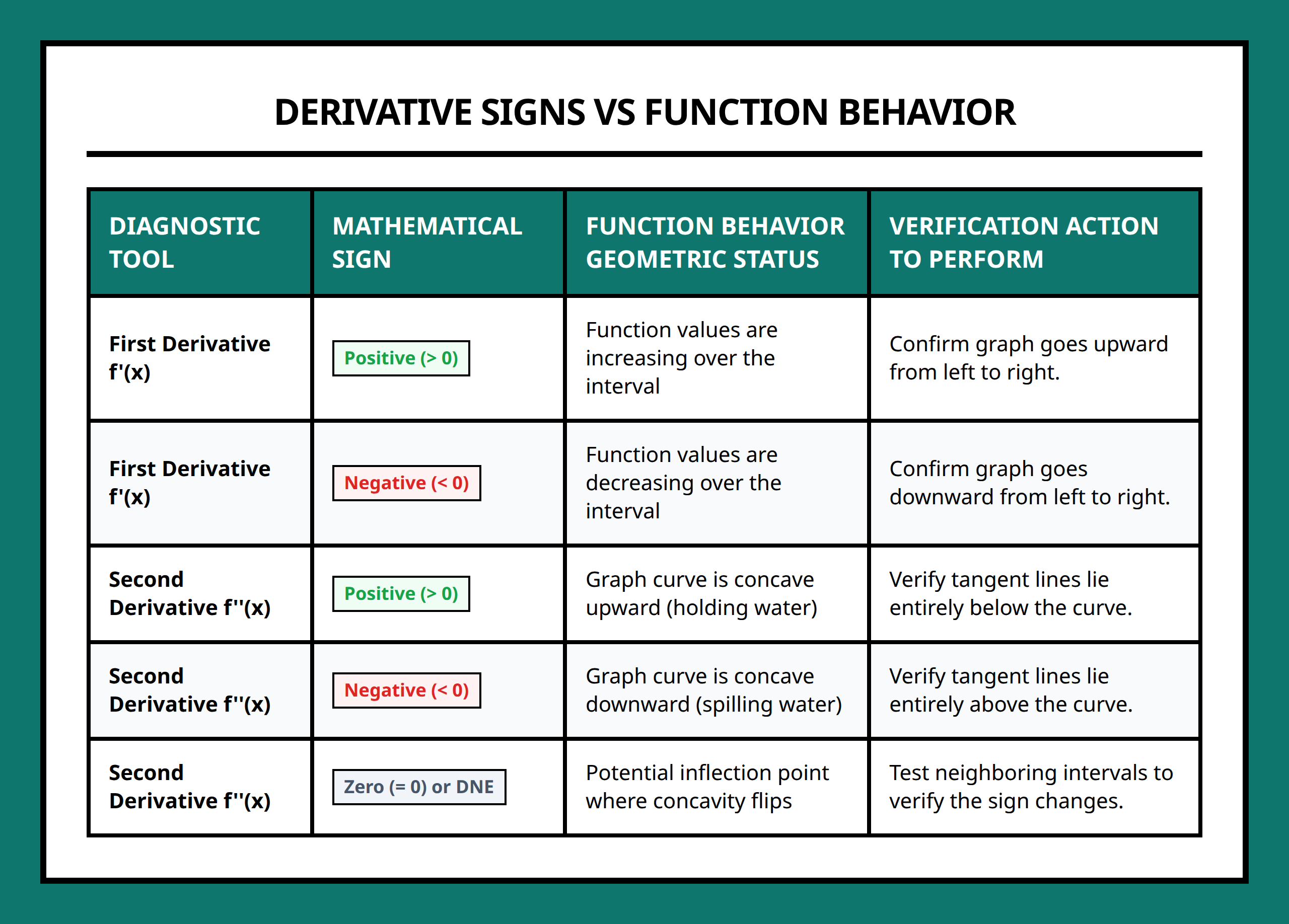
Beyond isolated extrema, the first derivative informs monotonicity. When f'(x) > 0 over an interval, the function rises; when f'(x) < 0, it falls.
In practice, I treat this as a checklist: determine where the derivative is positive, negative, or zero. Then map those intervals to identify increasing and decreasing behavior systematically.
This is particularly useful for engineering or applied problems where understanding trends—rather than exact values—guides decision-making or predictions.
Concavity Reveals How Functions Curve
The second derivative measures how the slope itself changes, revealing concavity. If f''(x) > 0, the function is concave upward, like a cup; if f''(x) < 0, it’s concave downward, like a cap.
Recognizing concavity helps anticipate how functions accelerate or decelerate. I often visualize this when sketching graphs or approximating function behavior locally. Concavity also informs which extrema are sharp or flat.
Inflection Points Mark Curvature Changes
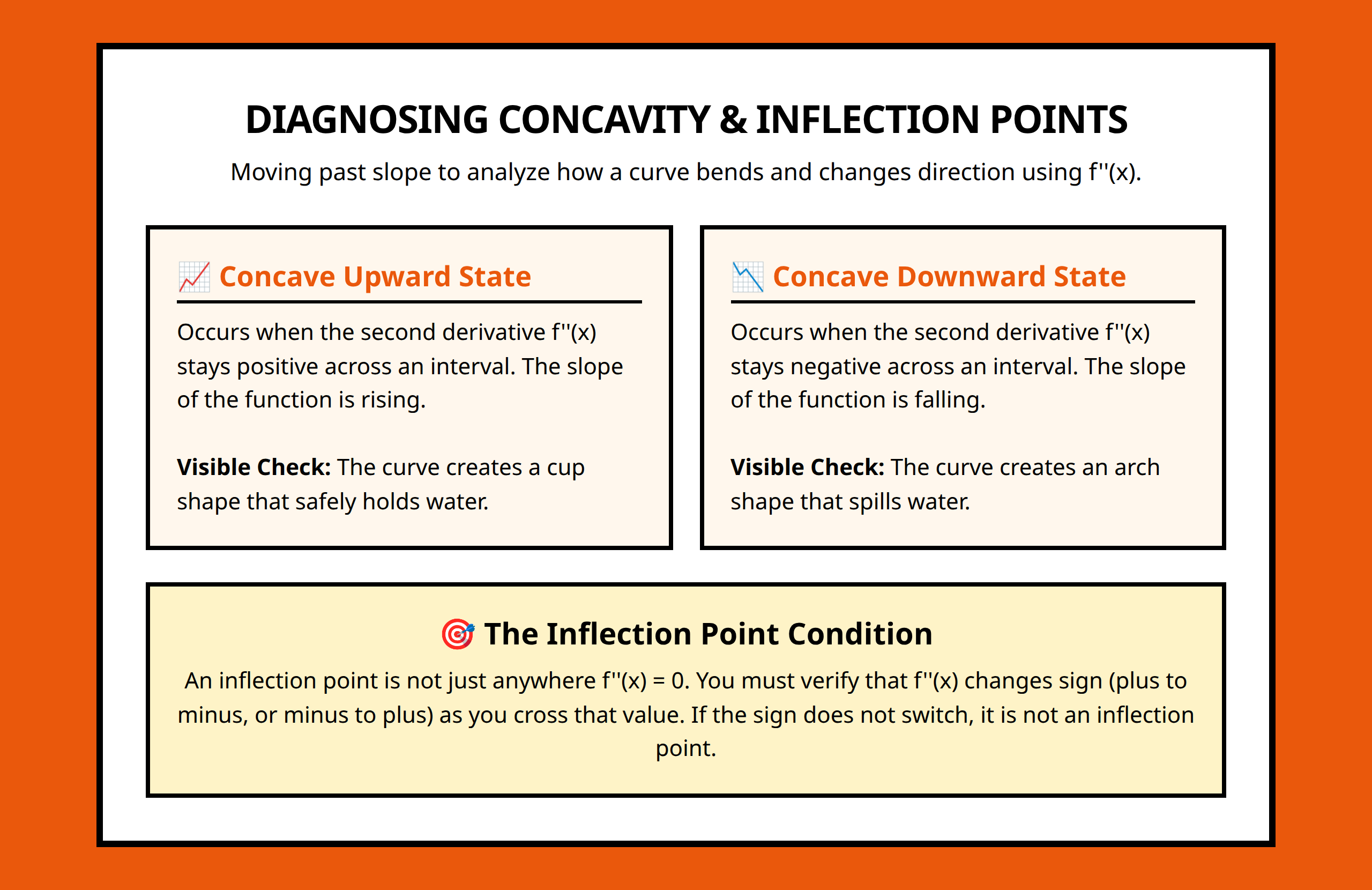
Inflection points occur where concavity changes, indicated by f''(x)=0 and a sign change in f''(x). These points often correspond to a transition in the behavior of the slope itself.
By checking for inflection points, I can see where a function might transition from bending upward to bending downward, which is crucial in optimization and curve analysis.
The Second Derivative Test Confirms Extrema
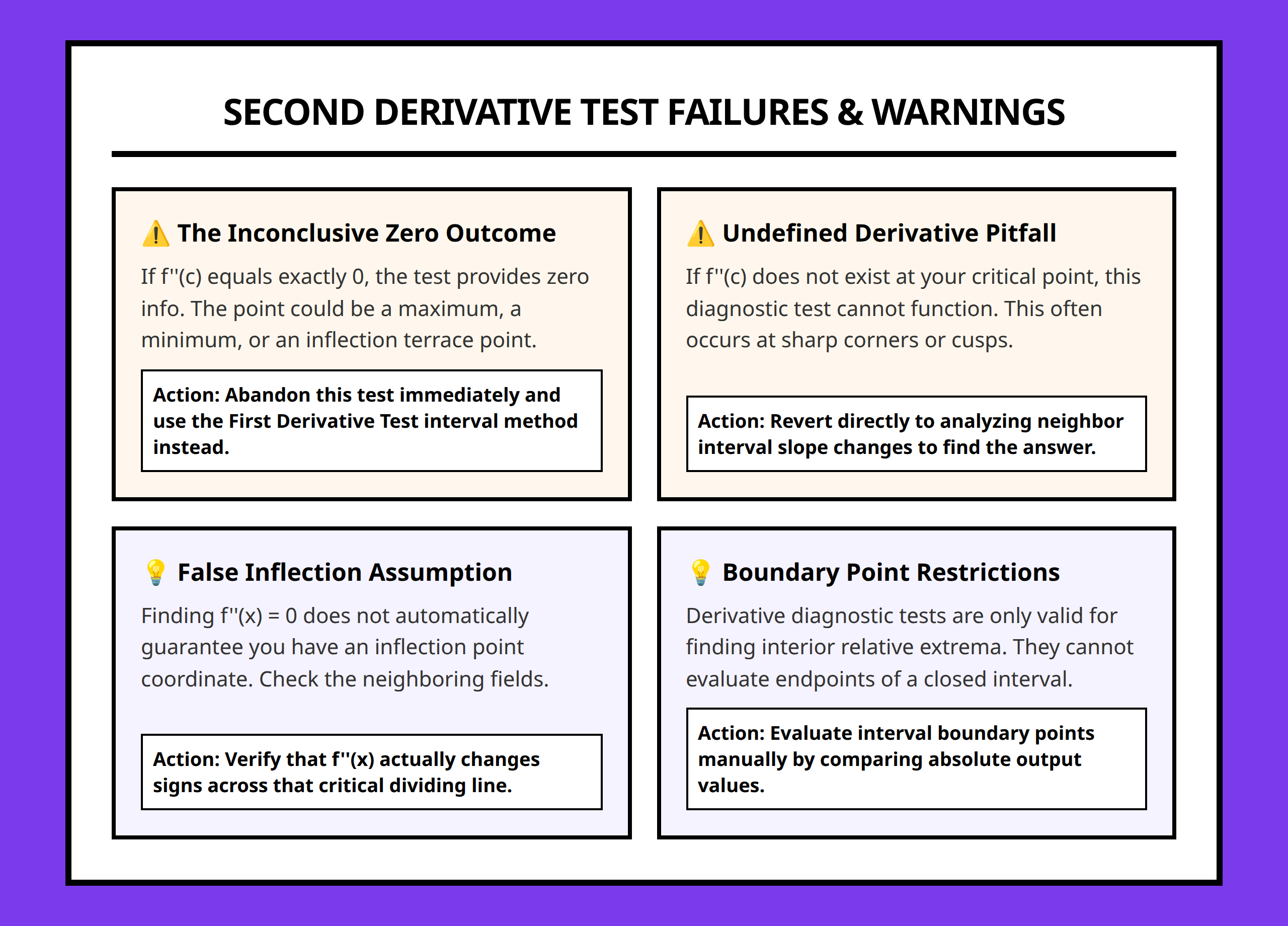
Once you locate candidate extrema with the first derivative, the second derivative helps confirm their nature. A positive second derivative at a critical point confirms a local minimum; a negative confirms a local maximum.
This test allows me to validate first derivative observations quickly and identify points where slope behavior aligns with curvature. It’s a concise diagnostic shortcut that combines slope and curvature information into one check.
Why Using Derivative Tests Systematically Works Better Than Memorizing Rules
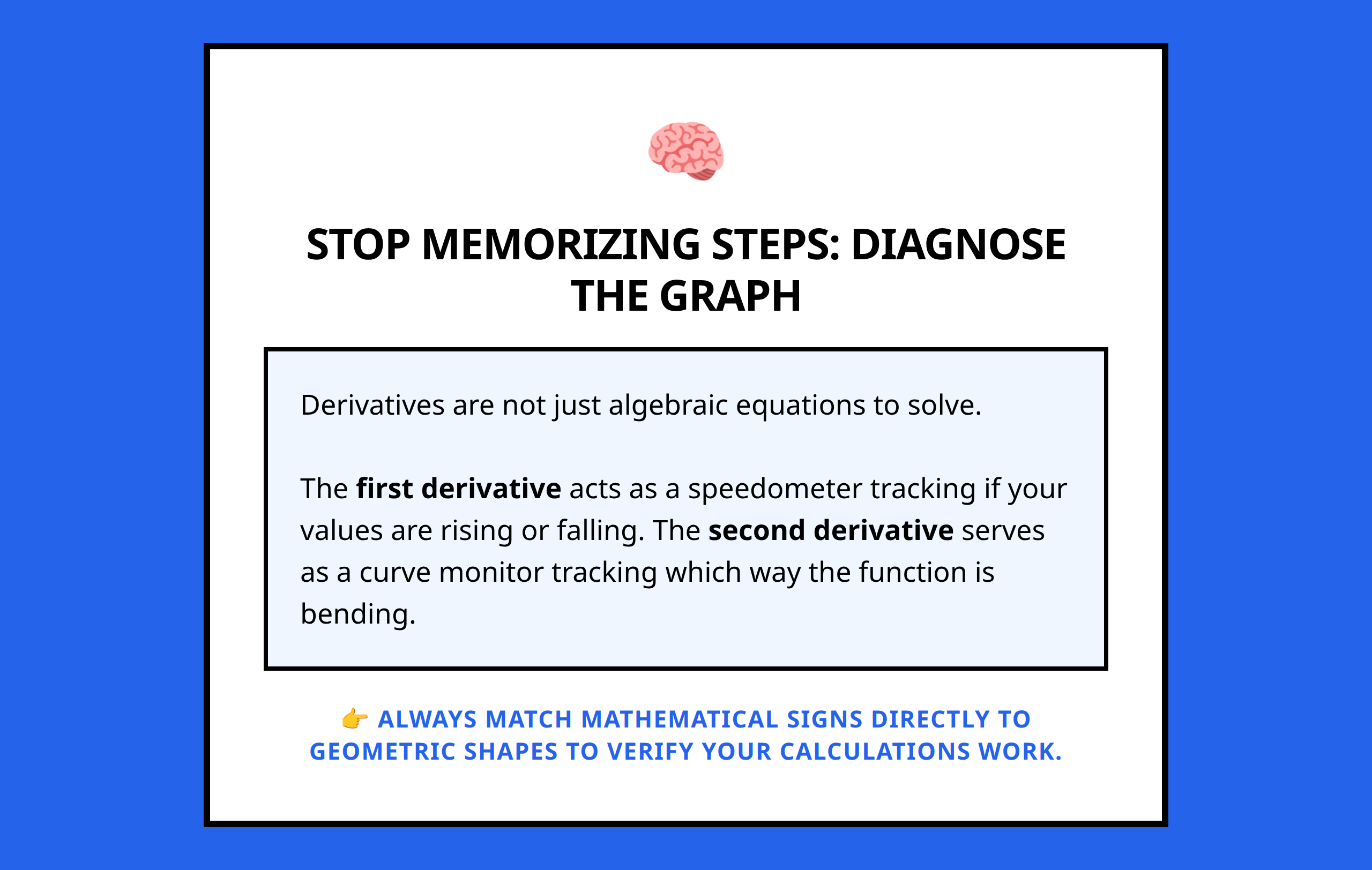
Many students treat derivative tests as a set of formulas to recall. In reality, the power lies in structured reasoning. I view derivatives as sensors that detect behavior: slope tells direction, curvature tells bending, and critical points pinpoint extremes.
Following a structured diagnostic approach means first locating critical points, mapping monotonicity intervals, examining concavity, and confirming extrema with the second derivative. This workflow transforms derivative analysis from rote computation into operational understanding, making function behavior predictable and interpretable.
Using first and second derivative tests as a toolkit rather than a set of memorized formulas allows deeper insight, whether for problem-solving in calculus, modeling in engineering, or analyzing trends in applied mathematics.
References:
- https://www.youtube.com/watch?v=SOauDbuoWms
- https://www.youtube.com/watch?v=ZChSemkznBM
- https://www.youtube.com/watch?v=M8j_J6SSiNw
- https://www.youtube.com/watch?v=15awMHeP1Yc
- https://math.stackexchange.com/questions/74155/calculus-first-second-derivative-tests
- https://flexbooks.ck12.org/cbook/cálculo-2.0/section/4.6/related/lesson/the-first-and-second-derivative-tests/
- https://www.albert.io/blog/first-and-second-derivative-test-ap-calculus-ab-bc-review/
- https://math.dartmouth.edu/opencalc2/cole/lecture8.pdf
- https://tutorial.math.lamar.edu/classes/calci/shapeofgraphptii.aspx
- https://www.storyofmathematics.com/derivative-test/
- https://www.reddit.com/r/learnmath/comments/4y27o4/how_do_you_perform_the_first_and_second/
- https://math.umd.edu/~tjp/14004.5lecturenotes.pdf
- https://www.youtube.com/watch?v=s4WCL907jrU
- https://www.youtube.com/watch?v=G8GAsYkZlpE
- https://www.khanacademy.org/math/ap-calculus-ab/ab-diff-analytical-applications-new/ab-5-7/v/second-derivative-test
- https://articles.outlier.org/what-is-the-second-derivative-test
- https://www.youtube.com/watch?v=1VUavSfYsvw
- https://www.youtube.com/watch?v=G5wlKltW7pM
- https://byjus.com/maths/first-derivative-test/