
Taylor expansions become much easier to use once you stop treating them as memorized formulas. Their real power comes from simplifying complicated local behavior into manageable approximations that reveal how functions actually behave near a point.
I used to think Taylor expansions were mostly decorative formulas added to advanced calculus problems. Students would memorize a few standard expansions, plug them into exercises, and move on without understanding why the process worked so well.
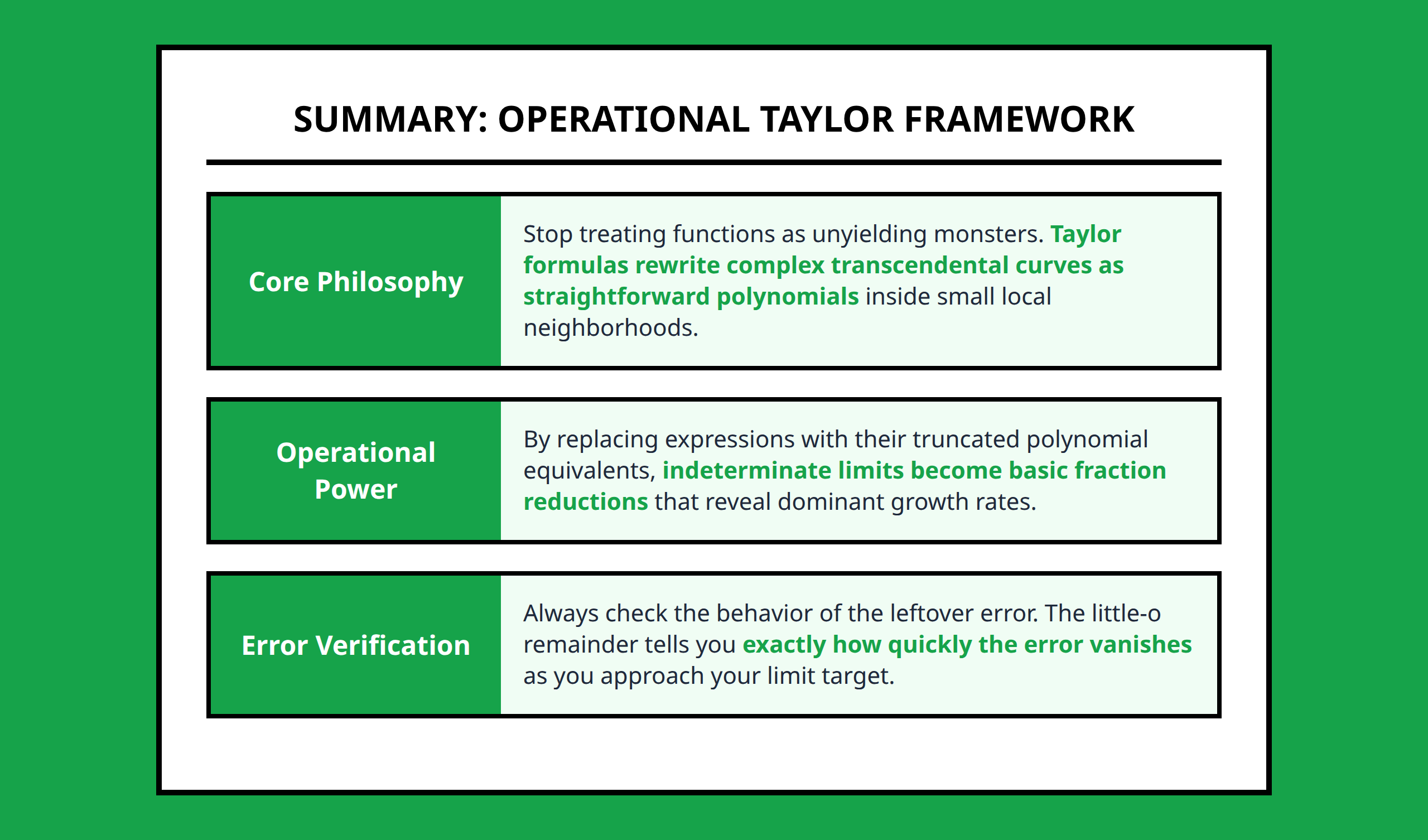
What changed my perspective was realizing that Taylor expansions are really compression tools. They replace difficult local behavior with simpler polynomial behavior while preserving the essential structure of the function nearby.
Once I started seeing expansions that way, many asymptotic problems stopped feeling mysterious.
Taylor Expansions Replace Complexity With Local Structure
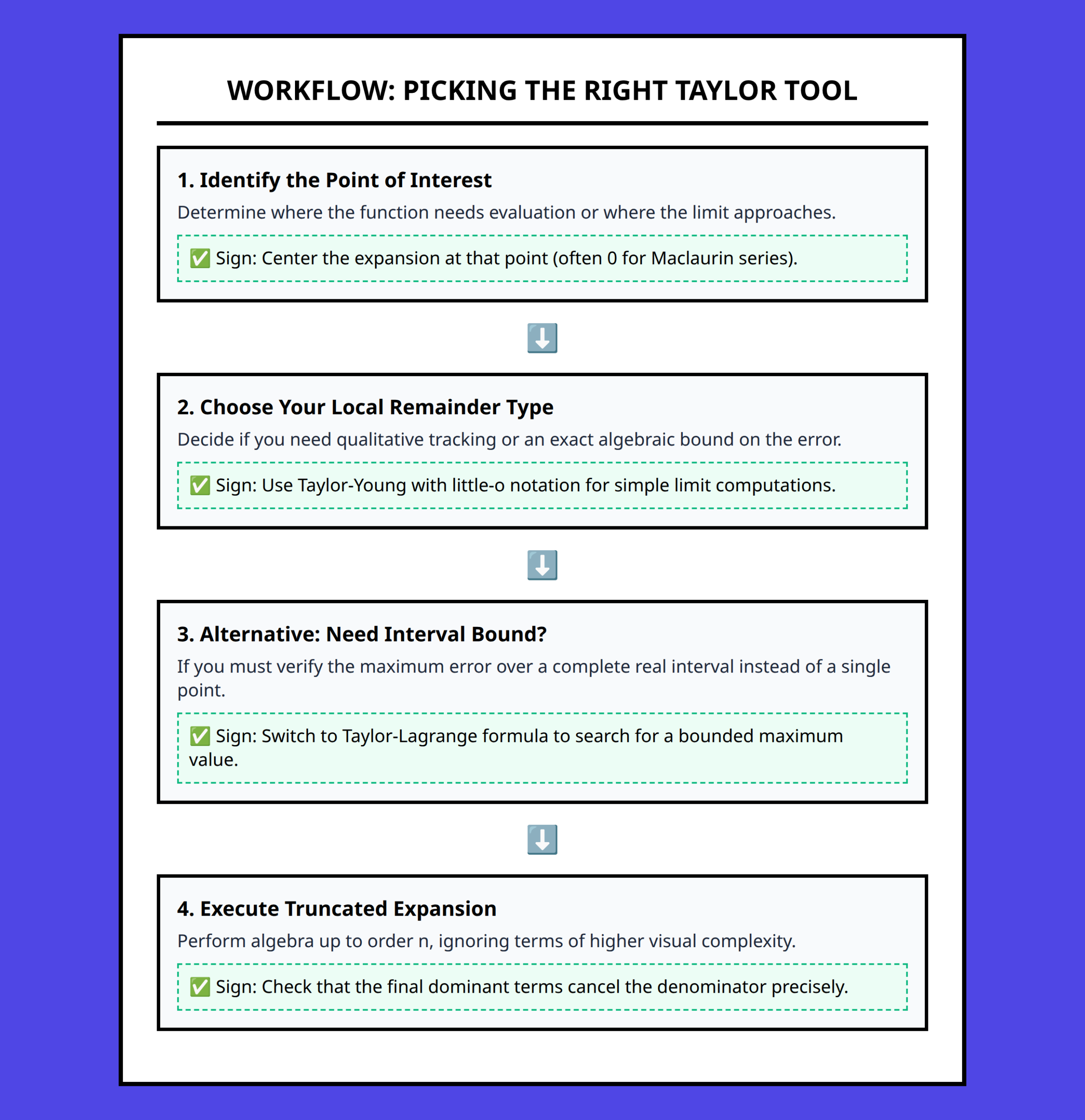
A Taylor expansion approximates a function near a chosen point using polynomial terms built from derivatives.
That description is technically correct, but it misses the operational idea.
The important point is that the expansion isolates the dominant local behavior of the function.
Near the expansion point, many complicated functions behave almost like carefully constructed polynomials. The farther terms become progressively less important locally.
I think students often struggle because they approach Taylor formulas as objects to memorize instead of asking:
What behavior is this approximation trying to preserve?
For example, near zero:
sin(x)
behaves very similarly to:
x
for small values of x.
The higher-order correction terms refine the approximation, but the dominant local structure already becomes visible immediately.
That is why Taylor expansions simplify difficult limits so effectively. They expose the behavior that actually matters near the point of interest.
The Taylor–Lagrange Formula Explains the Role of Error
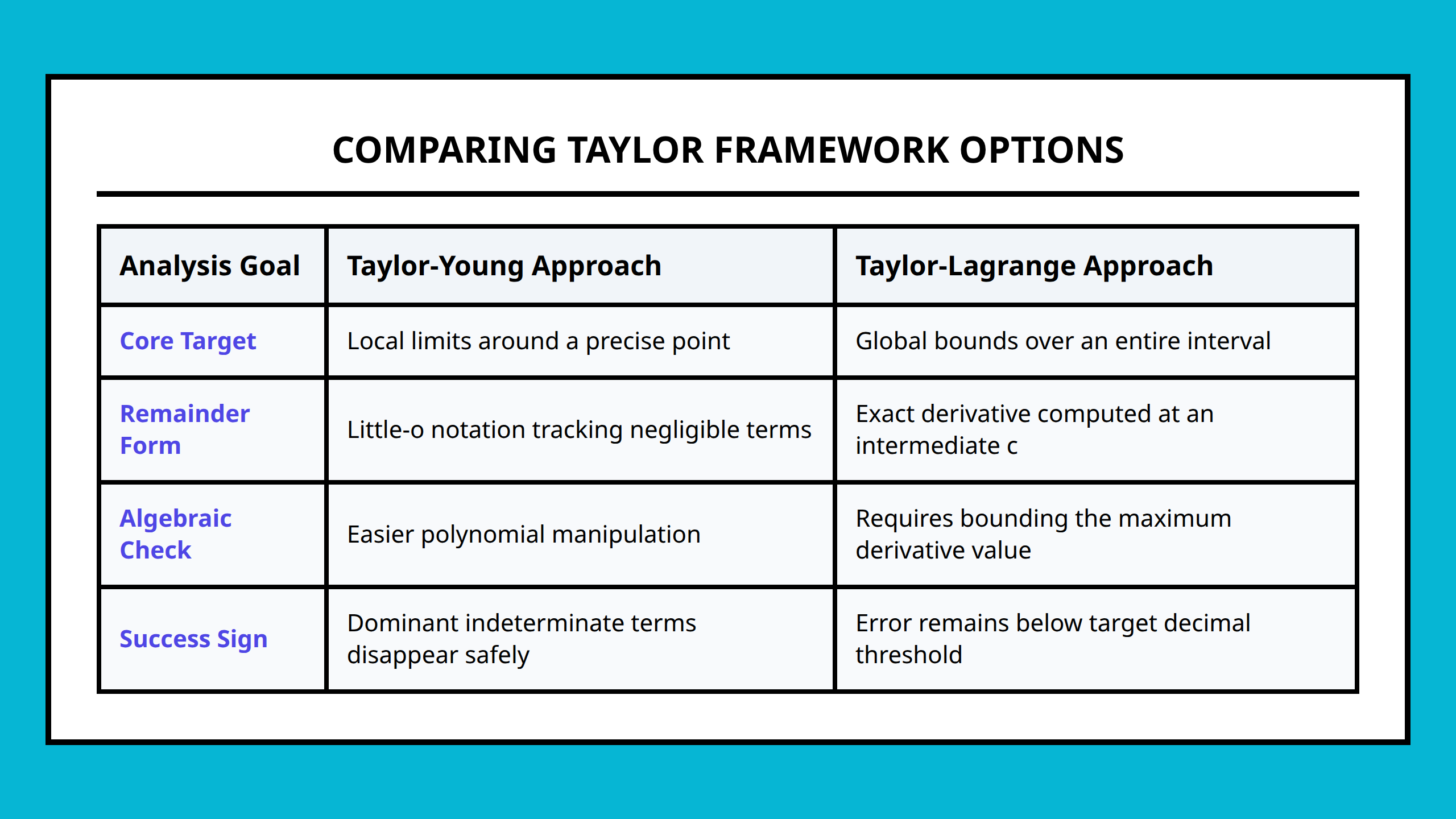
One of the most important conceptual steps in asymptotic analysis is understanding that a Taylor approximation is not exact.
The remainder matters.
The Taylor–Lagrange formula makes this explicit by separating the approximation into:
- the polynomial approximation
- the remaining error term
I think this distinction is extremely valuable because it prevents students from treating expansions like magical substitutions.
The remainder measures how much behavior the approximation still misses.
In practice, though, the error often becomes small enough near the expansion point that the polynomial captures nearly all relevant behavior.
A realistic way to picture this is to imagine zooming into a curved road on a digital map. From far away the road looks complicated. As you zoom closer to one small section, the curve starts looking almost straight.
The local simplification becomes accurate because the ignored curvature contributes less and less over that tiny region.
Taylor approximations work similarly.
The Taylor–Young Formula Makes Local Behavior Easier to Read
The Taylor–Young viewpoint becomes especially useful in asymptotic analysis because it focuses directly on dominant terms and negligible remainders.
I would describe this as a readability tool for local behavior.
Instead of carrying exact expressions everywhere, the expansion highlights:
- which terms dominate
- which terms vanish faster
- which corrections matter operationally
For example, near zero:
e^x = 1 + x + o(x)
The little-o notation expresses something important structurally:
the remaining error becomes negligible relative to x.
I think this is where asymptotic analysis starts feeling much more strategic than procedural.
You stop treating every term equally and begin organizing behavior hierarchically.
Most Difficult Limits Become Simpler Once Dominant Terms Are Visible
One of the most practical applications of Taylor expansions is limit computation.
Students often face limits where direct substitution produces indeterminate forms like:
0/0
or
∞/∞
At that point many people immediately search for algebraic tricks or repeated applications of L’Hôpital’s rule.
I would usually check for local expansions first.
Taylor expansions simplify the expressions structurally before the limit is evaluated.
Suppose you encounter:
(sin x - x)/x³
Near zero, the expansion:
sin x = x - x³/6 + o(x³)
immediately reveals the cancellation structure.
The dominant linear terms disappear, leaving the cubic behavior exposed naturally.
That is the real advantage.
The expansion explains why the cancellation occurs instead of merely forcing the computation mechanically.
Truncated Expansions Help Control Complexity
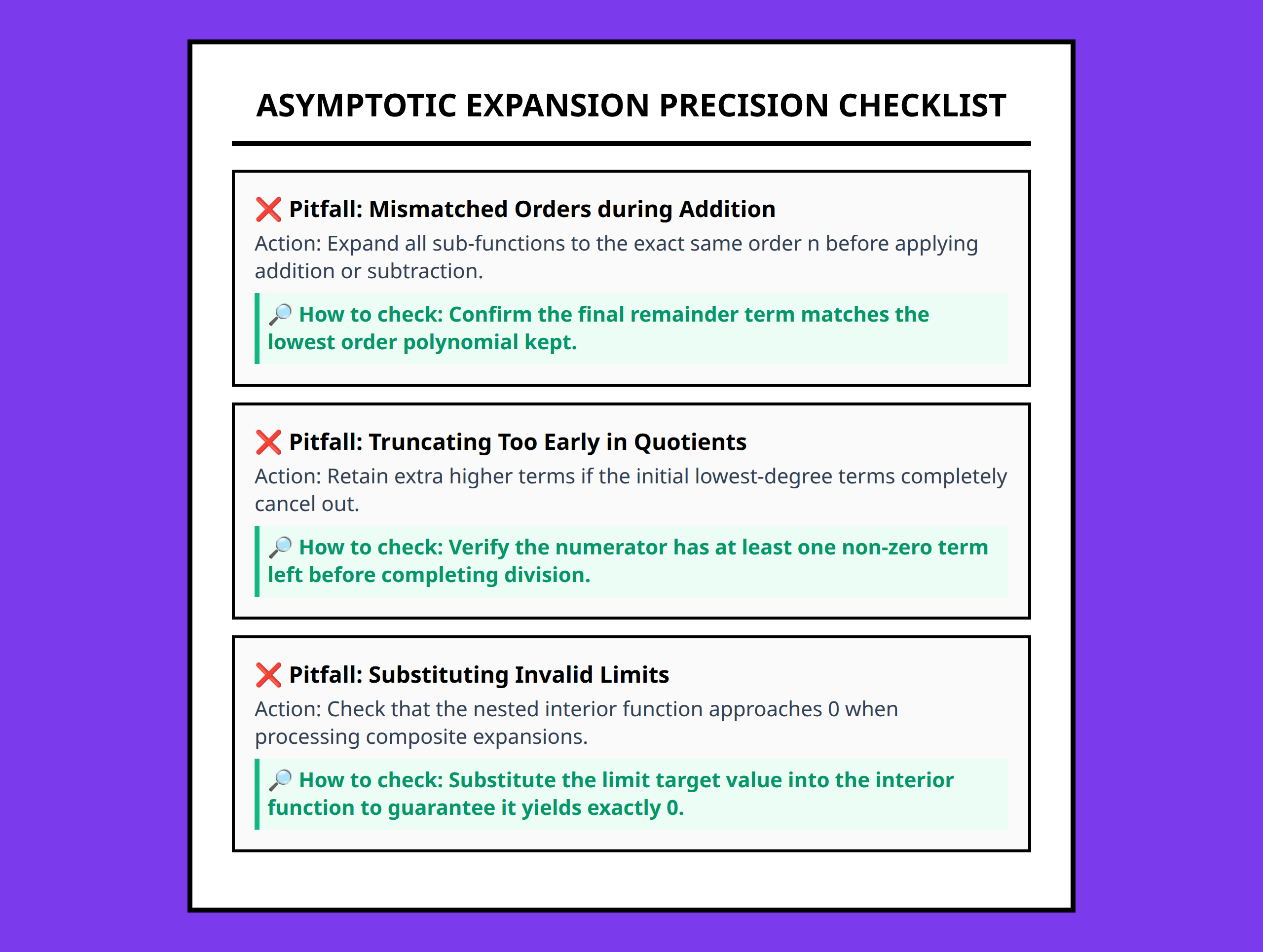
One practical skill in asymptotic work is deciding how many terms are actually necessary.
This is where truncated expansions become useful.
You do not always need the full expansion. You only need enough information to capture the behavior relevant to the problem.
I think many students initially overcomplicate Taylor problems because they try to expand everything completely.
But asymptotic analysis is usually selective.
If a second-order approximation already determines the limit or comparison behavior, higher-order terms may contribute nothing important operationally.
This resembles estimating travel time during a short commute. You may not need second-by-second precision to make a useful decision. A sufficiently accurate approximation already captures the essential behavior.
Good asymptotic work often depends on knowing where further precision stops changing the conclusion.
Operations on Expansions Reveal Structural Relationships Between Functions
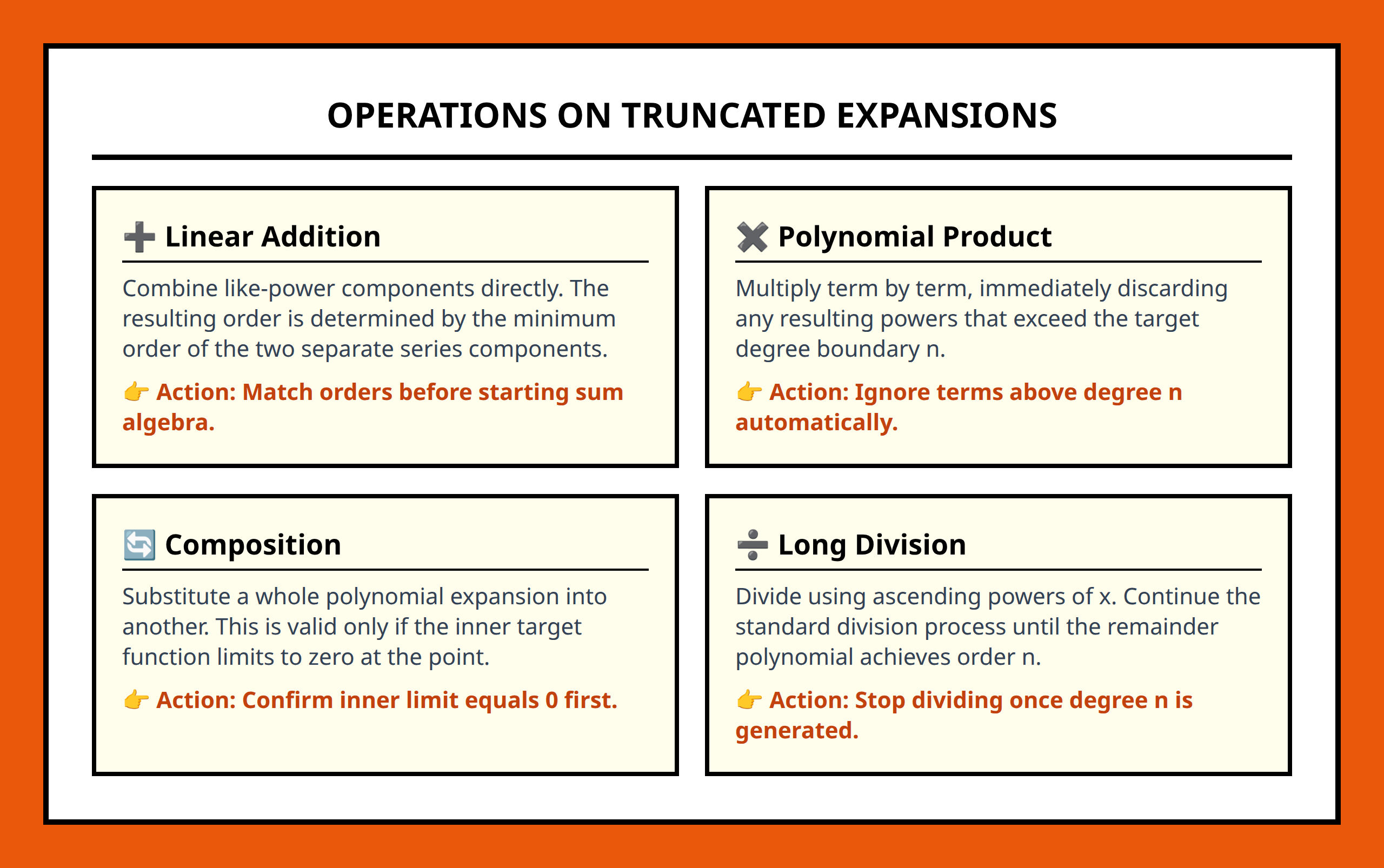
One reason Taylor expansions become so powerful is that expansions can be combined systematically.
You can:
- add expansions
- multiply expansions
- compose functions
- invert local behavior
I think this is the moment where expansions stop looking like isolated formulas and start behaving like a full analytical language.
Complex expressions become manageable because local behaviors interact predictably.
For example, combining expansions for:
- exponential functions
- logarithms
- trigonometric functions
allows surprisingly difficult expressions to collapse into simple dominant-term comparisons.
The algebra becomes easier because the asymptotic hierarchy organizes the computation automatically.
Asymptotic Thinking Is Really About Relative Importance
I think one of the deepest lessons Taylor analysis teaches is that not every term deserves equal attention.
Near a specific point, some behaviors dominate while others fade rapidly into insignificance.
The expansion framework helps formalize that idea carefully.
Students often learn calculus computationally first. Every symbol seems equally important because every term remains visible on the page.
Asymptotic analysis changes that perspective.
You begin asking:
- Which term controls the local behavior?
- Which correction terms matter?
- Which contributions become negligible?
- What structure survives near the limit point?
That shift is what makes Taylor expansions so useful operationally.
They are not merely formulas for rewriting functions. They are tools for organizing importance.
Why Taylor Expansions Make Function Behavior Feel More Predictable
One reason I like Taylor methods pedagogically is that they make complicated functions feel less opaque.
Instead of staring at an intimidating expression, you gradually reveal the local structure hidden inside it.
A student working through asymptotic exercises late at night may suddenly notice something important: many unrelated-looking functions start behaving according to a small number of dominant local patterns.
That realization changes how difficult problems feel.
The goal stops being symbolic survival and becomes structural interpretation.
Once Taylor expansions become tools for reading behavior instead of formulas to memorize, difficult limits and asymptotic problems start looking less like puzzles and more like controlled simplification problems.
References:
- https://www.youtube.com/watch?v=EYjBnnUJTP8
- https://www.youtube.com/watch?v=3d6DsjIBzJ4
- https://www.youtube.com/watch?v=DULzJmUHN5g
- https://www.youtube.com/watch?v=ebfOSDj4j3I
- https://en.wikipedia.org/wiki/Taylor_series
- https://math.stackexchange.com/questions/4140727/evaluating-limits-using-taylor-expansions
- https://math.stackexchange.com/a/4140734
- https://math.stackexchange.com/questions/2307402/using-taylor-expansion-to-evaluate-limits
- https://math.stackexchange.com/questions/3747094/finding-limits-of-complex-functions-using-taylor-expansion
- https://www.parabola.unsw.edu.au/sites/default/files/2025-04/vol61_no1_7.pdf
- https://tutorial.math.lamar.edu/classes/calcii/taylorseries.aspx
- https://medium.com/@andrew.chamberlain/an-easy-way-to-remember-the-taylor-series-expansion-a7c3f9101063
- https://personal.math.ubc.ca/~feldman/m120/taylorLimits.pdf
- https://complex-analysis.com/content/taylor_series.html
- https://www.quora.com/Can-you-explain-the-intuition-behind-using-Taylor-series-expansions-in-calculus-problems-and-how-they-help-in-breaking-down-complex-integrals
- https://www.reddit.com/r/learnmath/comments/ewb3ev/can_anyone_explain_to_me_the_taylor_series_in_an/
- https://drpress.org/ojs/index.php/HSET/article/download/13486/13106/13200
- https://www.vaia.com/en-us/textbooks/math/an-introduction-to-numerical-analysis-2-edition/chapter-1/problem-26-use-taylor-approximations-to-avoid-the-loss-of-si/
- https://www.reddit.com/r/calculus/comments/lmumbi/whats_the_point_of_a_taylor_seriesapproximation/
- https://www.reddit.com/r/learnmath/comments/ewb3ev/comment/fg0w0cc/
- https://www.reddit.com/r/learnmath/comments/ewb3ev/comment/fg0u19c/
- https://www.reddit.com/r/learnmath/comments/ewb3ev/can_anyone_explain_to_me_the_taylor_series_in_an/fg1kkwi/