
Recursive sequences are one of the clearest ways to understand mathematical stability. Instead of looking at isolated formulas, you watch a process evolve step by step through iteration, boundedness, monotonicity, and long-term convergence behavior.
I think many students first meet recursive sequences as repetitive homework exercises. Compute the next term. Simplify the expression. Find the limit if it exists. The mechanical side often hides the interesting part.
What makes recursive sequences valuable is that they behave like evolving systems. Each term depends on the previous one, so the sequence develops through feedback. Some systems stabilize. Others oscillate. Others drift away completely.
Once I started treating recursive sequences as stability problems instead of algebra drills, the subject became much easier to understand conceptually.
A Recursive Sequence Is Really a Process Unfolding Over Time
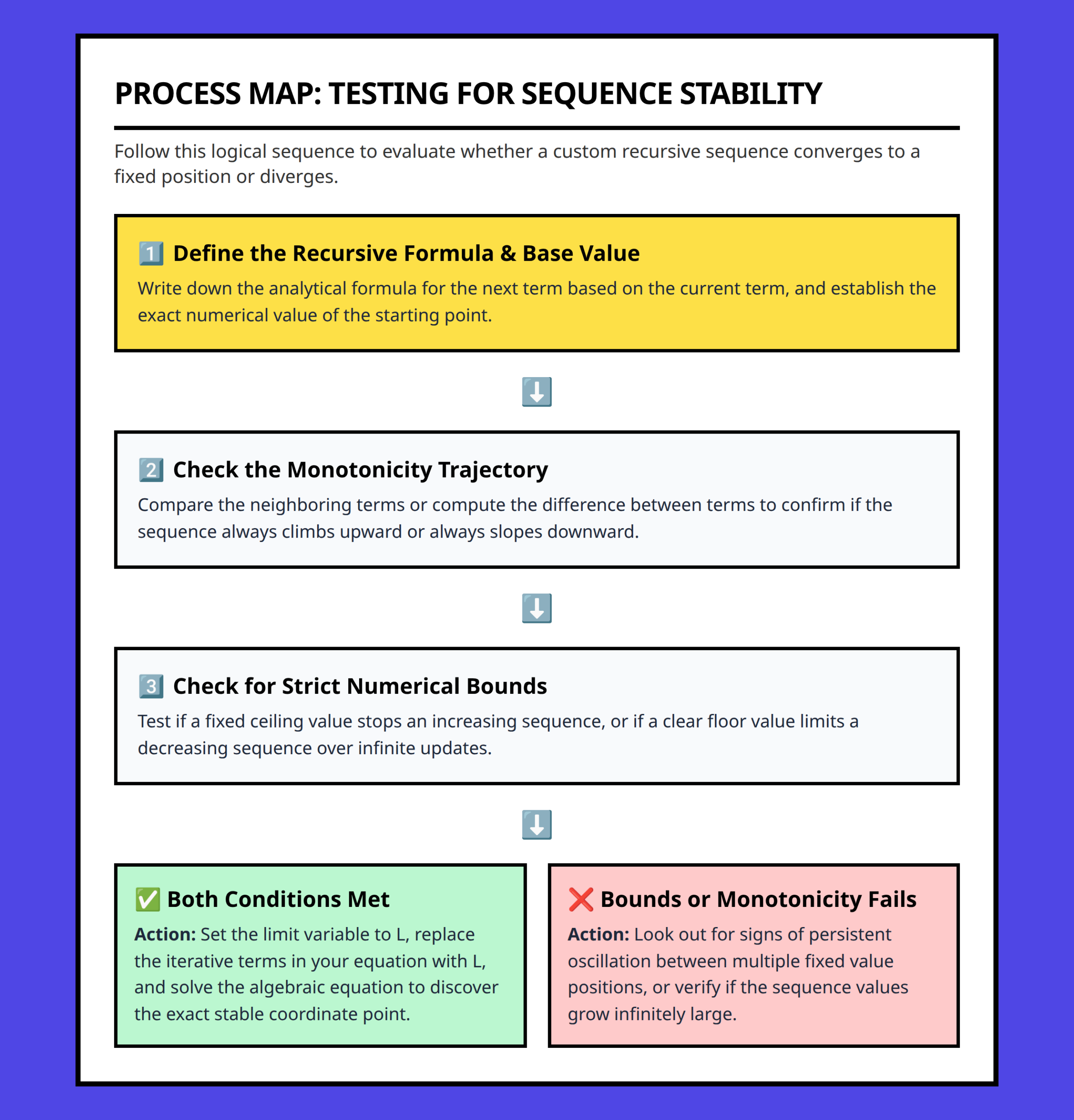
In a standard sequence, each term may come directly from a formula involving n. In a recursive sequence, each term is built from earlier terms.
That difference changes the entire way you read the problem.
A recursive definition creates dependency between stages. The current state affects the future state.
For example, a sequence may look like:
u_{n+1} = (u_n + 2)/2
Now the important question is no longer just “What is the formula?”
The real question becomes:
What happens when this updating process repeats indefinitely?
I think this is why recursive sequences feel more alive mathematically. You are observing behavior develop through iteration rather than simply evaluating isolated expressions.
The First Thing I Would Check Is Whether the Sequence Escapes Control
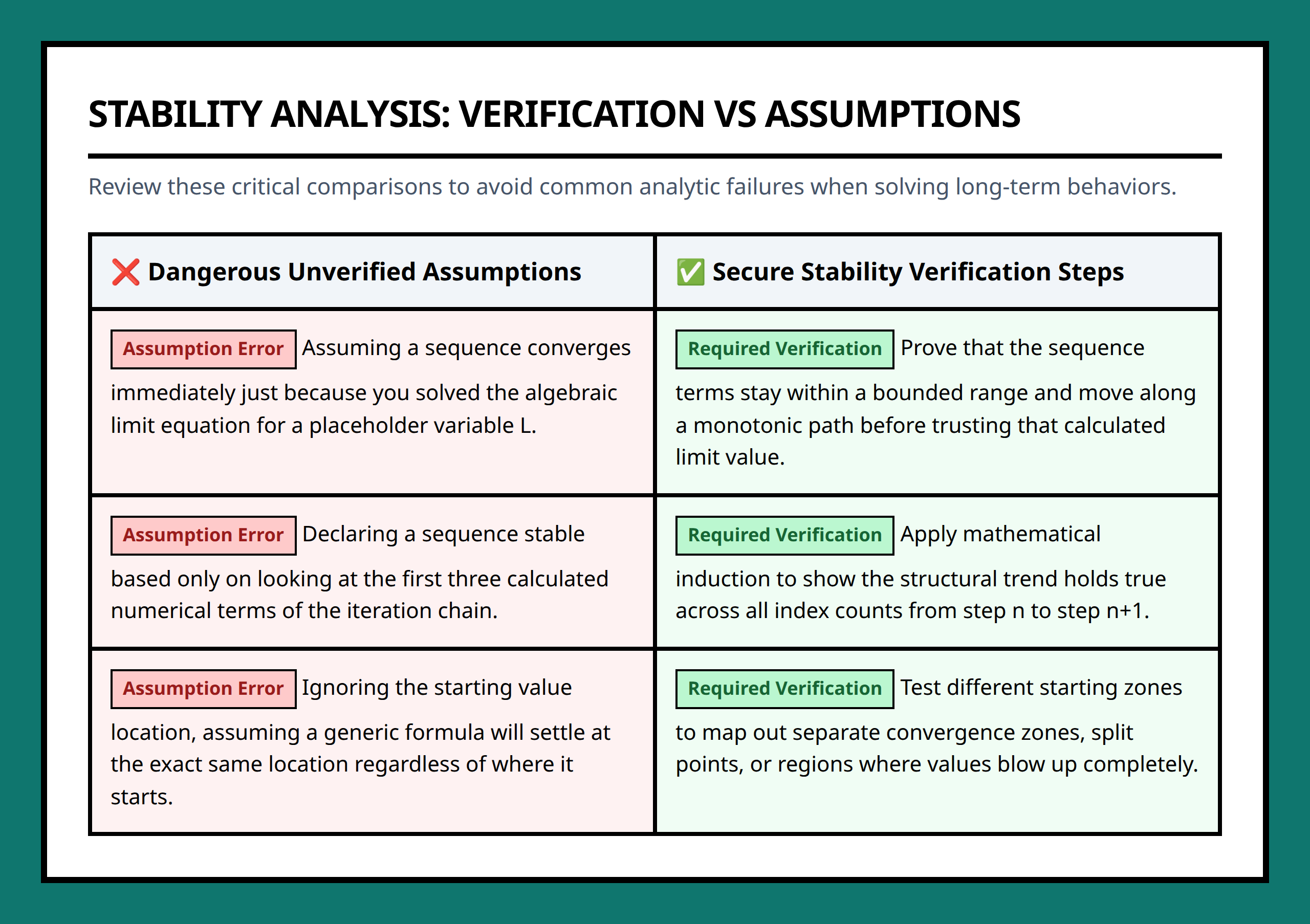
One of the most useful habits in recursive problems is checking boundedness early.
If the sequence grows without restriction, convergence becomes unlikely. If the terms remain trapped inside a stable interval, the possibility of convergence becomes much more realistic.
I would not treat boundedness as a technical side condition. It often acts like the first stability filter.
Imagine someone adjusting the temperature of a room using a thermostat that repeatedly reacts to previous measurements. If the corrections stay within a narrow operating range, the system may stabilize. If each adjustment becomes larger than the last, instability quickly appears.
Recursive sequences behave similarly.
When the iteration remains bounded, the recursion operates inside a controlled environment. That does not automatically prove convergence, but it removes many unstable possibilities immediately.
Monotonicity Reveals Directional Behavior
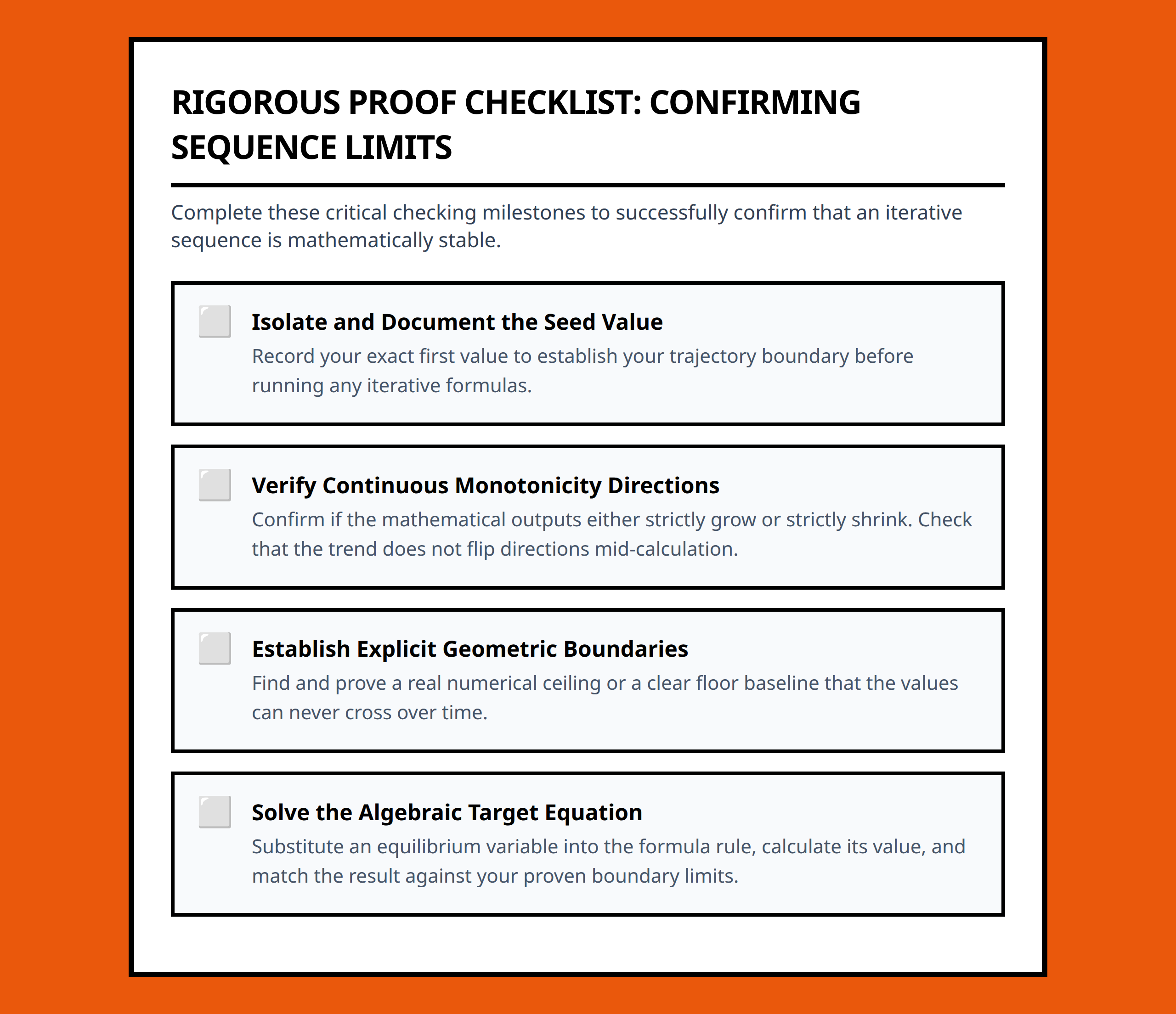
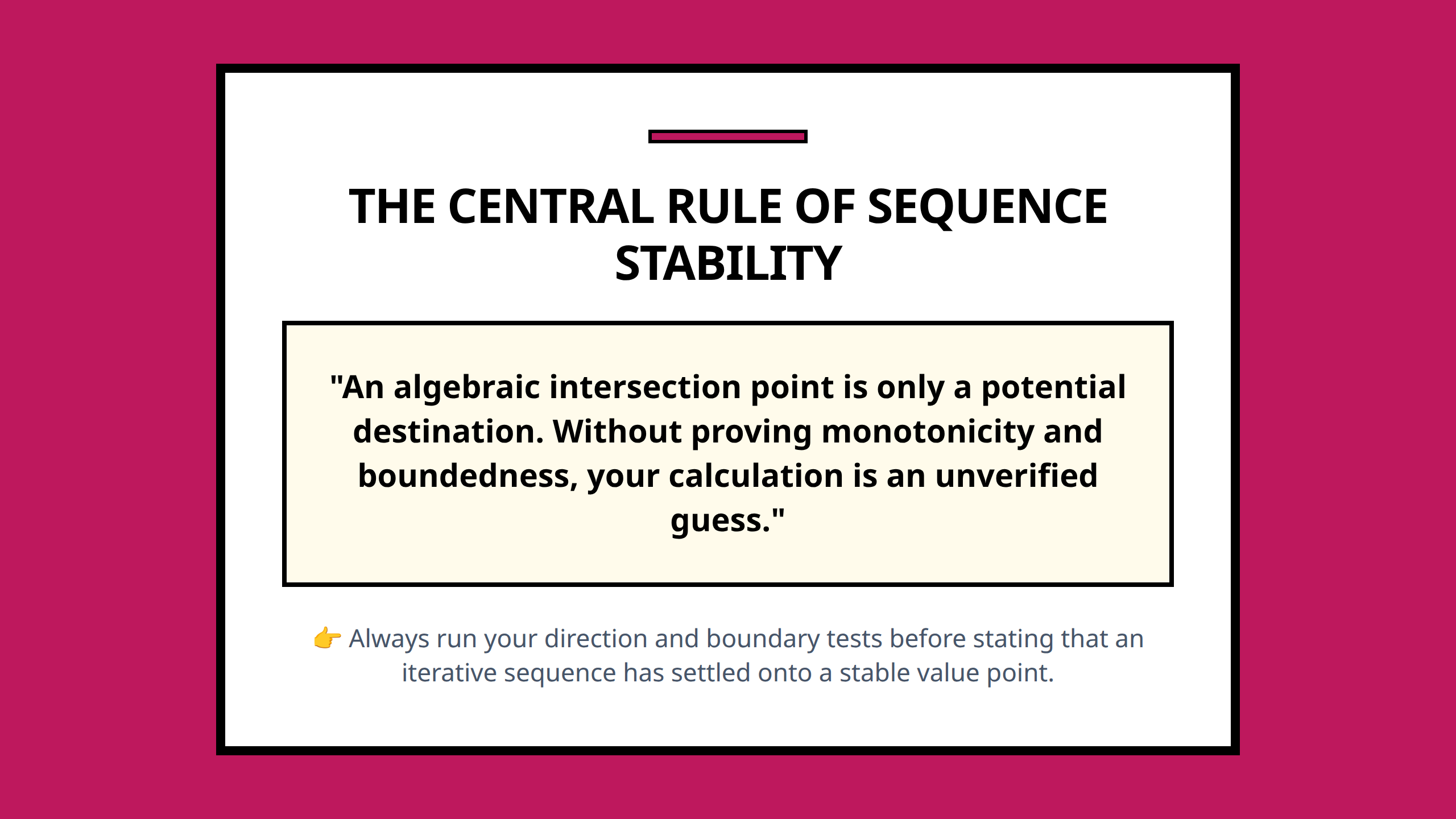
Boundedness alone is not enough.
A recursive sequence can remain bounded while still oscillating indefinitely.
This is why monotonicity becomes important.
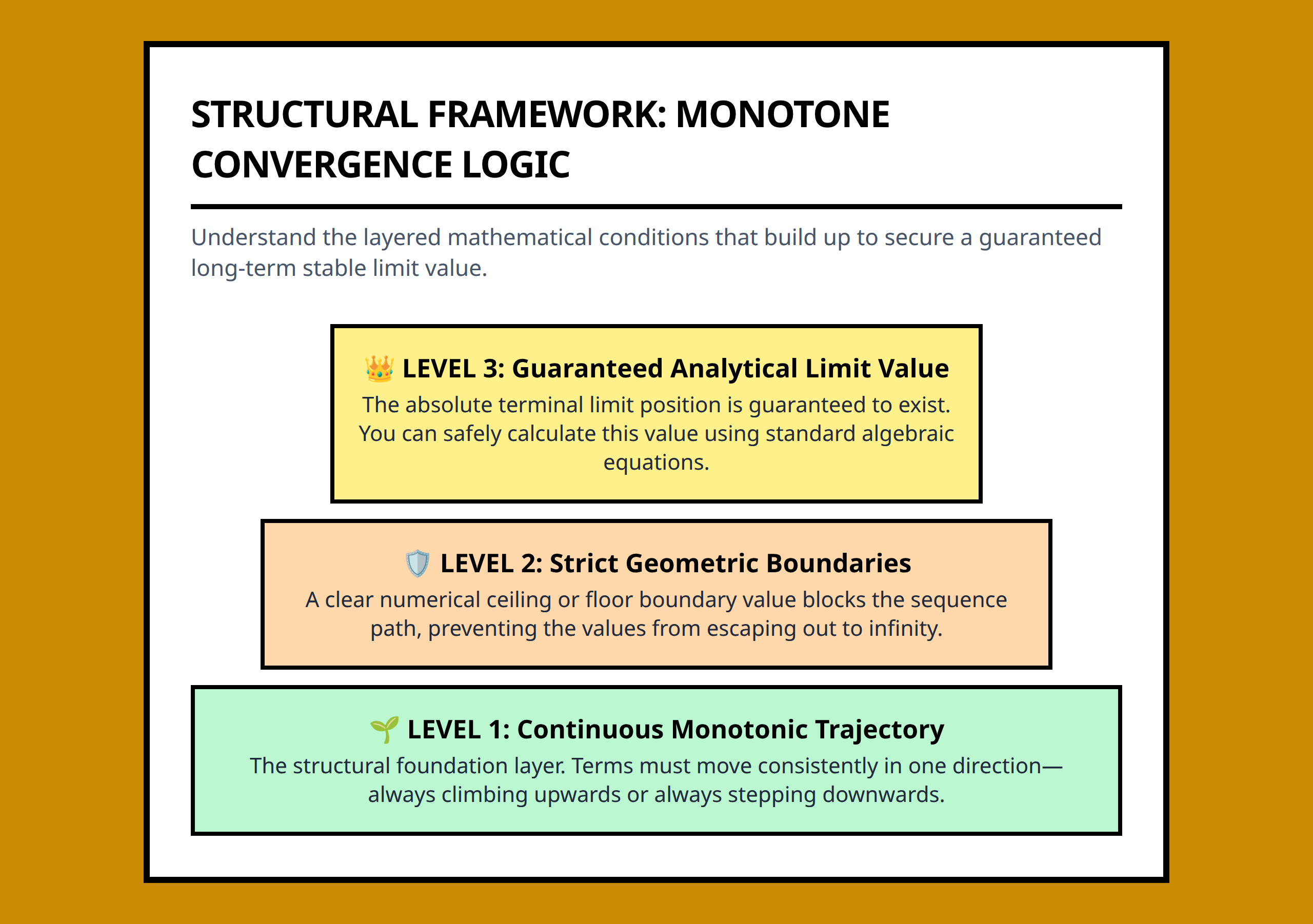
A monotone recursive sequence consistently moves upward or downward. Once monotonicity combines with boundedness, convergence becomes much easier to understand logically.
An increasing sequence with an upper bound cannot continue increasing forever without compression. Eventually the movement becomes squeezed near a limiting value.
I think this is one of the clearest examples of how convergence emerges from restrictions interacting with directional behavior.
The sequence is not converging by accident. The recursive update rule creates movement, while the bounds limit escape.
Together they produce stabilization.
Recursive Stability Often Depends on Fixed Behavior
Many recursive sequences eventually settle near a value that reproduces itself under the recursive rule.
This is where fixed-point reasoning naturally appears.
Suppose a recursive sequence satisfies:
u_{n+1} = f(u_n)
If the sequence converges toward some value L, then the limiting behavior often satisfies:
L = f(L)
I used to see this as a clever algebra trick. Later I realized it expresses something much deeper about stability.
The system reaches equilibrium because applying the update rule no longer changes the value meaningfully.
A practical way to picture this is to imagine repeatedly adjusting the brightness on a phone screen in response to surrounding light. At first the brightness changes noticeably. Eventually the adjustments become tiny because the system approaches a stable operating point.
That stabilization logic appears naturally inside recursive convergence problems.
Inequalities Quietly Control Most Recursive Arguments
Students often focus on the recursive formula itself while overlooking the inequalities surrounding it.
But many recursive convergence proofs depend heavily on inequalities.
I would pay attention to questions like:
- Can I show every term stays above a lower bound?
- Can I prove the sequence never exceeds a certain value?
- Can I compare consecutive terms?
- Can I show the differences between terms shrink?
These are inequality questions, not formula questions.
I think this is why recursive analysis starts connecting naturally with broader real analysis ideas. The same tools used in convergence theory reappear:
- boundedness
- comparison logic
- distance control
- monotonicity
- limit behavior
The recursion simply makes the interactions more visible.
Oscillation Is a Different Kind of Behavior, Not Just Failure
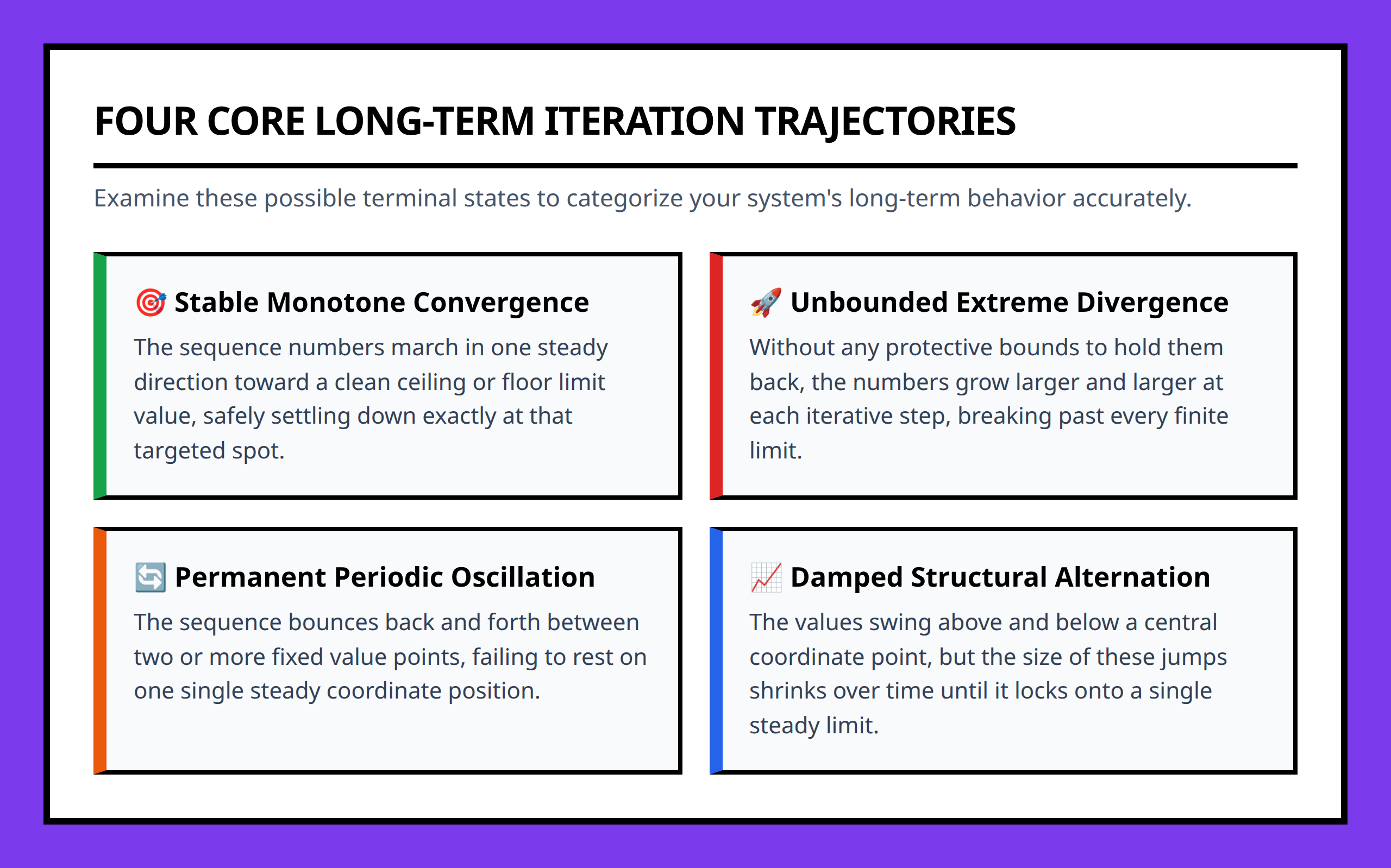
One important thing recursive sequences teach is that non-convergence does not always mean chaos.
Some recursive systems oscillate between behaviors in highly structured ways.
A sequence may alternate between two values or move repeatedly across a bounded interval without settling into a single limit.
I think this distinction matters because students sometimes classify every non-convergent sequence as “bad behavior.”
But oscillation often contains its own internal structure.
For example, if a recursive rule repeatedly flips sign while preserving magnitude, the sequence may remain bounded forever while never converging.
That reveals something important about stability:
boundedness alone does not guarantee equilibrium.
The directional behavior still matters.
Recursive Sequences Make Convergence Feel Mechanical Instead of Magical
One reason I like recursive sequences pedagogically is that they make convergence easier to visualize.
You can often compute several terms and physically watch the behavior develop:
- rapid growth
- shrinking oscillation
- compression near a stable value
- divergence away from equilibrium
A student working through recursive terms on paper late at night may suddenly notice something important: the sequence is not randomly changing anymore. Each new term moves less dramatically than the previous one.
That observation matters because it transforms convergence from an abstract theorem into visible stabilization.
The recursive process starts behaving like a system settling down.
Why Recursive Sequences Connect So Many Analysis Ideas Together
Recursive sequences quietly combine many foundational ideas from elementary analysis into one setting.
To understand their long-term behavior, you often need:
- bounds
- order relations
- inequalities
- monotonicity
- limit reasoning
- comparison logic
That combination is what makes recursive problems so educationally useful.
I would even say recursive sequences expose the architecture underneath convergence theory more clearly than many direct limit exercises do.
You stop thinking only about formulas and start thinking about stability itself:
- What keeps the process controlled?
- What drives movement?
- What prevents escape?
- What kind of behavior repeats?
- What eventually settles?
Once those questions become natural, recursive sequences stop feeling like isolated exercises from a textbook. They begin to look like small mathematical models of how iterative systems behave under repeated feedback and restriction.
References:
- https://www.youtube.com/watch?v=0OcUAjOXmFc
- https://www.youtube.com/watch?v=IFHZQ6MaG6w
- https://www.khanacademy.org/math/algebra/x2f8bb11595b61c86:sequences/x2f8bb11595b61c86:constructing-arithmetic-sequences/v/recursive-formula-for-arithmetic-sequence
- https://www.comp.nus.edu.sg/~cs1231/lect/Week6_Sequences.pdf
- https://www.khanacademy.org/math/algebra/x2f8bb11595b61c86:sequences/x2f8bb11595b61c86:constructing-arithmetic-sequences/a/writing-recursive-formulas-for-arithmetic-sequences
- https://www.ms.uky.edu/~droyster/ma114F16/RecursiveSequences.pdf
- https://www.quantamagazine.org/the-astonishing-behavior-of-recursive-sequences-20231116/
- https://en.wikipedia.org/wiki/Constant-recursive_sequence
- https://www.reddit.com/r/learnmath/comments/r961x3/what_is_the_point_of_a_recursive_formula/
- https://www.reddit.com/r/learnmath/comments/r961x3/comment/hna1kra/
- https://mathbitsnotebook.com/Algebra2/Sequences/SSRefreshRecursive.html
- https://courses.lumenlearning.com/waymakercollegealgebra/chapter/sequences-defined-by-a-recursive-formula/