
Many students approach infinite series by memorizing separate convergence tests. A much better approach is to treat convergence like a diagnostic process based on positivity, comparison behavior, shrinking terms, and structural patterns inside the series itself.
One of the hardest parts of learning numerical series is not understanding what a test says. The hard part is deciding which test actually fits the problem in front of you.
I have seen students stare at a series for several minutes, trying to remember whether they should use a comparison test, the Cauchy criterion, or an alternating-series argument. The deeper problem is usually not memory. It is the lack of a decision process.
Once I started thinking about convergence as a workflow instead of a checklist, the subject became much easier to navigate. The important question stopped being “Which formula do I remember?” and became “What kind of behavior does this series show?”
A Numerical Series Is Really About Accumulated Behavior
A numerical series is built from the partial sums of a sequence. Instead of looking only at individual terms, you examine what happens when the terms are added progressively.
That shift matters.
A sequence can approach zero while the associated series still diverges. Many students initially assume shrinking terms automatically guarantee convergence. They do not.
I would treat the behavior of the accumulated sum as the main object of study. The terms themselves are only part of the story.
This becomes easier to feel in a realistic situation. Imagine someone adding smaller and smaller expenses to a monthly budget. Even if each new charge becomes tiny, the total spending can still grow indefinitely if the additions never stabilize fast enough.
That is essentially the problem numerical series are trying to diagnose.
The First Decision: Are the Terms Positive or Alternating?
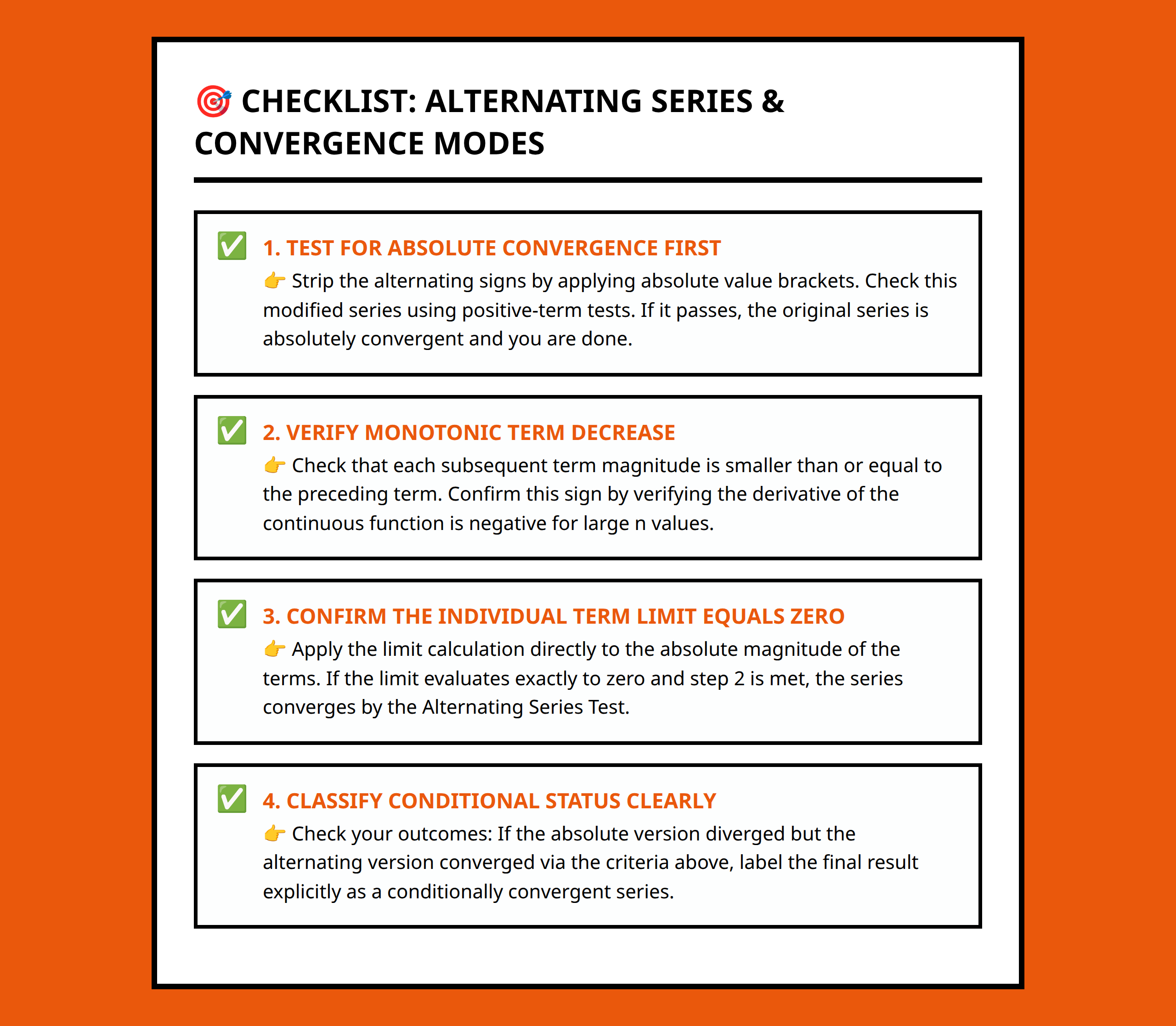
One of the most practical distinctions in convergence analysis is whether the series has positive terms or alternating signs.
I would check this immediately because it changes the entire reasoning process.
For positive-term series, the partial sums keep increasing. That means the main question becomes whether the growth remains bounded.
For alternating series, cancellation enters the picture. Positive and negative contributions start balancing each other, and different convergence logic becomes possible.
This sounds simple, but it prevents a lot of wasted effort. Students often apply advanced tests too early because they never paused to classify the structure of the series first.
That classification step acts like a routing system.
Comparison Tests Work Best When You Think in Terms of Dominance
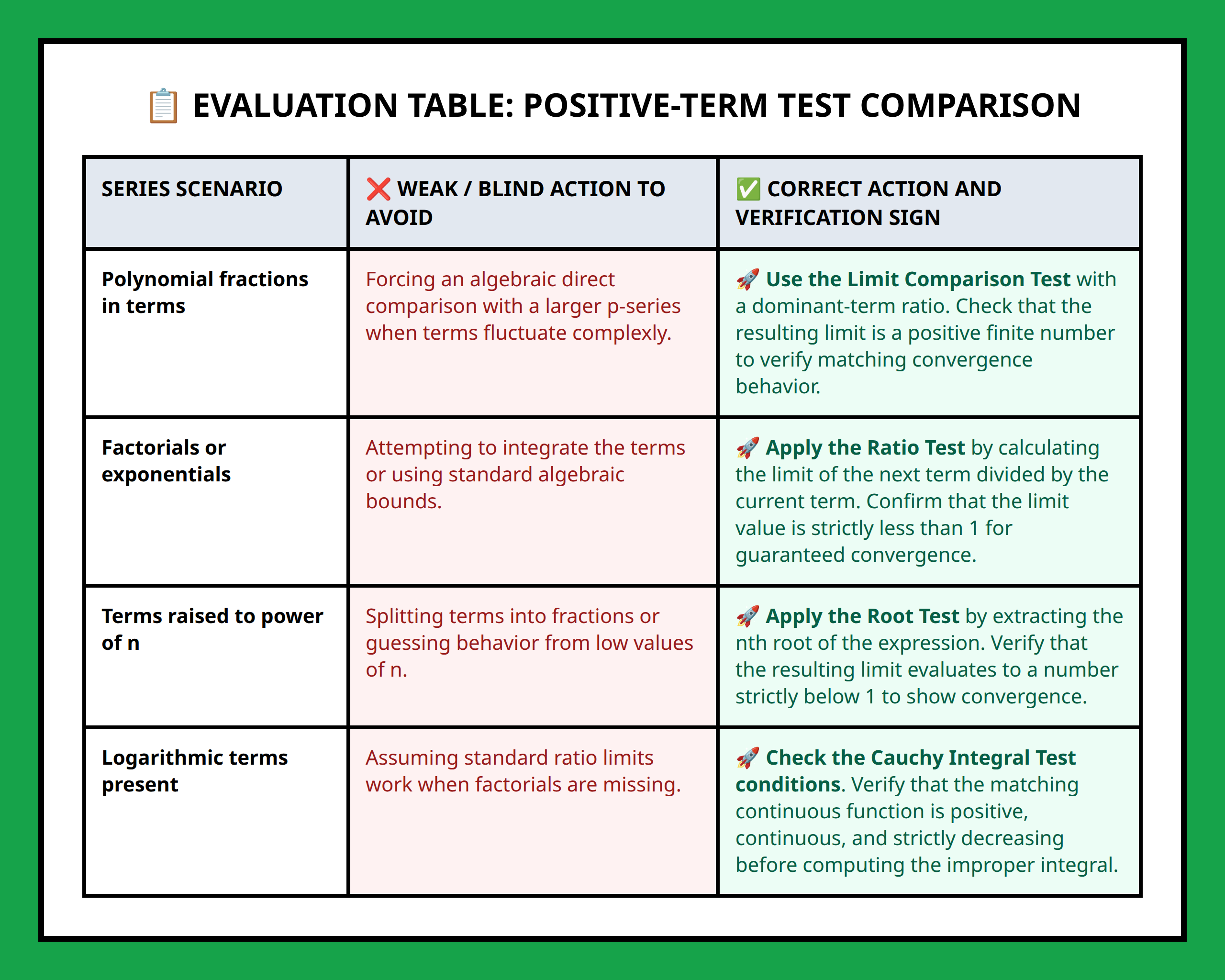
Comparison tests become much clearer once you stop treating them like formal templates.
The real idea is dominance.
You compare an unfamiliar series to another series whose behavior is already known. If the unfamiliar series behaves similarly to something convergent or divergent, the comparison transfers useful information.
I think students struggle here because they often search for a perfect comparison instead of a meaningful one.
For example, if a series behaves roughly like:
1/n²
then it makes sense to compare it with a known convergent p-series.
If it behaves more like:
1/n
then the harmonic-series behavior becomes relevant.
The important skill is not memorizing examples. The important skill is learning to recognize growth patterns.
I would ask questions like:
- Which part of the term dominates as n becomes large?
- Does the denominator grow fast enough?
- Does the series resemble a known benchmark?
Once you think this way, comparison tests stop feeling arbitrary.
The Cauchy Criterion Changes the Question Completely
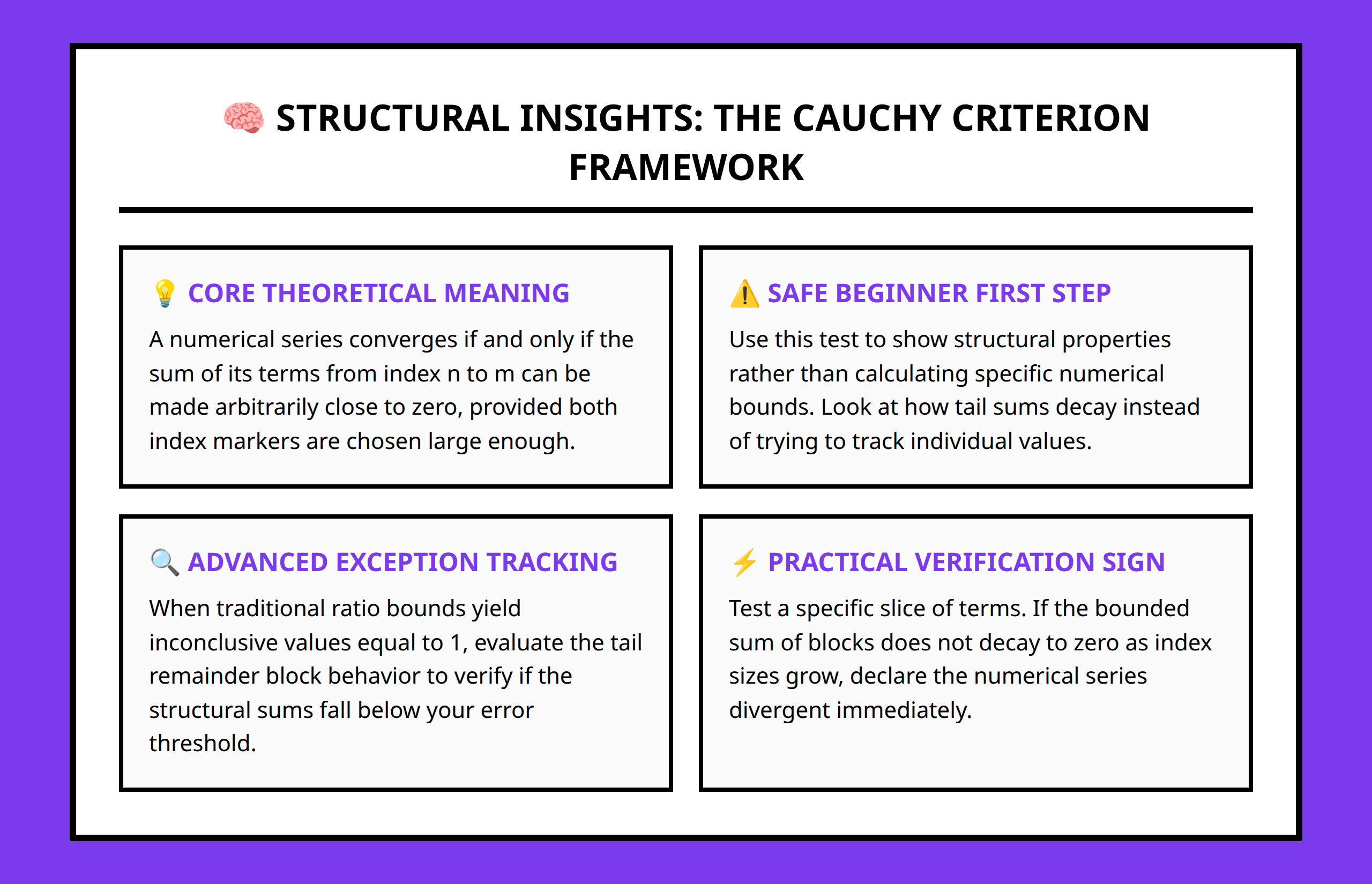
The Cauchy criterion introduces one of the most important perspective shifts in analysis.
Instead of focusing directly on the final sum, the criterion asks whether the tails of the series become arbitrarily small.
I think this idea is often underappreciated because students first encounter it through dense formal notation.
Conceptually, the logic is practical:
If adding more and more terms eventually changes the partial sums by only tiny amounts, then the series is stabilizing internally.
You no longer need to guess the exact final value first.
Imagine downloading a large software update on unstable internet. At first, the download progress changes rapidly. Later, the remaining updates become smaller and smaller. The process begins stabilizing because the unfinished portion shrinks toward insignificance.
The Cauchy viewpoint treats convergence similarly. The remaining “tail” must eventually become negligible.
I would pay attention to this criterion not only because it proves convergence, but because it explains what convergence really means operationally.
Absolute Convergence Is Stronger Than Many Students Realize
One of the most useful distinctions in series analysis is the difference between absolute convergence and conditional convergence.
If a series converges even after replacing every term with its absolute value, the convergence is much more stable structurally.
I think this matters because it changes how much cancellation the series depends on.
An absolutely convergent series does not rely on delicate balancing between positive and negative terms. The convergence survives even when all signs are removed.
That is a much stronger form of stability.
By contrast, conditionally convergent series depend heavily on cancellation behavior. Small structural changes can alter the result dramatically.
I would view this distinction almost like structural engineering. One bridge remains stable because the underlying support is strong. Another remains standing only because several opposing forces happen to balance precisely.
Both may function temporarily, but they are not equally robust.
Alternating Series Are About Controlled Cancellation
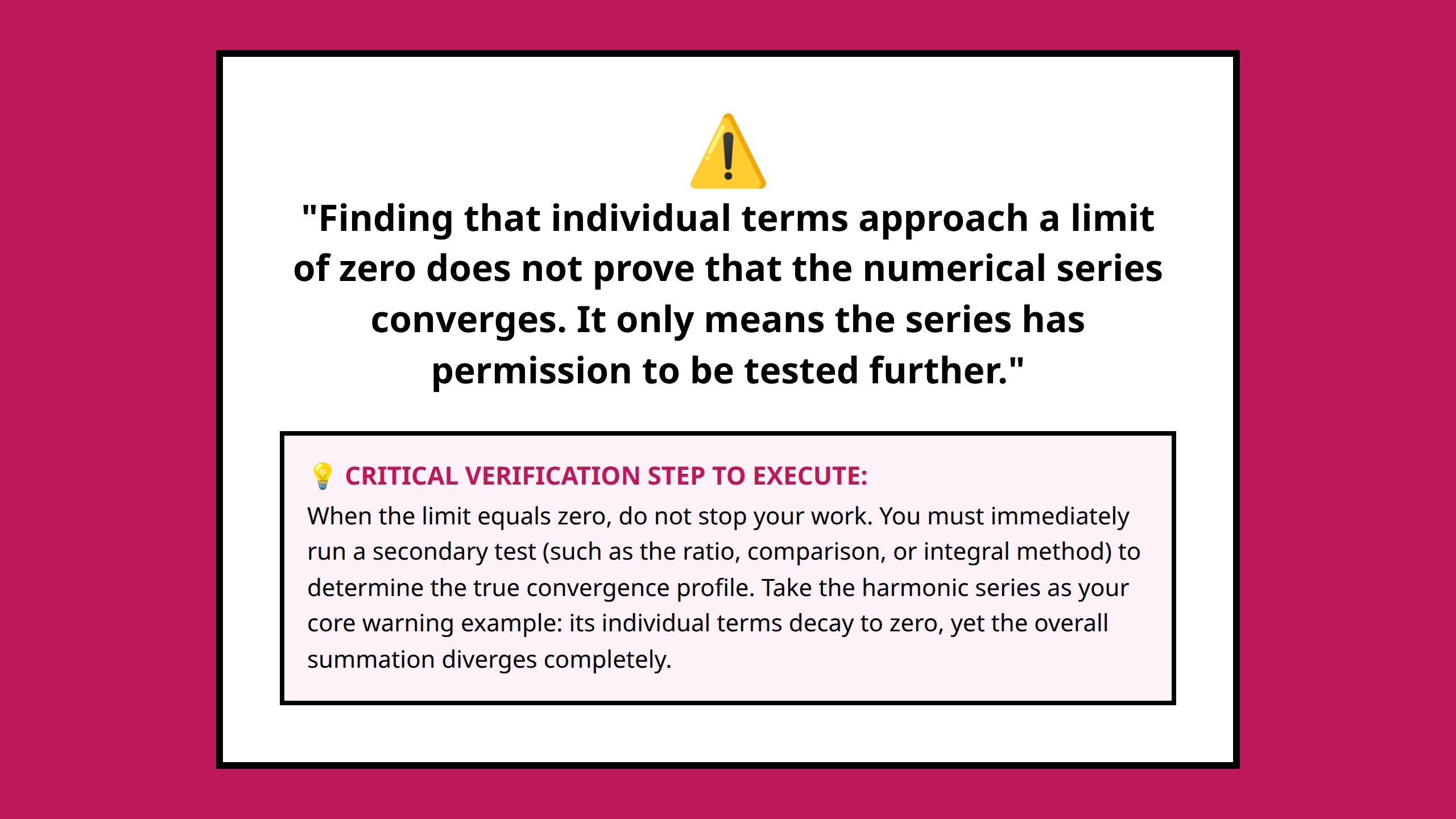
Alternating-series tests work because cancellation creates compression inside the partial sums.
But not every alternating series converges automatically.
The shrinking behavior of the terms still matters.
The usual logic requires:
- alternating signs
- decreasing term magnitude
- terms approaching zero
I like this test because it reveals how convergence can emerge from balancing forces rather than simple decay.
A practical mental picture helps here. Imagine someone repeatedly correcting a steering wheel while parking a car in a tight space. Each adjustment alternates direction, but the corrections become smaller over time. Eventually the motion settles instead of swinging wildly forever.
That is close to what alternating convergence feels like mathematically.
The decreasing size of the corrections matters just as much as the alternation itself.
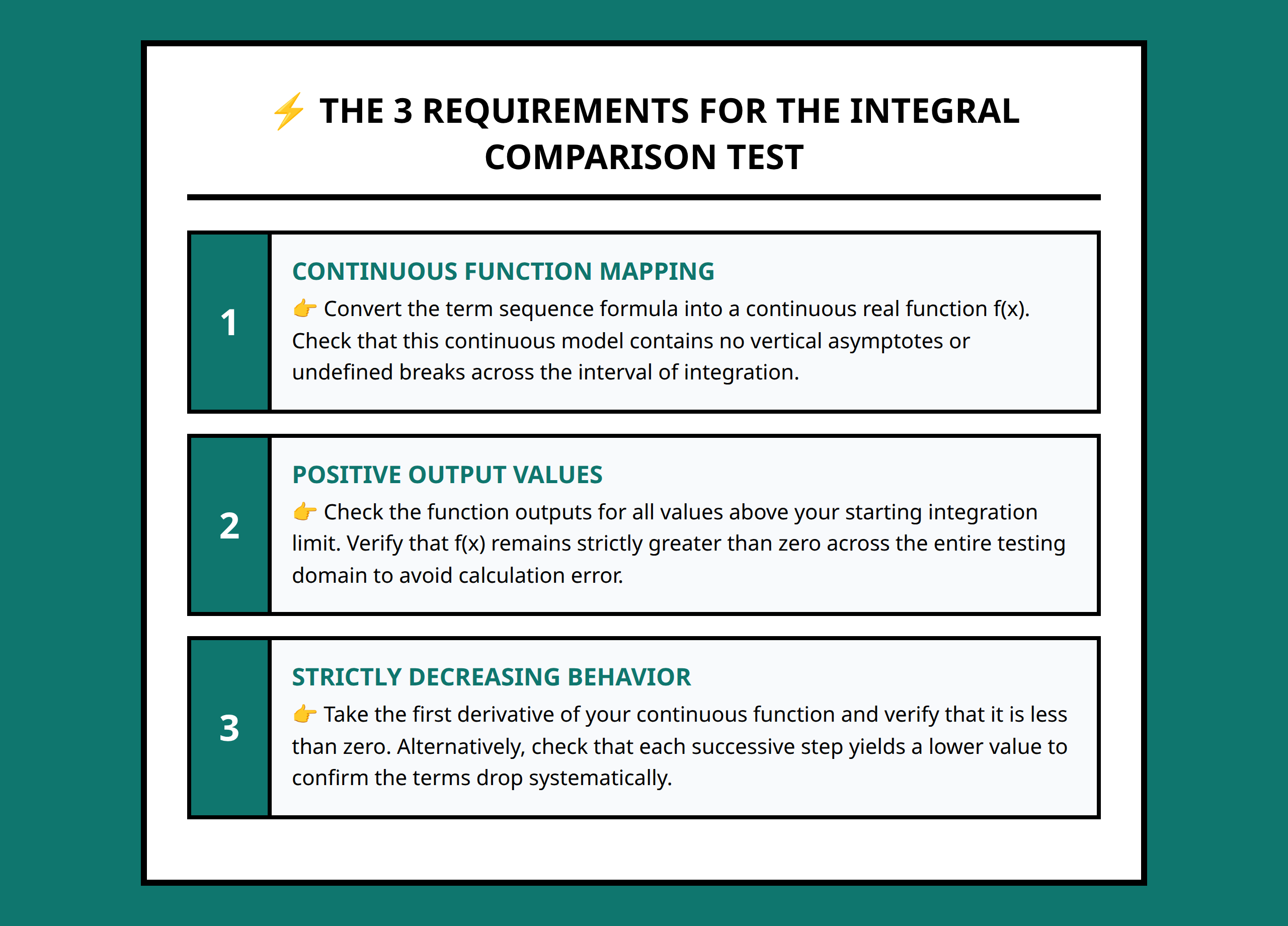
Integral Comparisons Help Translate Sums Into Area Behavior
The integral comparison approach becomes useful when a series resembles the behavior of a continuous positive function.
Instead of studying discrete sums directly, you compare them with the area under a curve.
I think this test becomes easier once you stop viewing series and integrals as unrelated topics from different chapters.
They are connected through accumulation.
If the corresponding improper integral converges, the associated series often shares similar behavior. If the area grows indefinitely, the series may diverge as well.
This method is especially useful because it provides geometric intuition.
You stop seeing the series as isolated symbols and begin seeing accumulation as physical growth over a domain.
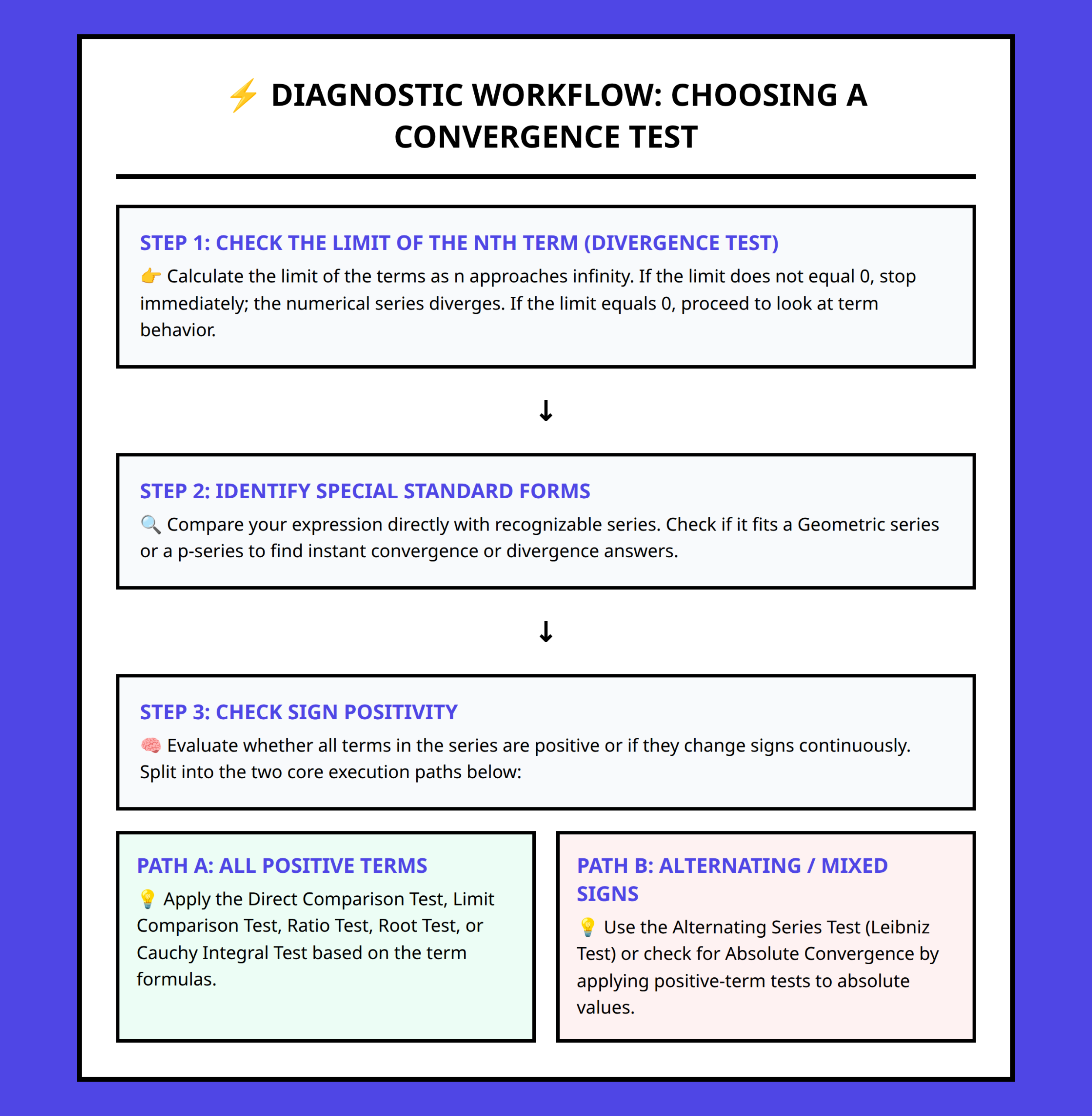
Why Test Selection Becomes Easier Once You Use a Workflow
The biggest mistake I see is students trying to memorize convergence tests as separate tools with no relationship between them.
That usually creates hesitation during exams and confusion during unfamiliar exercises.
I would rather use a layered workflow:
- Classify the sign behavior.
- Check whether the terms shrink toward zero.
- Look for positivity or alternating structure.
- Identify dominant growth patterns.
- Compare with known benchmark series.
- Examine internal stabilization using Cauchy logic.
- Use integral reasoning when accumulation resembles area growth.
Once the tests are organized this way, they stop feeling like disconnected formulas.
They become different ways of diagnosing the same underlying question:
Does the accumulated behavior stabilize, or does it continue growing without control?
That question sits underneath almost every convergence problem. The individual tests are useful, but the reasoning behind them is what actually helps you navigate unfamiliar series with confidence.
References:
- https://www.youtube.com/watch?v=x8085eaj-3c
- https://www.youtube.com/watch?v=Y9JctArSAQw
- https://www.youtube.com/watch?v=0wefqjpQyKM
- https://www.youtube.com/watch?v=-lD0skTnqFo
- https://personal.math.ubc.ca/~CLP/CLP2/clp_2_ic/chap_seq_ser-5.html
- https://web.ma.utexas.edu/users/m408s/CurrentWeb/LM11-7-2.php
- https://www.mathwords.com/c/convergence_tests.htm
- https://tutorial.math.lamar.edu/classes/calcii/alternatingseries.aspx
- https://en.wikipedia.org/wiki/Convergence_tests
- https://www.dummies.com/article/academics-the-arts/math/calculus/how-to-determine-whether-an-alternating-series-converges-or-diverges-192107/
- https://users.math.msu.edu/users/hensh/courses/320/summer15/handouts/ConvTests-2up.pdf
- https://en.wikipedia.org/wiki/Convergent_series
- https://www.kristakingmath.com/blog/p-series-test-for-convergence