
Embodiment science offers a different explanation for student disengagement and school-related stress. Instead of treating emotional struggles as isolated personal problems, it shows how traditional schooling often conflicts with the way human beings naturally think, feel, and regulate themselves.
I think many discussions about student mental health stay too close to symptoms. Schools talk about anxiety, absenteeism, burnout, behavioral problems, and declining motivation, but often without questioning the learning environments students experience every day.
What interests me about embodiment science is that it shifts attention toward the relationship between cognition, emotion, physical experience, and environment. Once that connection becomes visible, some school problems stop looking random.
They start looking systemic.
The Standard School Model Assumes the Mind Can Operate Separately From the Body
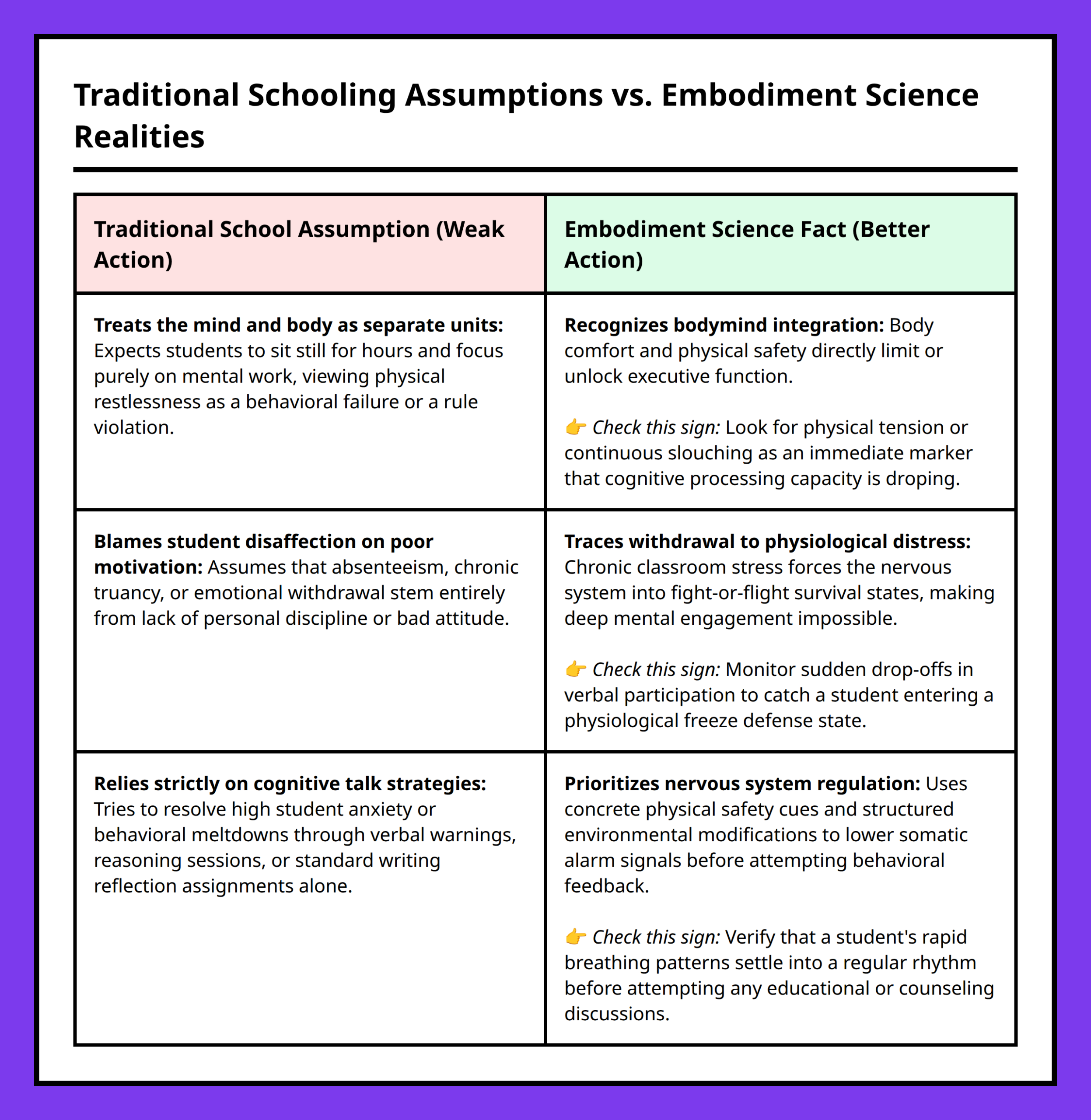
Traditional schooling often treats learning as a mostly mental process.
Students are expected to:
- sit still for extended periods
- suppress physical impulses
- manage stress quietly
- shift rapidly between subjects
- perform under constant evaluation
- prioritize abstract thinking over embodied experience
I do not think most schools intentionally create emotional strain. Many of these structures developed because they support efficiency, large-scale organization, and measurable assessment.
But embodiment science questions the assumption underneath them.
Human cognition is not detached from bodily states. Attention, emotional regulation, memory, and social behavior are all shaped by physical experience.
That means a school system built around bodily suppression may eventually create psychological strain, even when the academic intentions are good.
Disengagement Often Begins Physically Before It Becomes Behavioral
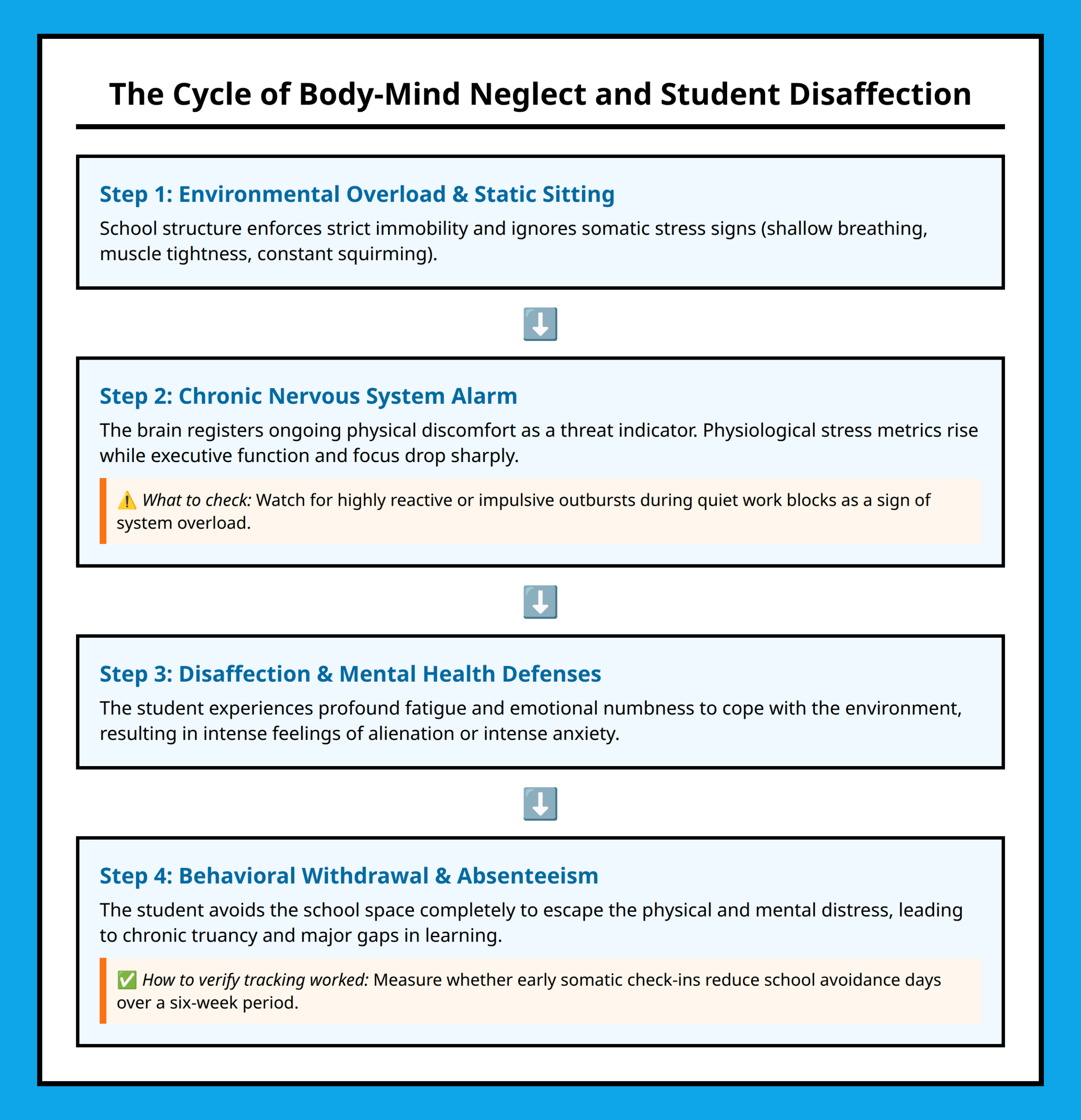
One idea I find especially important is that disaffection rarely appears suddenly.
Students often experience it gradually through accumulated stress, fatigue, emotional overload, and bodily dysregulation.
Picture a student near the middle of a long school day.
They have already transitioned through several classes, stayed seated most of the time, managed social pressure, responded to evaluation, and maintained concentration under repeated cognitive demands.
At first, the strain may appear physically:
- restlessness
- headaches
- fatigue
- muscle tension
- difficulty concentrating
- emotional irritability
Over time, those experiences can evolve into something broader:
- withdrawal
- chronic stress
- school avoidance
- loss of curiosity
- emotional numbness
- absenteeism
I think schools sometimes notice the later stages while overlooking the earlier embodied signals.
Why Emotional Distress Gets Misread as Motivation Problems
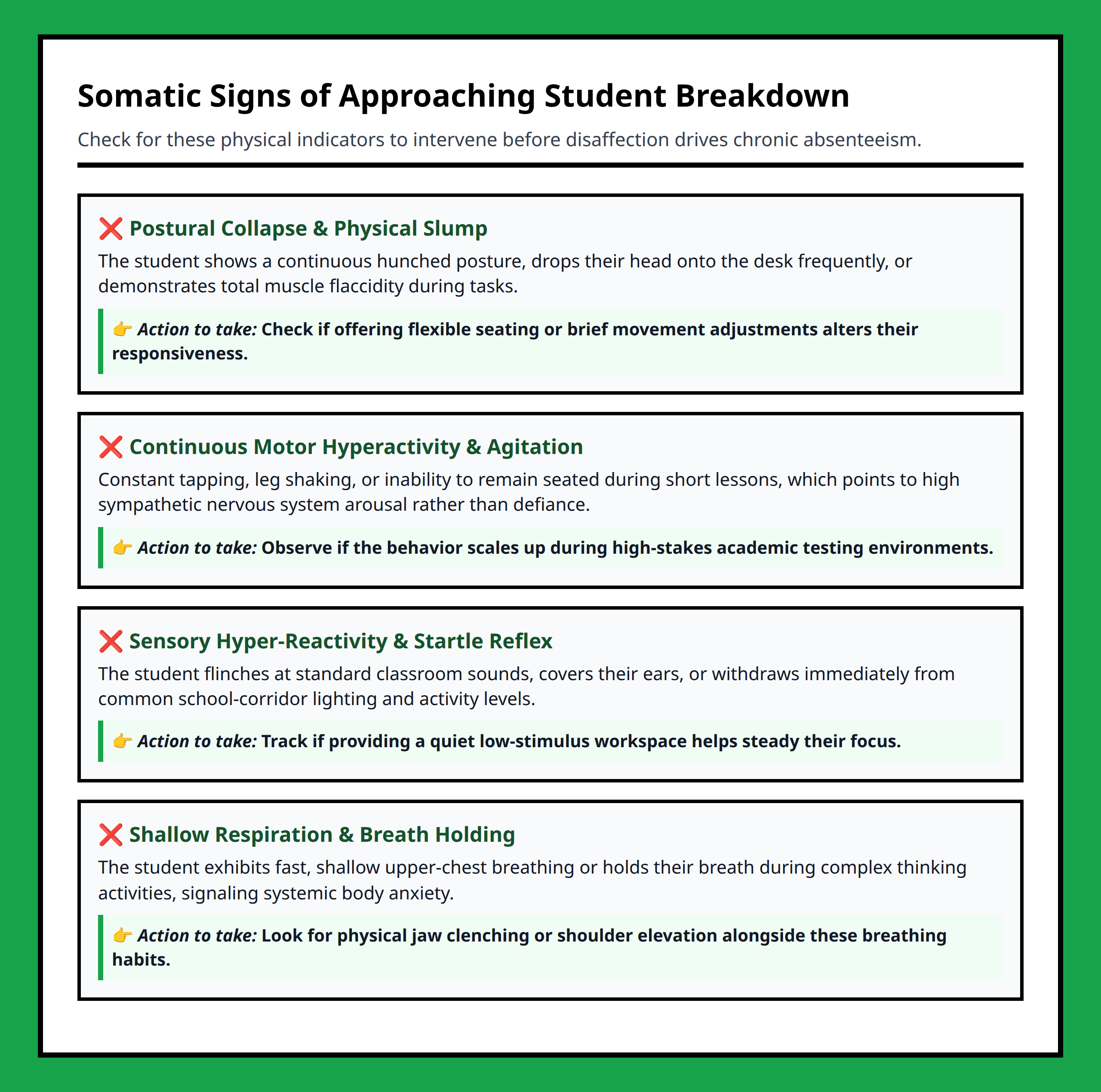
Many school systems still interpret disengagement through a behavioral lens.
If students stop participating, fail assignments, or resist school routines, the explanation often becomes:
- low motivation
- poor discipline
- lack of resilience
- limited effort
Embodiment science introduces a more complicated possibility.
Some students may not be resisting learning itself. They may be reacting to chronic dysregulation inside environments that continuously overload attention, emotion, and bodily self-management.
I would be careful here not to romanticize disengagement or dismiss accountability. Students still need structure, challenge, and responsibility.
But there is a difference between refusing effort and operating inside a prolonged stress state that gradually disconnects students from learning emotionally.
That distinction matters because schools respond very differently depending on which explanation they believe.
Constant Evaluation Changes How Students Experience Themselves
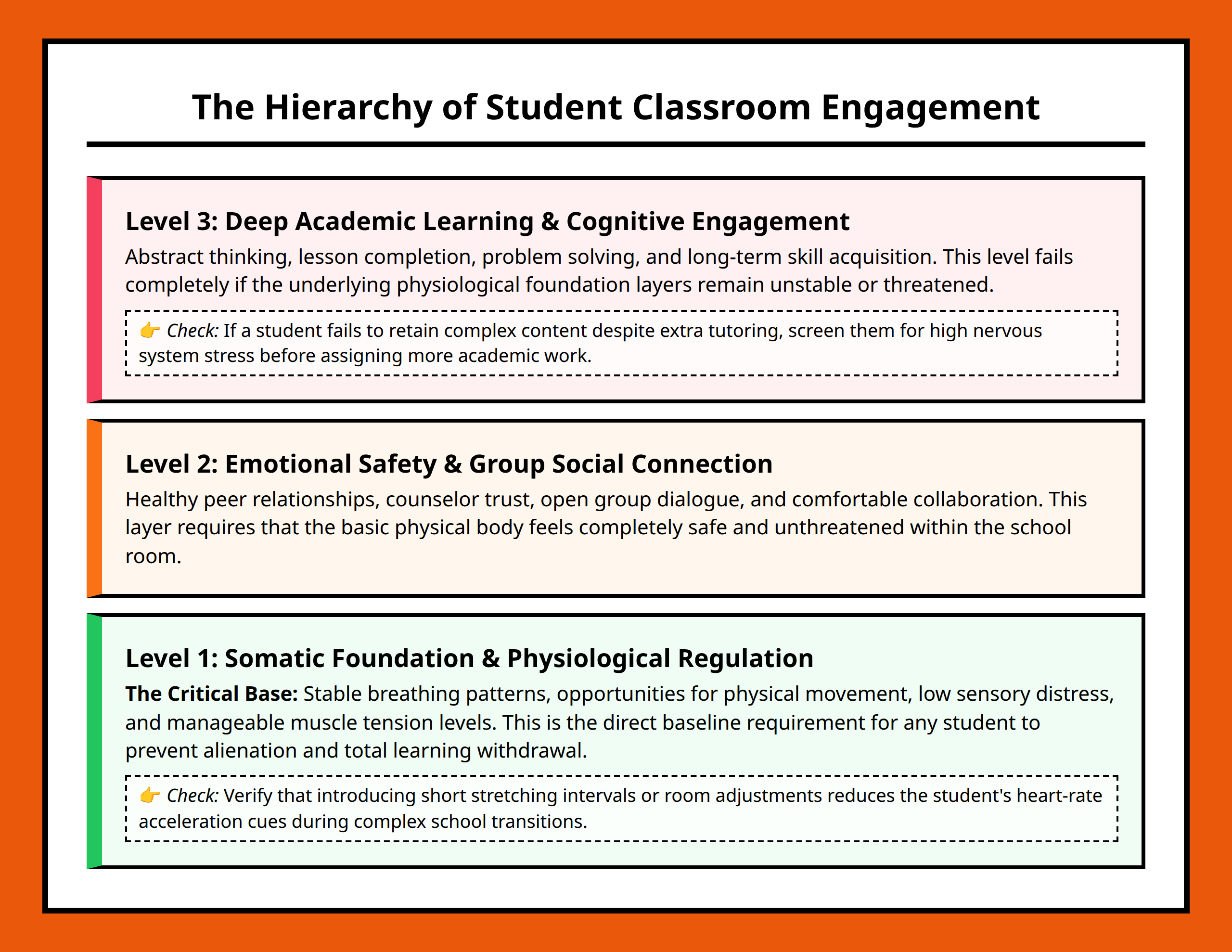
Another important issue is the role of continuous assessment.
Traditional schooling often places students inside ongoing cycles of comparison, grading, correction, and performance measurement.
Some students adapt successfully to that pressure. Others experience it as chronic threat monitoring.
I notice how this affects classroom behavior in subtle ways.
A student may stop volunteering answers because mistakes feel socially risky. Another may become hyper-focused on grades while losing genuine interest in the material itself. Some students disengage emotionally before they disengage academically.
Embodiment science suggests these reactions are not purely intellectual calculations. They involve physiological stress responses interacting with identity and emotion.
When students spend years associating learning with tension, surveillance, or fear of failure, school can gradually become emotionally exhausting rather than cognitively energizing.
The Body Keeps Participating Even When Schools Ignore It
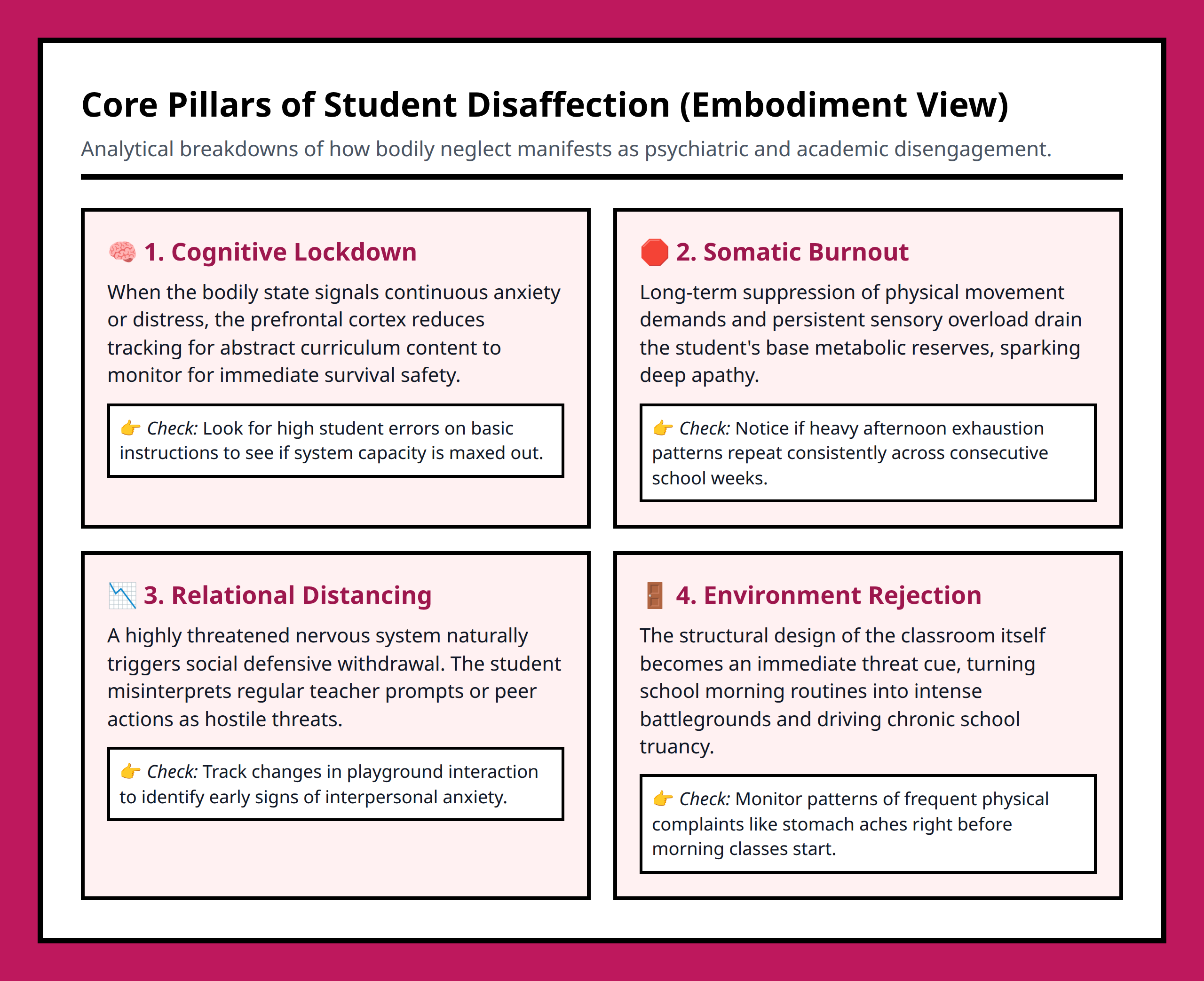
I think one of the clearest insights from embodiment science is that the body never stops participating in learning.
Even in highly abstract classrooms, students are still processing experience physically:
- stress responses shift breathing and attention
- fatigue changes memory and emotional control
- movement restriction affects regulation
- social anxiety influences cognition
- environmental tension shapes engagement
The problem is not that schools involve the body too much.
The problem is that many schools behave as if the body is irrelevant unless it becomes disruptive.
I think this creates a major blind spot in educational discussions about mental health.
Students are often asked to manage increasingly demanding emotional and cognitive environments while receiving relatively little support for bodymind regulation.
Absenteeism Can Become a Form of Self-Protection
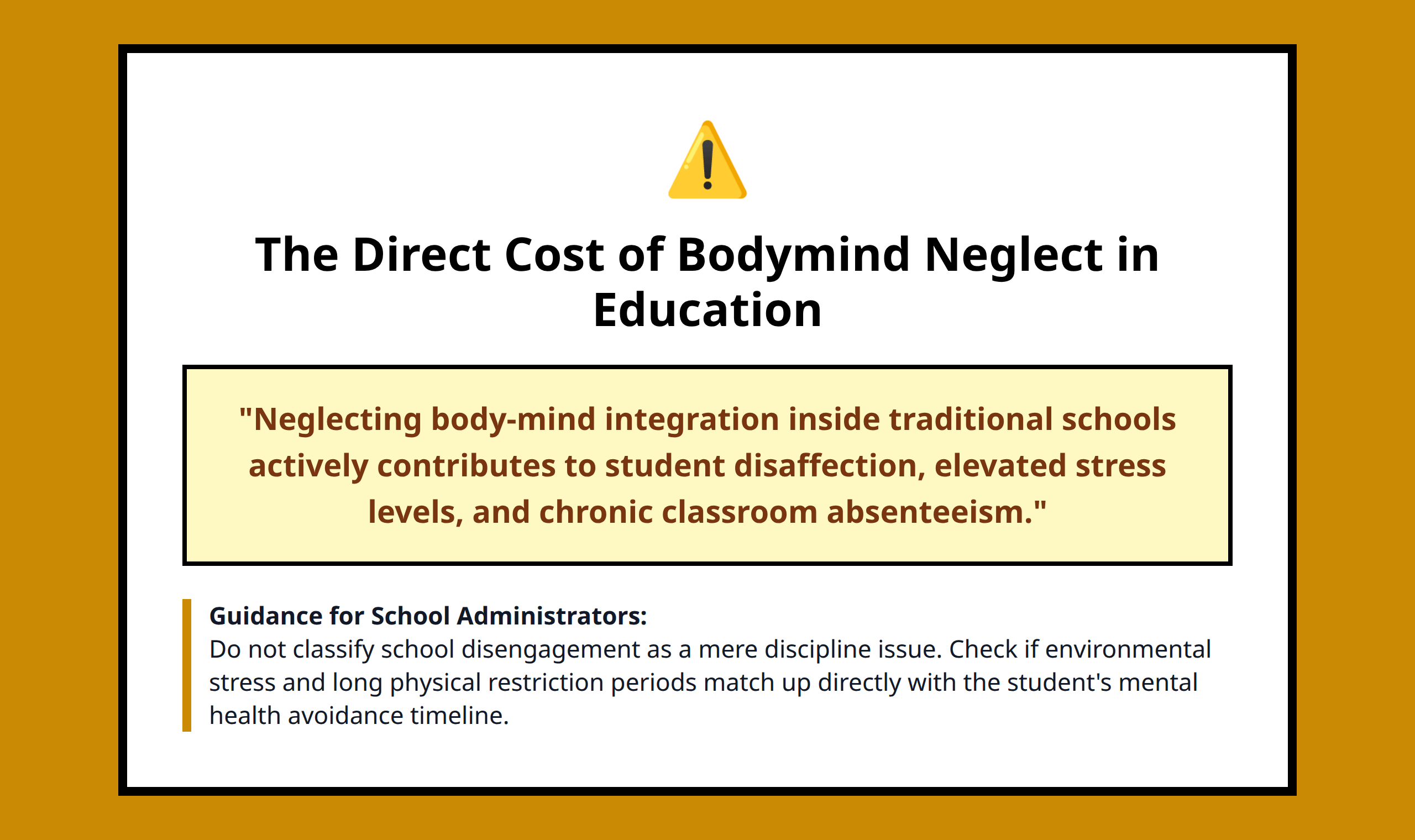
One difficult implication of embodiment science is that some school avoidance behaviors may function as protective responses rather than simple noncompliance.
I would approach this carefully because absenteeism has many causes. Family stress, economic conditions, bullying, neurodiversity, trauma, and social isolation all matter too.
But embodiment science adds another layer.
If students repeatedly experience school as physically exhausting, emotionally dysregulating, socially threatening, or cognitively overwhelming, avoidance may eventually become an attempt to reduce stress exposure.
That does not mean avoiding school solves the problem.
It means the behavior itself may contain information about how the student experiences the learning environment internally.
I think schools often intervene at the attendance level without fully investigating the embodied experience underneath the avoidance.
Quiet Compliance Can Hide Serious Disconnection
One warning I would take seriously is that visible behavior does not always reflect emotional well-being accurately.
Some highly compliant students are deeply disengaged internally.
They complete assignments, follow rules, and avoid disruption while feeling emotionally detached from learning itself.
I suspect these students are easy to overlook because traditional systems reward outward control.
But embodiment science suggests emotional shutdown can become another adaptation strategy.
A student who stops feeling connected, curious, or expressive may appear “well-behaved” while quietly experiencing exhaustion or alienation.
That possibility changes how I would interpret classroom calmness. Silence is not always the same thing as psychological safety or meaningful engagement.
The Deeper Problem Is Not Individual Weakness
I think one of the most important shifts in embodiment science is that it moves the conversation away from purely individual explanations.
Student stress and disaffection are not always signs of personal fragility.
Sometimes they reflect sustained tension between human developmental needs and educational structures that prioritize abstraction, control, standardization, and performance efficiency above embodied well-being.
That does not mean schools should remove challenge or lower expectations.
But it does suggest that emotional regulation, movement, social connection, physical experience, and cognitive learning cannot realistically be separated for very long without consequences.
Once schools ignore that connection consistently, disengagement stops looking like an isolated student problem. It starts looking like a predictable outcome of environments that ask students to learn while remaining increasingly disconnected from themselves.
References:
- https://pmc.ncbi.nlm.nih.gov/articles/PMC12190000/
- https://www.linkedin.com/posts/jonathan-boymal-448b5870_the-newly-released-bodies-of-learning-how-activity-7465154097902522368-j74m
- https://pmc.ncbi.nlm.nih.gov/articles/PMC11977779/
- https://www.tandfonline.com/doi/full/10.1080/02635143.2024.2303000
- https://www.frontiersin.org/journals/psychology/articles/10.3389/fpsyg.2026.1796613/full
- https://www.herts.ac.uk/link/volume-4,-issue-1/embodiment,-learning-and-wellbeing
- https://www.sciencedirect.com/science/article/pii/S2666558125000983
- https://www.researchgate.net/publication/368678640_Disembodiment_in_Psychology_and_Psychotherapy_A_Critical_Historical_Analysis_and_Clinical_Implications
- https://www.centerforengagedlearning.org/embodiment-in-learning-on-location-why-mindful-movement-matters/
- https://kclpure.kcl.ac.uk/portal/files/163904617/CHI22_Exploring_Situated_Embodied_Support_for_Youth_s_Mental_Health_with_Purrble_1_.pdf
- https://en.wikipedia.org/wiki/Embodied_cognition
- https://palmpointbehavioral.com/blog/how-schools-can-help-student-mental-health/
- https://explore.bps.org.uk/content/bpscpf/1/305/4
- https://www.integrationtraining.co.uk/blog/2013/04/science-of-embodiment/